
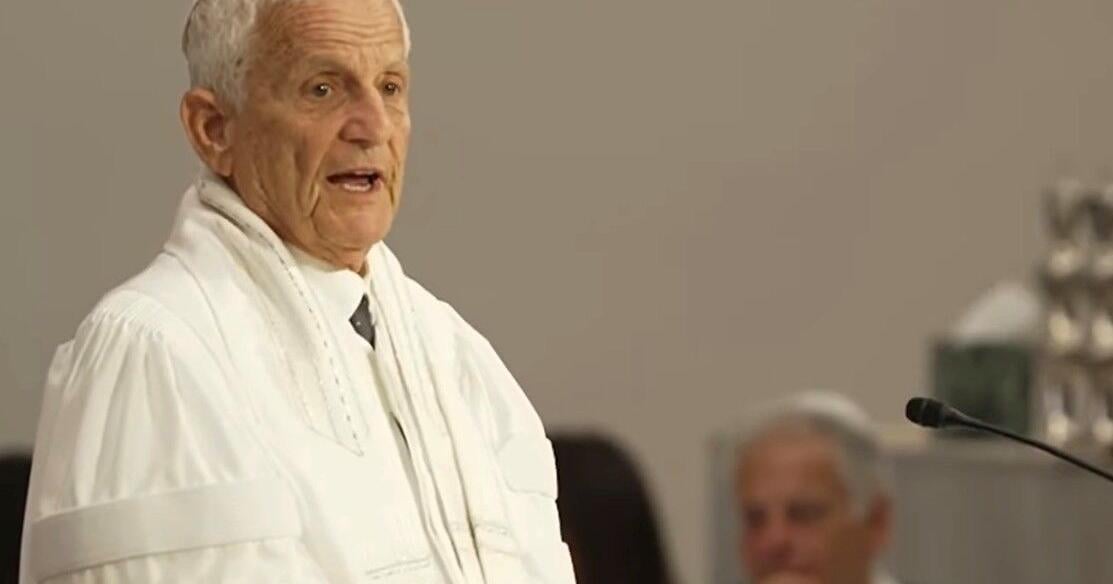
Temple Israel reopened its doors for Rosh Hashanah 183 days after the attack, as congregants, clergy and rescued Torahs returned home.
One hundred and eighty-three days after March 12, 2026 — that infamous date when a terrorist rammed his truck packed with explosives down a preschool hallway at Temple Israel — the Temple Israel family finally moved back into their beloved house of worship.
It had been a long and difficult six months, filled with plenty of tears, trauma, counseling, prayers and scrambling to find temporary quarters — all while tackling the Herculean task of rebuilding its badly damaged home.
“Temple Israel was never about a building,” Rabbi Paul Yedwab had frequently told the congregation these past six months. “It has always been about the people.”
But still, as the weeks and months passed and the congregation remained homeless, the Temple members, staff and clergy were eager to return to their home. The community had displayed extraordinary kindness toward them during those six months, starting with the Chaldean community which sheltered the staff and children on that horrific day and then hosted a Shabbat service the following day. The Jewish Community Center housed the Temple during the reconstruction period, and various synagogues stepped in to host the Temple’s weekly Shabbat services.

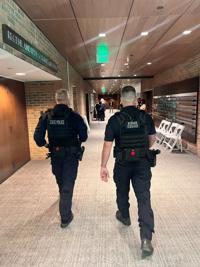
Members of the State Police bomb squad inspecting the Temple before the service.
But the question always hung over us: Can we get back into the building by Rosh Hashanah?
On Sept. 11 — ironically a date that will forever be linked to terrorism — the Temple Israel family finally came home. On Erev (“Eve”) Rosh Hashanah, as Jews around the world welcomed the Jewish new year with self-reflection, repentance and prayer, Temple Israel opened the doors to its newly restored building amid unprecedented security measures and an outpouring of mixed emotions.
It is a surreal feeling to walk up to your place of worship — a physical embodiment of spiritual comfort and inspiration — and realize that just six months ago it had been a crime scene. Our building had been visited by evil, with one man intent on killing as many preschool children as possible and inflicting maximum damage to the building. The attacker had been killed in the Temple, just down the hall from where we were. Our Director of Security, Danny Phillips, was struck by the truck and broke his leg, yet still engaged the attacker and helped to neutralize him. One hundred and four preschoolers and the staff survived the attack without a single physical injury — a fact that is now commonly accepted at the Temple as a “miracle.”
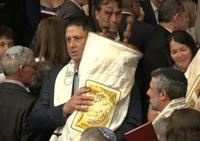
Director of Security, Danny Phillips, who broke his leg the day of the attack, was given the honor of carrying one of the torah
Danny Phillips and three other lead members of the security team — dubbed as our “Guardian Angels” by the clergy — were recognized on Erev Rosh Hashanah and then honored in greater length the following morning, when they were called to the bimah to open the ark and hold the Torahs. Danny, still recovering from his injuries, gingerly walked up the steps. A very grateful congregation gave them a long, heartfelt and tearful standing ovation. Those four men saved a lot of lives, and they will forever be cherished as true heroes of the Temple Israel family.
A New Normal
As we approached the building, we got our first glimpse of our new normal. We walked alongside dozens of mortar and metal barriers, passing multiple police officers, security guards and SWAT team soldiers wearing full combat gear and holding large rifles. One of the SWAT team members was visibly perched on the roof. There were members from the Michigan State Police bomb unit and a bomb sniffing dog. One of the officers told a friend there that the place “was safer than Fort Knox.”
We were ushered through a controlled single entrance where we passed through metal detectors before entering the building. From there, we were led straight to the re-built sanctuary, the 1,000-plus seat venue that has been the Temple’s primary place of worship since the Temple moved to West Bloomfield 46 years ago. Entering the sanctuary, we were offered prayer books and Kleenex, which many of us grabbed. The Temple had gone to great lengths to meticulously re-make the sanctuary to look as closely as possible to the old one before it had been decimated. Practically everything in that massive, ornate space needed to be replaced.
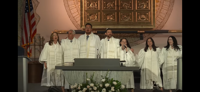
The clergy concludes the emotional service as the congregation shows its appreciation.
Seeing the sanctuary was like reuniting with an old friend who had been through hell and survived. There was joy and relief to see it beautifully rebuilt, but also an air of sadness at the thought of what this space — and our people — had been through. Unlike past years where people would enter the sanctuary on a holiday and happily greet each other with expressions like “Shanah Tovah” and light chitchat, the mood this year was distinctly different.
The sanctuary had indeed looked identical to the old one, which felt comforting and familiar, but that joy was tempered by the knowledge that while things might look the same, actually nothing at all would ever be the same again.
Among the attendees at the jammed-packed Rosh Hashanah service were scores of people who had been at the temple on March 12. For them, walking back into that building meant coming face to face with the trauma that has haunted them for the past six months. They had witnessed the horror up close, the booming explosions and gunfire, the large fire, the black billowing smoke, the confused and frightened young children, and the screams of arriving parents. There were the teachers who, under police escort, heroically led the children across the street to Shenandoah Country Club where they calmed them with games, M&Ms and singing “Wheels on the Bus.”
There were the clergy who displayed enormous leadership and courage during those terrible moments but later confessed that there were times when they asked themselves if the coming week would be filled with multiple funerals for children and staff members. There were parents whose children were there that day and are still struggling with PTSD (one parent recently described how his child heard fireworks on July 4 and went into a complete panic attack).
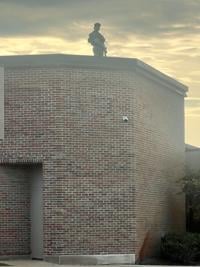
A SWAT team member kept a watchful eye perched atop the Temple’s roof.
The service began with Cantor Neil Michaels and the music team repeatedly singing the words, “In this hall, sacred space, we are one, together we pray.” Cantor Michaels then spoke: “Shanah Tovah. Welcome home. For months we have prayed in borrowed sanctuaries, and we have discovered something our people have known for thousands and thousands of years: a sacred community is not defined by walls. And yet, there is something about coming home. On a terrible day last March, this sacred place became something we never imagined it could be. But that day does not get the last word. We do.”
The Torahs Return
As he finished, a slow parade of 15 people — which included Danny Phillips and the other lead security officers, the Temple’s executive director, key staff and lay leaders, the architect for the rebuild project and others — quietly entered the sanctuary from the rear, each carrying one of the Torahs that had been rescued on March 12. The congregation immediately stood up, overcome with emotion and gratitude. Some of the people carrying the Torahs were weeping, as were many of the congregants. People flocked to get close to the Torahs and touch them with their prayer books. The Torahs were brought to the bimah where they were received by the rabbis who assisted in placing them back in the ark, their former site.
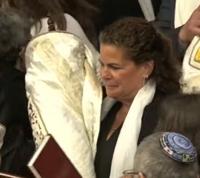
Director of the Family Life Center at Temple Israel, Kari Provider, overcome with emotion while carrying one of the torahs to the bima
Now we were officially back in our Temple home.
Rabbi Jen Lader paid tribute to the memory of Sept. 11, stating, “Tonight, on the 25th anniversary of 9/11, the eve of Rosh Hashanah, we remember those lost and heed the call to run toward one another, not away. That is true redemption.”
In a rare sight at Temple Israel for a Rosh Hashanah service, the congregation broke into thunderous applause and standing ovations when the clergy called out Danny Phillips, the Temple Israel teachers, the staff, the Chaldean community, the architects and Sheldon Yellen of Belfor Property Restoration, who was heralded for miraculously completing two years’ worth of work in six months.
Rabbi Jen Kaluzny delivered a heartwarming sermon on the journey the Temple’s Torahs had taken over the past six months. They had been moved from her home to the Holocaust Center for safe storage during that time. “Why do we save Torahs?” she asked. “Because we are Torahs. Each of us is the sum total of generations past … the Torah continues to be written every day, by each of us.”
An Unforgettable Experience
People left the service feeling overwhelmed by what they had just witnessed. Many were still tearful, and all came away feeling that the Temple service had struck the perfect chord. As one member said while walking out, echoing the sentiment of everyone, “That service was a life experience I will never forget.”
The resiliency of the Jewish people is embodied in the popular Hebrew phrase “Am Yisrael Chai,” which literally means “the people of Israel live.” On Rosh Hashanah at Temple Israel — on the 25th anniversary of 9/11 — those words were on full display. The people of Israel do indeed live, as do the people of Temple Israel, who are now well on their way toward healing and, once again, thriving.
Mark Jacobs is a longtime member of Temple Israel.
The Detroit Jewish News has been supported by readers like you since 1942. Support independent, local, Jewish journalism with a donation today.