
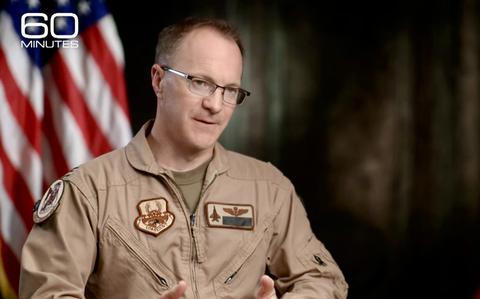
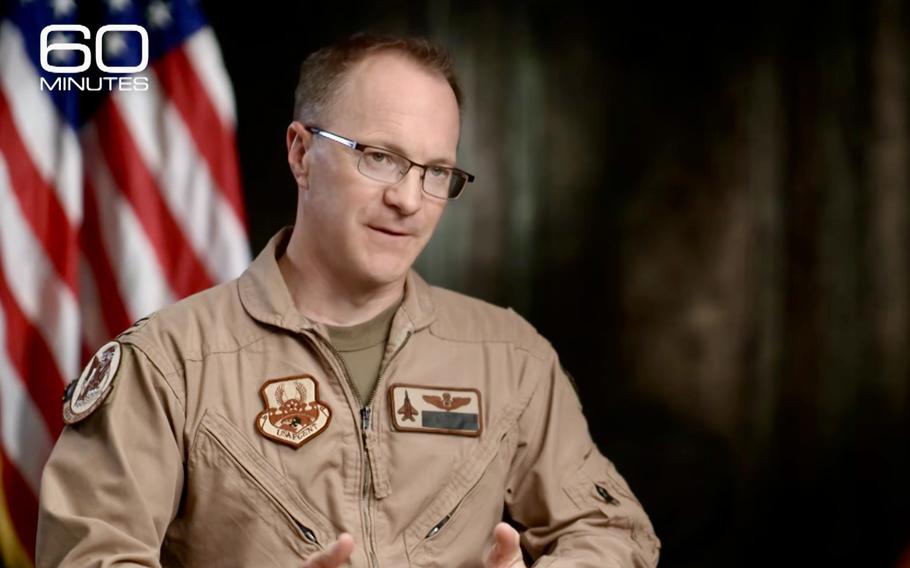
An Air Force weapons systems officer, identified only by the call sign Bravo, describes the downing of his F-15E Strike Eagle over Iran in April. During his “60 Minutes” interview, which aired Sept. 13, 2026, Bravo said he spent roughly two days evading capture in the Iranian mountains while dealing with a broken back, arm and shoulder. (CBS News)
An Iranian shoulder-fired missile brought down a U.S. F-15E over hostile territory in early April, and a damaged parachute sent one of its airmen crashing to the ground, according to new details revealed Sunday by the CBS program “60 Minutes.”
The mission involved about 90 U.S. troops on the ground inside Iran, hundreds more in the air and thousands of personnel in supporting roles as American forces raced to recover two downed Air Force officers in one of the largest combat rescue operations in U.S. military history.
When the missile struck, it felt like “getting hit by a freight train,” the Air Force weapons systems officer, identified only by his mission call sign, Bravo, said during the interview.
The aircraft was attacking industrial facilities associated with Iran’s missile and drone programs, Adm. Brad Cooper, commander of U.S. Central Command, said on the program. It was brought down by a shoulder-fired missile, according to Bravo.
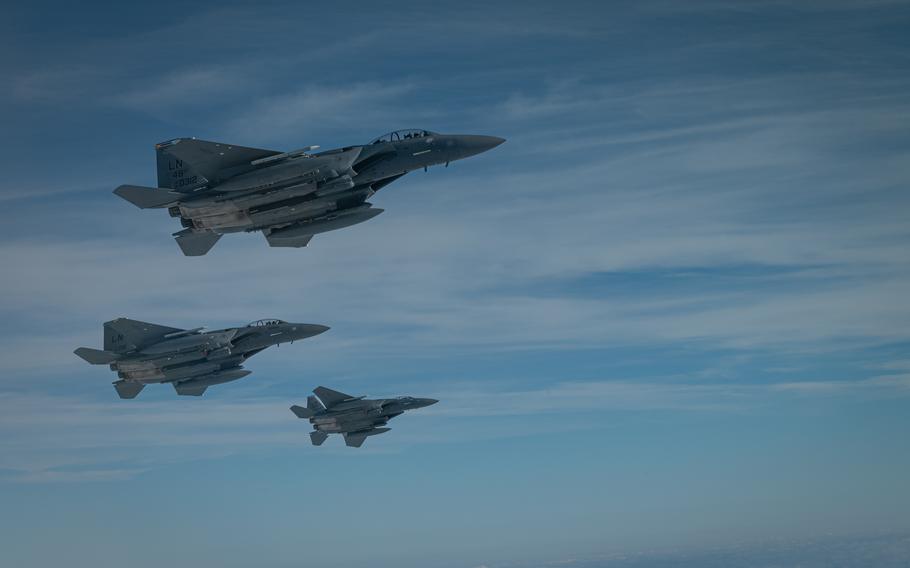
Three Air Force F-15 Eagle fighter jets assigned to the 48th Fighter Wing fly alongside a KC-46 Pegasus refueling tanker off the coast of England on Sept. 24, 2024. The wing’s 494th Fighter Squadron, based at RAF Lakenheath, had an F-15E Strike Eagle shot down over Iran in April, and the jet’s weapons systems officer described the rescue that followed in a “60 Minutes” interview that aired Sept. 13, 2026. (Timothy Hayden/U.S. Air Force)
When the two-man crew ejected, Bravo was in immediate danger.
The missile had damaged his parachute, causing Bravo to free-fall for at least part of his descent and hit the ground at an estimated 70 to 100 miles per hour, he said.
“At one point when I looked up and saw no parachute, that was the most terrifying thing I’ve ever seen,” Bravo said in his first public account of what happened. “So I paused right then and I prayed, ‘Lord, your will be done. But if I’m getting through this, I need help.’”
The impact broke his back, arm and shoulder and sprained his ankle, “60 Minutes” reported. The pilot, referred to as Alpha, and Bravo came down about 5 miles apart as Iranian forces converged on the area.
Although badly injured, Bravo said he needed to get moving and worked his way along a roughly 7,000-foot-high ridgeline in search of a hideout. The threat of possible capture helped him push through the pain.
“Never let a lack of motivation put you on Iranian TV,” he said.
U.S. officials told CBS that at one point, the Iranians came within several hundred meters of Bravo’s location.
The first rescue effort focused on Alpha, who was pulled out during a daylight recovery operation some six hours after being downed, “60 Minutes” reported.
“It was a gunfight all the way in and all the way out,” Defense Secretary Pete Hegseth said. “But they got Alpha back.”
Bravo remained missing, however. While on the move through the mountains, he established contact and told U.S. forces he was injured.
The U.S. military received support from a CIA deception campaign designed to confuse and misdirect the Iranians, “60 Minutes” reported. But that meant Bravo needed to remain hidden longer.
“That was a really tough decision,” Hegseth said. “I’ll never forget, you know, being in the Situation Room and saying, ‘OK, I guess we’re going to roll 24,’ which means, ‘Hey, Bravo’s going to be out there for basically 24 hours more.’”
The CIA eventually helped locate Bravo using classified technology, the report said. U.S. bombers and drones also struck Iranian targets that threatened the rescue operation.
Cooper said about 90 American troops went into Iranian territory, with several hundred more in the air and thousands of other personnel supporting the mission overall.
The ground deployment marked the first presence of U.S. troops inside Iran in 46 years, Cooper said.
Two large rescue aircraft landed on a makeshift desert strip. They then launched “Little Bird” helicopters toward Bravo’s location. Two Air Force pararescuemen eventually reached him on the ridgeline.
“Let’s go,” Bravo told them after hiding out for two days.
But then the two large recovery aircraft used for the mission became stuck in the desert sand, leaving Bravo and the U.S. special operators temporarily stranded.
Another Air Force unit was then brought in to extract them, according to CBS.
U.S. forces later bombed the abandoned aircraft and equipment to keep sensitive technology from falling into Iranian hands. Roughly 50 hours after being downed, Bravo was out.
The rescue, Bravo said, was an example of what “America’s willing to do in order to uphold our promise and leave no man behind.”