
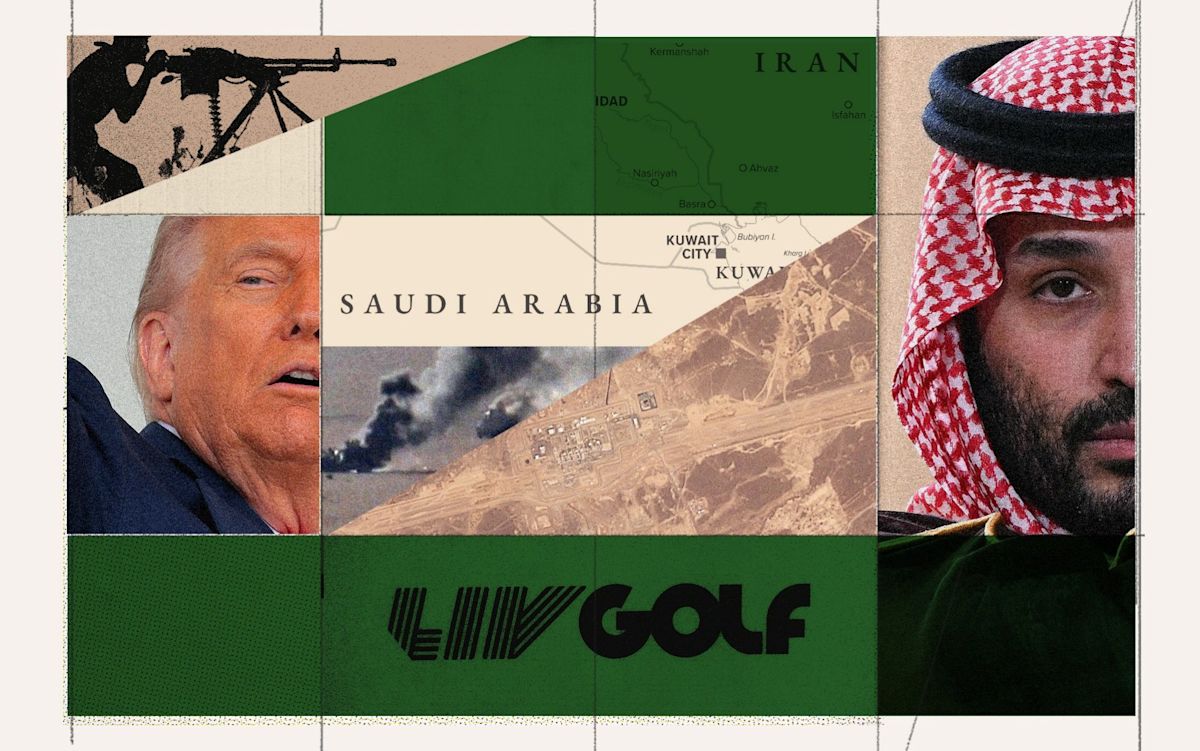
Mohammed bin Salman (MBS), Saudi Arabia’s de facto leader, is in a bind.
To the north, Iran-backed militias in Iraq struck the kingdom’s East-West pipeline. To the south, the Houthis are advancing along Yemen’s Red Sea coast, threatening the Bab el-Mandeb strait. To the east, the Iran war has disrupted the Strait of Hormuz.
In the middle sits Saudi Arabia and a crown prince who built his economic revolution on one assumption: that he could keep the wars of the Middle East at bay.
When that became impossible, and the Houthis threatened his country, MBS reportedly phoned Donald Trump twice seeking American military intervention. Washington offered intelligence and other assistance, but Mr Trump declined the strikes that Riyadh wanted.
Britain – Bloomberg reports – has sent military advisers but, like the US, has not committed to providing tangible military support.
The timing could not be worse for the once seemingly untouchable prince.
MBS’s great bargain has been Vision 2030: his strategy launched in 2016 to reduce Saudi Arabia’s dependence on oil and diversify its economy.
That ambitious plan involves tourists, concerts, international sport, futuristic cities and trillions of dollars of investment. All, however, require peace.
With war at his doorstep and the crown prince appearing increasingly isolated on the world stage, experts told The Telegraph that this strategy was under threat, even more so than in the wake of the 2018 killing of Saudi journalist and dissident Jamal Khashoggi.

The crown prince built his plans for economic revolution on the assumption that he could keep the wars of the Middle East at bay – AFP via Getty Images/Brendan Smialowski
“His entire grand strategy has subsequently been predicated on creating a stable regional environment in which Saudi Arabia can focus inward on economic transformation,” said Dr Rob Geist Pinfold, a lecturer in international security at King’s College London.
“That entire grand strategy is now under unprecedented threat,” he added.
Even before Shia militants in Iraq bombed Saudi Arabia’s East-West pipeline, the kingdom’s oil production was at its lowest point for 36 years, according to Opec.
When the US-Iran war threatened tankers in the Strait of Hormuz, and with Yemen’s Houthis threatening the Bab el-Mandeb, the pipeline – which bypasses both – became vital for exports. With its closure, Saudi oil refineries on its west coast are expected to start cutting production.
Riyadh could step up its exports through the US-controlled side of the Strait of Hormuz, but the risk of Iranian attacks remains.
Meanwhile, the military option – defeating the Houthis and removing them as a threat to the Red Sea – has eluded MBS for years.
The kingdom’s intervention in Yemen in 2015 became a lesson in the limits of military power: Riyadh could neither defeat the Houthis nor impose the settlement it wanted.
“He apparently realised he could be ambitious at home or abroad, he could not have both,” said Dr Pinfold.
Riyadh pivoted towards détente with Iran in 2023 and accommodation with the Houthis. This fell apart in July, when the Houthis announced they would blockade Saudi ports in support of Iran.
The Houthis, meanwhile, need only make Saudi Arabia look vulnerable.
Dr Kristian Alexander, a Gulf security and foreign-policy analyst, said: “Calibrated attacks can be more useful.”
They could “raise economic costs, weaken confidence in Saudi security, pressure MBS to negotiate and expose the limitations of American protection without necessarily provoking an all-out response”, he said.

MBS cannot simply concede, which would show that missiles and drones can influence Saudi policy. But returning to war risks reopening one of the costliest chapters of his rule.
“Saudi Arabia is thus caught between escalation and accommodation,” Dr Alexander said.
“The kingdom can inflict enormous damage on the Houthis, yet it cannot reliably compel them to surrender.”
Saudi Arabia’s allies are also reluctant to rescue it.
At the weekend, Mr Trump told reporters: “The Houthis called us, and they don’t want to fight with us.”
The United Arab Emirates, once Riyadh’s indispensable partner against Yemen, is on fragile terms with the kingdom.
Dr Pinfold said: “The Saudis have been thus far unable to rely on their traditional strategy of relying on partners and allies to help bail them out.”

Donald Trump has not committed to providing tangible military support to MBS – REUTERS/Evelyn Hockstein
Entifadh Qanbar, a former spokesman for Iraq’s deputy prime minister and a Middle East policy adviser in Washington, said the split had weakened the Gulf as Iran and its proxies increased pressure.
“This is an extremely unfortunate division at precisely the wrong moment,” he said. “A serious Saudi-Emirati split weakens Gulf co-operation at a time when the region faces enormous security challenges from Iran and Iran-backed armed groups, both north and south.
“There is no magic solution and no single military action that will solve this crisis. Saudi Arabia cannot effectively confront all of these challenges alone.”
Riyadh has broadened security relationships with Turkey and Pakistan, but Mr Qanbar said Washington and Gulf co-operation remained indispensable, adding that Mr Trump should intervene to repair Saudi-Emirati relations.

Mr Qanbar also said Iran was using its proxy network to threaten shipping and energy supplies and push up oil prices, increasing economic pressure on Mr Trump and Republicans before the US Midterms.
The military crisis is colliding with a financial one.
The Line, the 106-mile mirrored city intended to embody the new Saudi Arabia, has been dramatically scaled back because of layoffs. Saudi Arabia also poured more than $5bn (£3.7bn) into LIV Golf, which entered Chapter 11 bankruptcy proceedings this month after the Public Investment Fund (PIF) withdrew support.
Despite this, Ahmed Alkhuzaie, a Gulf affairs analyst from Bahrain, argued that MBS remained strong. Scaling back The Line and reallocating PIF capital is discipline, not retreat.
“When launching ambitious, multi-billion-dollar visions, one either adapts to market realities or goes broke,” he said.
Nor, he argued, should appeals to allies be mistaken for panic. “Reaching out to longstanding allies in Washington or London during tense moments isn’t a sign of panic; it’s basic statecraft.”

Saudi Arabia has scaled back The Line, a 106-mile mirrored city – AFP via Getty Images
Pressure on MBS is also different from a threat to his power. After spending almost a decade consolidating rule, rivals have been marginalised and security institutions brought under his control.
Dr Alexander believes a coup remains highly unlikely. There was, he said, “no credible basis for forecasting one within months or even several years”.
A dangerous scenario would require oil exports to be paralysed, serious military reversals and a sharp economic contraction, a situation that remains distant.
The crown prince survived the political fallout from the killing of Khashoggi, which made him a pariah in much of the West, only for world leaders and executives to return to Riyadh within years.
At home, Mr Alkhuzaie argued that Western observers saw MBS through the lens of Khashoggi rather than the social changes Saudis had experienced.
“MBS built a massive base of domestic support, particularly among the country’s huge youth population,” he said. “His control over state institutions is solid.”
The immediate threat to MBS is not his throne. It is that the world around Saudi Arabia becomes too dangerous and too expensive for the transformation on which he has staked it.
For years, he tried to make the kingdom an island of investment and stability in a violent Middle East. Now, the violence is closing in.