
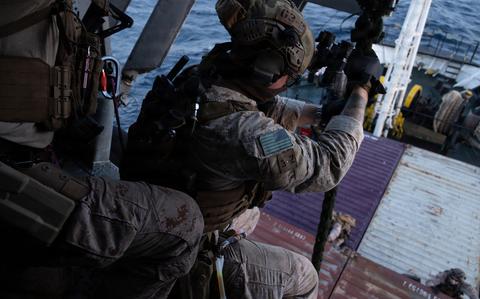
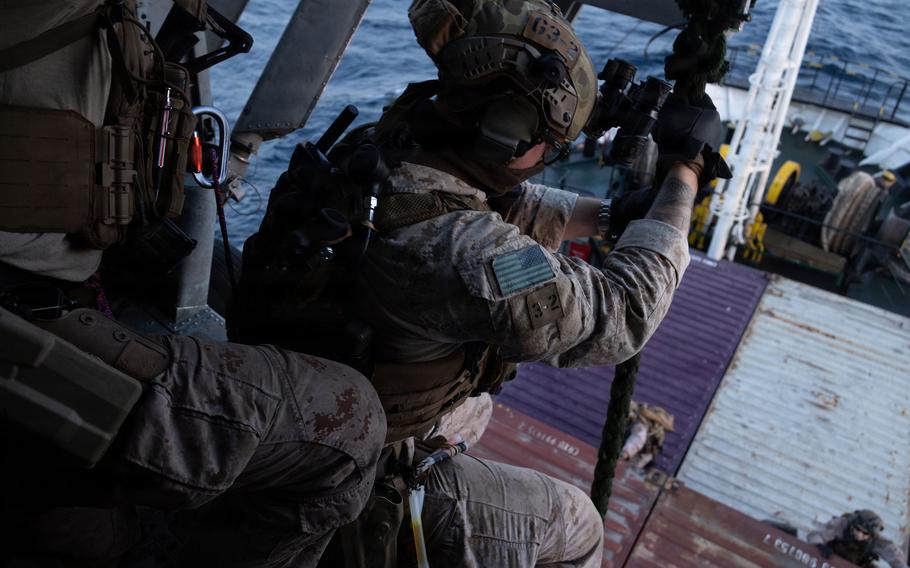
Marines from the 31st Marine Expeditionary Unit board a commercial ship suspected of attempting to transit to Iran in violation of the U.S. blockade on April 28, 2026. (U.S. Marine Corps)
WASHINGTON — The 31st Marine Expeditionary Unit quickly pivoted from routine drills to the Middle East and a supporting role in the war against Iran.
As quickly as it could pivot, anyway.
“I keep having this epiphany that the ocean is big. I mean, it really is, and you can intellectually know that,” Col. Chris Niedziocha, the commanding officer of the 31st MEU during the deployment, told reporters Wednesday. “But then when you realize that where you’re going is like 14 to 17 days away, and you can’t go (in) straight lines. You got to go around the land.”
After participating in Iron Fist 26, a three-week bilateral training event held in Japan to strengthen combined amphibious capabilities between the U.S. and Japan, the amphibious assault ship USS Tripoli and its amphibious ready group — the transport dock ship USS New Orleans and the dock landing ship USS Rushmore — pivoted to the northern Arabian Sea in March to support Operation Epic Fury.
The group’s 2,500 Marines of the 31st MEU are based on Okinawa.
During the four months operating in the U.S. Central Command area of responsibility, the group logged more than 1,600 hours of combat aviation missions and transported more than 800,000 pounds of cargo during the deployment, according to the news release at the time.
Marines conducted four maritime interdiction operations, three of which culminated in boarding the vessel, Niedziocha said.
The colonel said the most difficult part of the deployment was managing the “human terrain” because there were times where the mission was open-ended.
“I felt manned, trained, equipped (and) fully prepared for everything that we were asked to do,” Niedziocha said. “The lessons learned from one patrol are pushed forward to refine the preparation for the following patrols.”
During the mission, the 31st MEU he said saw the range of Iran’s capabilities — surveillance and reconnaissance assets, one-way attack drones, along with short and medium range ballistic missiles.
“It’s almost a full-time job keeping up with the new gear, and a lot of it is counter-(uncrewed aircraft systems),” Niedziocha added.
Preparation included being ready for the possibility of a land assault.
President Donald Trump in a social media post on June 11 threatened that the U.S. would seize Kharg Island and “assume total control” of Iran’s country’s oil and gas markets “at some point in the not too distant future.
“We looked at the full range of options. If it was a piece of air or water or land, we thought about how to operate effectively there,” Niedziocha said. “There was a full range of options that we generated and put in front of CENTCOM and let them pick and choose what they thought they were going to do.”
U.S. forces have struck Kharg Island during the conflict now in its seventh month, but forces have not seized the island.
Eighteen U.S. service members have been killed and more than 800 have been wounded, according to the latest Pentagon statistics, since the conflict began on Feb. 28.