
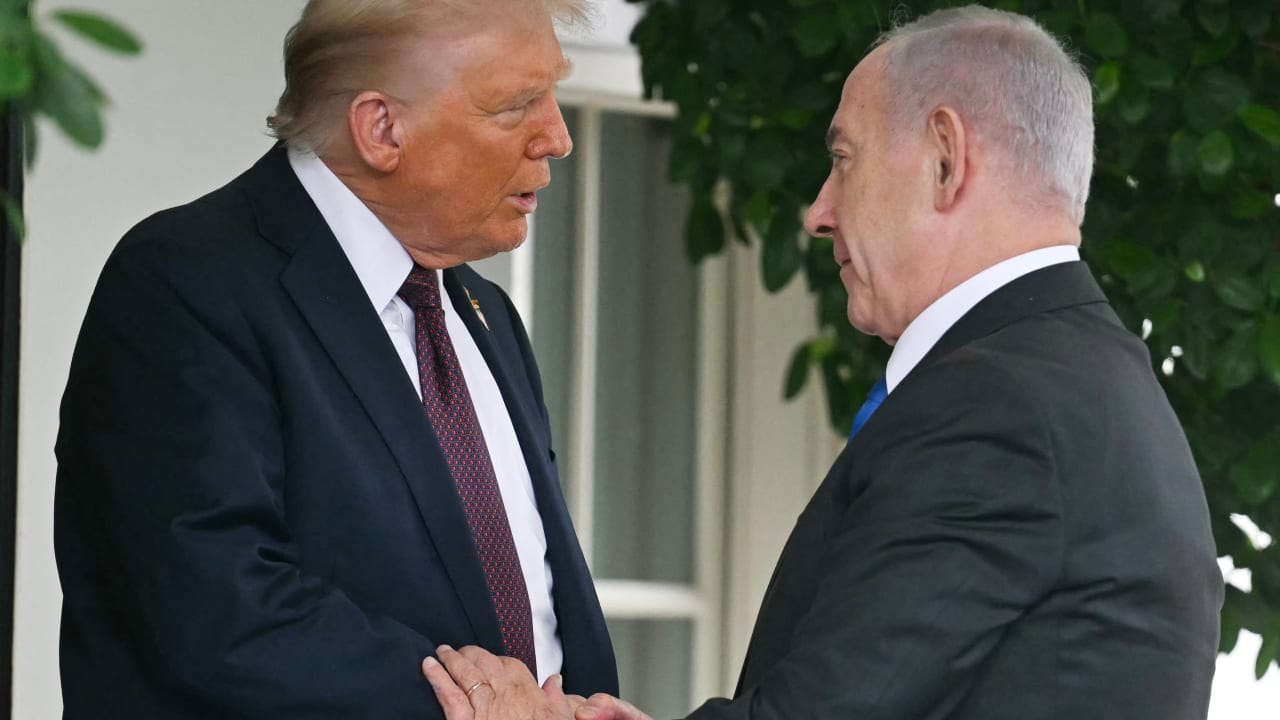
US Donald Trump has an unprecedented track record of opposing Israeli Prime Minister Benjamin Netanyahu when it comes to advancing the interest of the American people, Vice President JD Vance said during a virtual address Tuesday at a Los Angeles-based technology summit.
More than any president in the last 40 years Trump “has shown a willingness to actually part ways with ‘Bibi’ Netanyahu when he feels like the interests of the American people are different from the interests of the government of Israel,” Vance told the All-In Summit on technology.
The claim that Trump is the “one president” who would differ with Netanyahu is one that would surprise many watchers of the US-Israel relationship.
The most significant US-Israel rupture since 2009, when Netanyahu was first elected prime minister, was with President Barack Obama in 2015 over Obama’s nuclear deal with Iran.
Gap between US, Israeli interests continues increasing, Vance says
Vance’s comments were the latest in a series he has made emphasizing the widening gulf between Jerusalem and Washington as November midterm elections approach and at a time when Netanyahu’s popularity in the United States is at a low after three years of Middle East wars.

A Pew poll from the end of March, when the United States was actively at war with Iran, found that 60% of US adults unfavorably view Israel and that 59% lacked confidence in Netanyahu’s handling of world affairs, an increase of 7% in both categories.
Republicans are scrambling to shuck off unpopular policies and associations, fearing the party will lose control of Congress in the midterms, a result that would cripple Trump’s agenda in the final two years of his presidency.
“I find it a little ironic … that you have Democrats criticizing Donald Trump for his relationship with Bibi when Donald Trump is the one president of the last 40 years who’s been willing to say, you know what, yeah, Bibi is a good partner, but also Bibi and I have a different opinion on this, or Bibi’s wrong about this, or maybe Bibi’s right about this from the perspective of Israel. But the American people need us to go in a different direction,” Vance said.
Trump has often touted himself as the president who has done the most for Israel, including relocating his country’s embassy to Jerusalem and rupturing Obama’s Iran deal, during his first term in 2018 and securing the release of the Gaza hostages in 2025 during his second, nonconsecutive term. The war he and Netanyahu launched against Iran in February is the first ever joint US-Israeli military action.
The friendship between the two leaders is a highly public one, with Netanyahu enjoying more White House visits than any other world leader. Each has made the close ties central to their electoral campaigns. Netanyahu pitches himself as the world leader most influential with Trump, while Trump’s evangelical base lauds his closeness with Israel.
Emphasizing differences between US, Israel
Vance, however, has often taken a harsher line, including accusing Israel of trying to manipulate US public opinion on the Iran war.
“Israel has been an important partner when it comes to military technology, when it comes to intelligence sharing, but also sometimes the United States doesn’t always agree with Israel,” Vance said on Tuesday.
Serious differences have emerged since the joint US-Israel goals in the Iran war – to change the regime and end once and for all Iran’s potential to acquire a nuclear weapon – have foundered. Among these has been the US decision to end the Iran war without a clear plan to block the Islamic Republic’s path to nuclear weapons and its agreement to enter into a civilian nuclear deal with Saudi Arabia, without insisting on a normalization deal with the Jewish state.
“We cannot let our Middle Eastern foreign policy be subservient to the state of Israel,” Vance told the All In Summit.
Pro-Israel figures object to Vance’s attitude towards Israel
Vance has also ruffled American Jewish feathers by refusing to disavow media personality Tucker Carlson, who has promoted conspiracy theories about Israel and Jews.
Vance’s remarks rankled pro-Israel figures who have otherwise been supportive of Trump’s policies.
“American foreign policy should be subservient to no country,” Jonathan Schanzer, the executive director of the Foundation for the Defense of Democracies, an influential think tank that backed the Iran war, wrote on X/Twitter. “Why does the VP feel compelled to call out Israel in this respect? Why not call out the Qataris, or the Saudis, or Ukraine? Odd how this keeps happening.”
Heather Johnston, a Christian evangelical who founded the US Israel Education Association, accused Vance on X of catering to Israel haters.
“Our US foreign policy has never been subservient to Israel’s foreign policy,” she said, attaching a clip of Vance’s remarks. “He knows that. Why would he need to say that unless he’s trying to politically gain some points with Israel haters?”
The accusation hit a nerve. Vance’s communications director Taylor Van Kirk quoted Johnston’s tweet, and posted the entire exchange on X. “Let’s all take a moment to actually watch this exchange in full, where the VP was specifically asked about Israel,” Van Kirk said.