
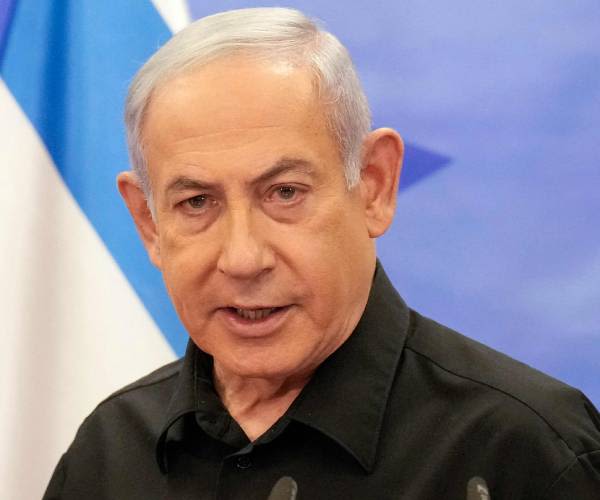

Israeli Prime Minister Benjamin Netanyahu (Getty)
Israeli Prime Minister Benjamin Netanyahu’s political bloc has moved narrowly ahead of its main opposition rivals in a new Channel 13 poll.
It’s the latest sign of a tightening contest ahead of Israel’s Oct. 27 parliamentary election with the Times of Israel saying the poll showed a “turnaround” for Netanyahu’s prospects.
The survey, released this week, projects parties aligned with Netanyahu winning 54 seats in Israel’s 120-member Knesset, compared with 52 for the opposing Zionist bloc.
The two predominantly Arab parties were projected to take the remaining 14 seats.
The result does not give Netanyahu’s bloc the 61 seats required for a parliamentary majority, meaning the prime minister would still face a challenging coalition-building process if the election produced a similar result.
But if Netanyahu’s coalition were to have the largest bloc after the election, he would likely be the first asked to form a new government.
But the Channel 13 numbers give Netanyahu’s camp a two-seat advantage over its principal rivals, continuing a shift from some earlier surveys in which the opposition held the lead.
The Oct. 27 election is scheduled to be Israel’s first national election held on schedule in nearly four decades.
The Channel 13 survey questioned 886 respondents and had a margin of error of plus or minus 3.3 percentage points.
Netanyahu’s Likud itself was projected to win 18 seats, trailing former military chief Gadi Eisenkot’s Yashar party, with 22. The Bennett-Lapid B’Yachad list followed with 12, while the Democrats are projected to get 10.
Other parties projected to enter parliament included Religious Zionism, Otzma Yehudit and Yisrael Beytenu, each with eight seats; the Joint Arab List with eight; the ultra-Orthodox Shas and United Torah Judaism parties with seven each; and Ofer Winter’s People of Israel and the Arab Ra’am party with six apiece.
Israel’s proportional, multiparty parliamentary system makes coalition negotiations central to forming governments.
Parties compete for Knesset seats nationwide, and lists receiving at least 3.25% of valid votes qualify for representation, a relatively low threshold that allows numerous parties to enter parliament.
Seats are then allocated broadly according to each qualifying list’s share of the vote.
The latest numbers also reinforce an earlier September poll reported by Newsmax that showed Netanyahu’s political camp edging ahead.
A Kan public broadcaster survey published earlier this month projected Netanyahu-aligned parties taking 52 seats against 51 for the opposition, with Arab parties receiving 13 and a nonaligned party four.
A Sept. 6 polling average cited by Newsmax also had Likud narrowly ahead of Yashar, 24 seats to 23.
© 2026 Newsmax. All rights reserved.