
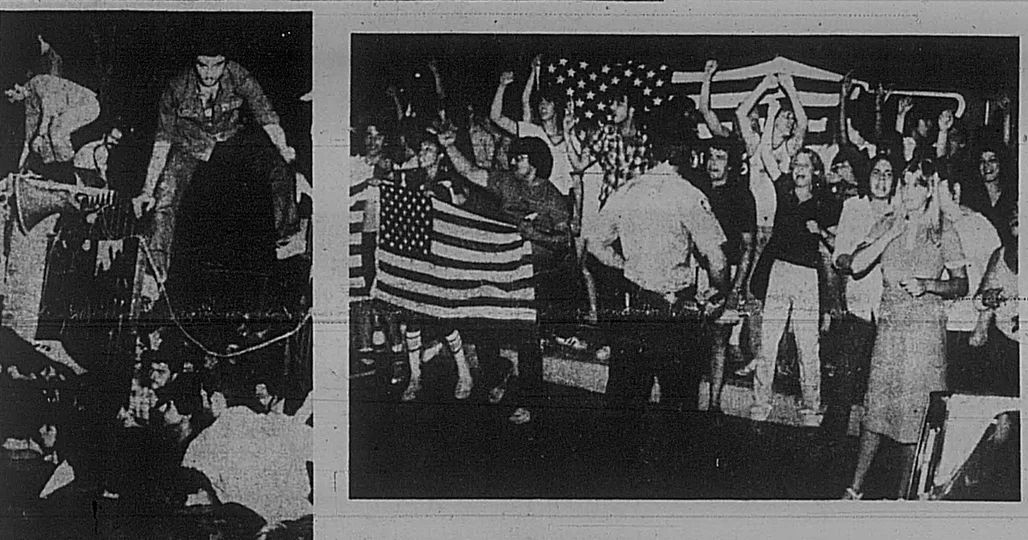
PUNXSUTAWNEY — As the United States of America celebrates its semiquincentennial, The Spirit once again looks back to its own coverage of major historical events. This week covers the Iran hostage crisis of the 1970s.
The sequence of events leading to the crisis began well before the ’70s. During World War II, the British and Soviet governments invaded and occupied Iran, ostensibly to stop the Shah of Iran — Reza Shah Pahlavi — from aligning with Germany, though some historians have speculated that Iran’s official neutrality in the conflict and consequent refusal to allow Soviet troops to use its territory for training or supply were the true basis. The invasion forced the Shah to abdicate for his son, Mohammad Reza Pahlavi. Following the war, the U.S. helped secure Iran’s independence after a diplomatic pressure campaign on the Soviet Union.
Iran spent the early 1950s in the throes of a power struggle between the new Shah and its prime minister, Mohammad Mosaddegh, who led a general strike demanding that Iran receive an increased share of petroleum revenue from the Anglo-Iranian Oil Company. The United Kingdom responded by reducing Iran’s revenue instead, and in 1953 coordinated with the U.S. on a military coup that deposed Mosaddegh and extended the Shah’s power to an absolute monarchy that purged disloyal elements within the state. The U.S. supported the Shah in the following years, with the CIA training Iran’s secret police.
Public opinion turned against the Shah in the decades that followed, leading to the Iranian Revolution in 1979. The Shah fled the country on Jan. 16, and the revolution began Feb. 1 with the return of Ayatollah Khomeini from exile as Iran’s prospective new leader.
The following report shows the changing political tides as they were reported in the U.S.:
Soldiers March With People In Anti-Shah Demonstrations
TEHRAN, IRAN (AP) — Hundreds of soldiers marched along with a million other Iranians in Tehran Thursday in a show of support for an antishah revolutionary government. But Prime Minister Shapour Bakhtiar held his ground, vowing he will not surrender power to a “mob.”
The leader of the “transitional government” trying to oust Bakhtiar was quoted as saying Washington has “indirectly” expressed a desire to establish good relations with a future revolutionary regime.
Marches here and in other Iranian cities were generally peaceful, but new political violence flared in two provincial towns.
In Gorgan, on the Caspian Sea, nine persons were reported killed and 26 others wounded when troops opened fire on anti-Bakhtiar protesters setting fire to banks, shops and other buildings, the state radio said.
Opposition spokesmen said that in the town of Koi, near the Turkish border, a group of mullahs, Moslem preachers, was attacked and badly beaten by a rival faction while en route to an opposition rally.
State radio said more than one million people took part in the Tehran march in support of Ayatullah Ruhollah Khomeini’s designation of a rival government headed by Moslem nationalist Mehdi Bazargan.
Khomeini, who returned to Iran last week after leading the anti-shah movement from exile, wants the Bakhtiar government to resign, the monarchy to be abolished and a religiously oriented Islamic republic to be established.
The well-disciplined marchers recited in unison from slogan sheets: “Bazargan, Bazargan, you are our prime minister!” and “Bakhtiar, Bakhtiar, you take orders from the U.S.A.!”
Among them were more Iranian servicemen in uniform than had been seen before in such demonstrations here, raising new questions about the loyalty of lower-ranking troops to the Bakhtiar government. Khomeini spokesmen said between 2,000 and 3,000 soldiers took part. Reporters on the scene counted at least 200 airmen in blue uniforms.
Demonstrators carried five fatigue-clad soldiers on their shoulders, chanting “The army must obey Bazargan!” and tossing flowers at them.
A Tehran newspaper published a photo purporting to show a throng of uniformed airmen saluting Khomeini outside his headquarters. Bakhtiar called the picture a “complete fabrication,” but a Bazargan spokesman insisted it was authentic and said the photo was taken from behind to prevent reprisals against the servicemen.
The allegiance of the armed forces is expected to be key to a resolution of Iran’s political crisis.
Historical perspective: The first assault on the U.S. Embassy took place Feb. 14, when the Organization of Iranian People’s Fedai Guerrillas took a Marine, Kenneth Kraus, hostage. He was tortured, tried and convicted of murder, and was to be executed until the Carter administration secured his release. The situation lasted only about a week. On Oct. 27, the U.S. controversially permitted the Shah, who had lymphoma, to enter the country for medical treatment, over the objections of the State Department. This intensified anti-American sentiment among Iran’s revolutionaries, who began planning to occupy the embassy and take hostages as leverage to compel the return of the Shah to Iran to stand trial. The attack took place Nov. 4.