
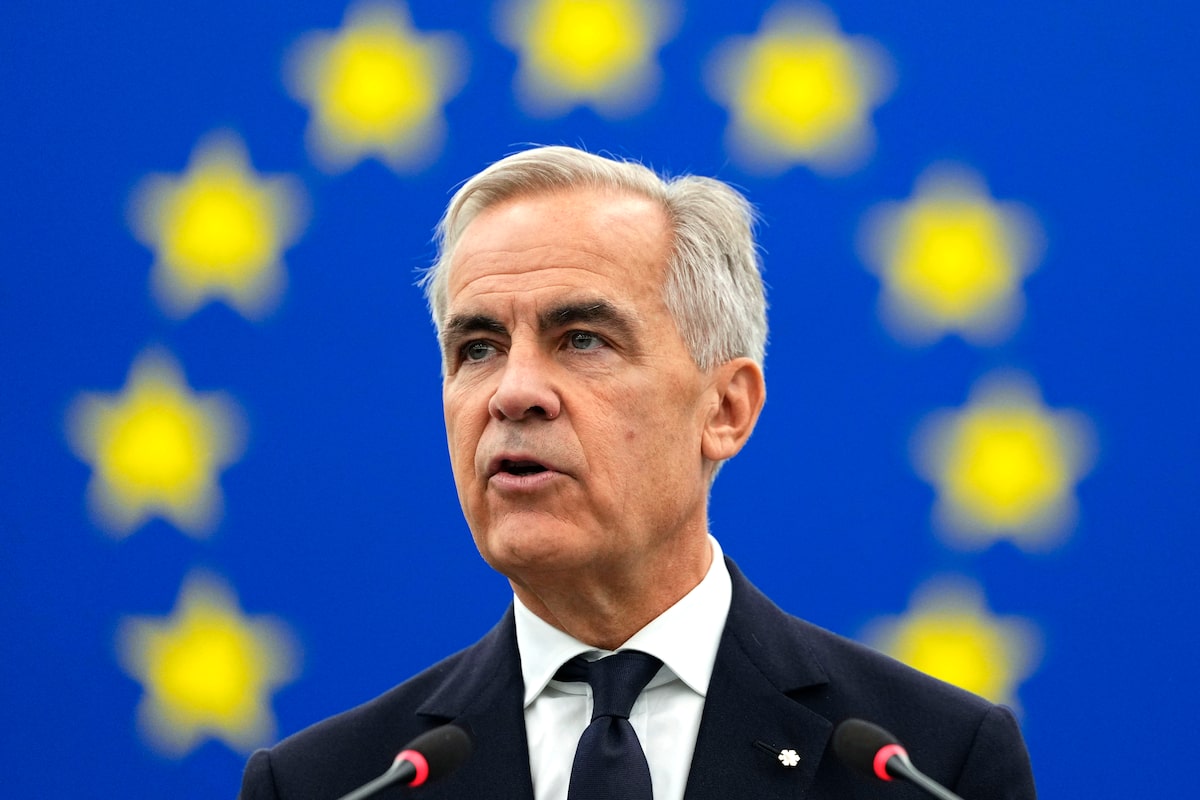
Prime Minister Mark Carney addresses the European Parliament in Strasbourg, France, on Thursday. He is scheduled to meet in the coming days with French President Emmanuel Macron and Norwegian Prime Minister Jonas Gahr Store.Justin Tang/The Canadian Press
Prime Minister Mark Carney is back from Europe and now Europe is coming closer to him.
Over 48 hours on Sunday and Monday, he’ll meet with two European allies, two leaders who, like Mr. Carney, see strategic autonomy as the key goal of their foreign policy.
If he wanted allies to help knit together a trans-Atlantic geopolitical alliance, he could not find more likely choices that France’s President Emmanuel Macron, who Mr. Carney will meet Sunday in the French territory of Saint-Pierre and Miquelon, off Newfoundland’s coast, and Norwegian Prime Minister Jonas Gahr Store, who arrives in Ottawa that evening.
Mr. Carney has just had a big European week, attending European Commission President Ursula von der Leyen’s State of the Union speech in Strasbourg, France, to hear her invite Canada to become an associate member of the European Union on Wednesday – then offering his own pitch for a broad alliance in a speech to the European Parliament the next day.
Now he will have a European weekend, albeit closer to home.
Carney promises sweeping economic legislation, fast pace this fall during caucus meeting
Mr. Macron leads Europe’s second-largest country and has been on the phone with Mr. Carney many times to talk about a closer alliance. Mr. Store’s Norway isn’t a member of the EU, but it has a closer partnership to the bloc than Canada will ever have even if it takes on a new status as the EU’s first associate member.
It’s too much to treat these two meetings alone as a European rush to Mr. Carney. Every September, a number of world leaders travel to New York for the opening of the United Nations General Assembly – as Mr. Carney will next week – and typically a few stop in Canada on the way. Mr. Macron is travelling to home soil.
But coming on the heels of the launch of an alliance initiative, the meetings are a symbol of just how central Europe is to Mr. Carney’s foreign policy and his whole governing agenda.
They also underline just how much Mr. Carney’s approach, and analysis of the world order, which he offered in Davos in January, has become a common paradigm with many European capitals.
Mr. Macron, left, greets Mr. Store at an event held in Paris in support of Ukraine this summer.Teresa Suares/The Associated Press
In February, Mr. Store’s speech to the Oslo Security Conference cited Mr. Carney’s assertion that the world is experiencing a “rupture” in the international order and provided a similar analysis, noting that great powers, including the U.S., have weaponized economic relations.
One envoy from a European country said this week that foreign-service colleagues from his country speak about Mr. Carney as something like a hero, lauding his Davos speech even when it was unclear what it meant in practice.
Tobias Cremer, a Social Democrat Member of the European Parliament from Germany who in March shepherded a parliamentary recommendation that the EU forge closer ties to Canada, said interest in the idea has grown quickly. “There is an accelerator because of the geopolitics of all of that, with a war-addicted Russia, with an assertive China, with a somewhat erratic American ally,” he said in an interview this week.
Mr. Store’s Norway is certainly an advocate of building strategic autonomy through alliances. The country announced it would join France’s nuclear umbrella initiative in June. And though it is not an EU member it has joined Europe’s common market and free-movement areas.
Mr. Macron was the Cassandra-like apostle of European strategic autonomy for many years before Mr. Carney entered politics, preaching similar proposals for building up its capabilities and independence in defence, technology and energy.
Mr. Macron’s support could be critical as officials from Canada and Europe hammer out detailed measures before a Canada-EU economic summit in October and then in advancing them through the notoriously complicated EU structures.
What are Carney’s next moves after EU meetings and the investment summit? Ask us your questions
But Mr. Macron is also desperately unpopular at home. Polls put the far-right and euroskeptic National Rally’s Marine Le Pen way ahead in the 2027 presidential election race. And several other European countries have seen centrist politicians lose ground to far-right, anti-EU forces. Part of Mr. Carney’s appeal to those European centrists is his popularity.
German MEP Mr. Cremer said many see Canada’s Prime Minister as a figure who offers hope.
“What Carney also represents to many Europeans is a centrist leader who … managed to come out with a positive, constructive message,” Mr. Cremer said.
However, there is a potential risk to Mr. Carney’s grand plan to link Canada to a like-minded EU: The European bloc could be divided from the inside.
For now, Mr. Carney is spending a lot of time with European allies who think like him.