

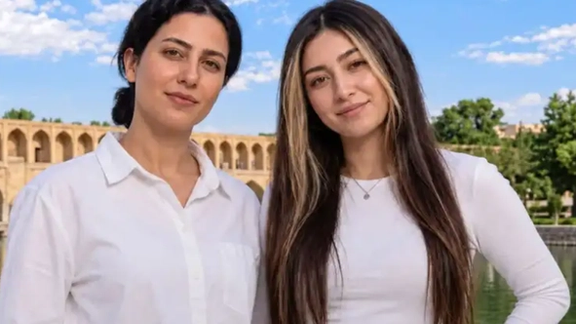
Taraneh Rahimi, 20, is being held alongside her twin sister Romina at Dowlatabad Prison in Isfahan. Their cousin, Masoud Nourmohammadi, told Iran International’s Eye for Iran that Taraneh’s condition has deteriorated as her lawyers race to appeal her death sentence.
“Taraneh could not walk,” Nourmohammadi said. “The (hospital) doctor says you have to go to the hospital and be hospitalized and get an MRI to see what’s going on with your leg because it is in bad shape,” he said.
Nourmohammadi said the doctor considered the treatment urgent, but prison authorities refused to allow Taraneh to leave for hospital.
Her family also purchased medical equipment and medication for her and brought the supplies to the prison, he said, but authorities did not allow them to reach her.
The allegations come days after Nourmohammadi told Iran International that prison authorities had stopped providing Taraneh with food, forcing her to rely on leftovers shared by other prisoners.
“They stopped giving Taraneh food a few days back,” he said. “They ask her to use other people’s leftovers and eat those. Who does that?”
‘If you don’t confess, we’re going to rape your sister’
The new allegations come as lawyers for the twins have finally been given access to their case file after months of waiting, according to Nourmohammadi.
He said the lawyers found no substantive evidence tying Taraneh or Romina to violence during the January protests and are now preparing an appeal.
“Their consensus is that there’s no evidence against those two girls in the case,” he said. “The only thing that is left … is basically their confession.”
The family says those confessions were obtained through torture and threats of sexual violence.
“They told Taraneh, ‘If you don’t confess, we’re going to rape your sister in front of you,’” Nourmohammadi said.
He said lawyers are also filing a complaint over the alleged torture and sexual abuse of the sisters while in custody.
Human Rights Watch and the Abdorrahman Boroumand Center for Human Rights in Iran have documented allegations of torture, coerced confessions and serious due-process violations involving defendants in the Shohada Square case.
Taraneh and Romina were among 16 defendants prosecuted over events surrounding protests in Isfahan in January. Ten of the defendants, including Taraneh, received death sentences, while Romina was sentenced to decades in prison.
The defendants faced charges including moharebeh, or “waging war against God,” destruction of public property, assembly and collusion against national security and propaganda against the state.
Rights groups have said none of the 16 defendants was charged with murder, despite prosecutors linking the case to incidents in which two people died.
‘A few days left’ to appeal
Nourmohammadi said the family believes only days remain in the formal window for lawyers to appeal Taraneh’s death sentence, adding that the family remains deeply concerned that authorities could move more quickly.
“You never know with that regime,” he said. “Anything can happen. It’s unpredictable.”
The sisters were 19 when security forces arrested them separately on January 24, weeks after they joined demonstrations around Isfahan’s Shohada Square. They have since turned 20 in prison.
Before her arrest, Taraneh was an equestrian and horse trainer. She had previously undergone surgery on her leg following a riding injury, according to her family.
Nourmohammadi alleges interrogators knew about the injury and deliberately targeted the same leg during torture.
When the twins’ mother was eventually permitted to see her daughters after roughly three months without knowing where they were being held, Nourmohammadi said Taraneh was already limping.
He said she also had broken fingers and knuckles and alleged that both sisters had lost much of their hair after being dragged between cells by their hair.
‘She wanted a life for her kids’
The twins’ mother raised Taraneh and Romina as a single parent.
For roughly three months after their arrests, she did not know where her daughters were being held. Family members searched hospitals, courthouses and prisons, at times waiting outside detention facilities seeking information.
When their mother was eventually allowed to see them, Nourmohammadi said the twins had swollen faces, bruises and significant hair loss.
After Taraneh was sentenced to death, he said his aunt was so devastated that she has barely been able to speak.
Instead, she wrote a message about raising her daughters and working to give them a future.
“She was a single mom. She worked really hard for her kids,” Nourmohammadi said. “She wanted a life for her kids. She didn’t want a prison or execution and a rope around their neck.”