
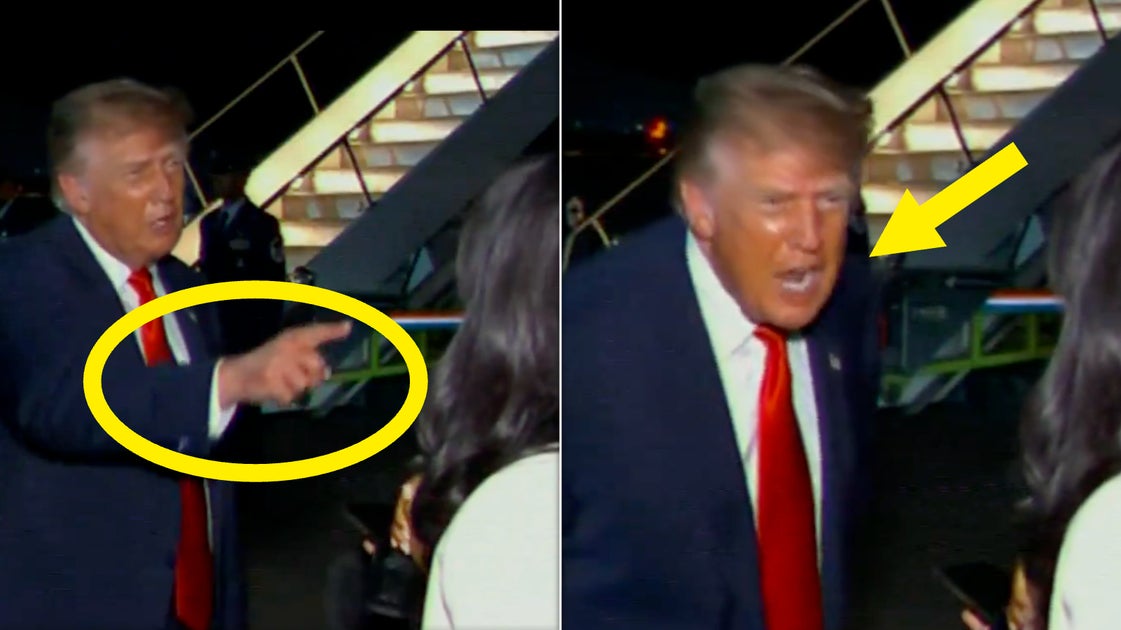
President Donald Trump has a tendency to go after female reporters. Last Thursday night, he turned his sights on ABC’s Rachel Scott, and body language experts say what happened next was a textbook intimidation display.
Scott pressed Trump about his preposterous promise to send $5,000 checks to every adult citizen in the U.S. if Republicans win the midterm elections.
“If your economic policies are working, why do you need an incentive for people to turn out to vote?” she asked.
Avoiding the question, the president responded, “I didn’t do it for turning out the vote. I did it as a reward for people having to put up with five years and four years of horrible, a horrible situation caused by Biden,” he said, later adding. “It’s almost a reward for the people having to put up with Biden’s policies.”
When Scott tried to ask a follow-up question about the tariff refund checks Trump had previously promised, he cut her off with “Not you! Not you!” Then, he moved in closer to her face and took on a growling tone as he said, “Hey! Not you!”
“Your network and you, you’re the worst,” he added.
Traci Brown, a body language expert and behavior analyst, was struck by the physical dimension of Trump’s response, particularly the moment he leaned toward Scott.
“He is getting on her level, eye to eye, in her face, to threaten and scare her a bit,” she told HuffPost.
Q: On the checks, we have $40 trillion in debt. If your economic policies are working, why do you need an incentive for people to turn out to vote?
TRUMP: I’m doing it as a reward for people having to put up for five years and four years of a horrible situation caused by Biden… pic.twitter.com/Iq4LpS1pNt
— Aaron Rupar (@atrupar) September 11, 2026
Rather than let the reporter ask her follow-up question and continue to engage in a back-and-forth dialogue, Trump was “trying to wrestle back control,” said clinical psychologist and behavioral expert Denise Dudley.
She identified the president’s response as a specific behavioral technique: proxemic intrusion. Basically, it refers to a deliberate violation of personal space used to assert dominance and signal aggression
“Proxemic intrusion is an aggressive move, and it’s kind of scary to us,” Dudley explained. “Human beings and mammals in general are very sensitive to proxemic intrusion because evolutionarily and biologically, we see that as somebody coming in at us and we don’t know if they’re friend or foe.”
Body language and nonverbal communication expert Patti Wood tracked the escalation in Trump’s physical behavior, particularly as he moved closer to Scott when she tried to ask a follow-up question.
“His voice rose. He angrily yells at her, ‘Hey, not you’ the first time, and he steps closer and leans in and repeats with his mouth and lips overworking, overarticulating,” she said. “He gives a focused glare of anger with lowered, drawn-together eyebrows.”
Then it escalated further. “He moves in closer, leaning in with his full upper body and head closer to her personal zone of space, less than two feet,” Wood said. “We see his jaw and chin tighten and his lips thin and tighten. The lips narrowing is a very reliable sign of anger.”
She noted that Trump’s anger was not controlled, as his thin lips jutted outward rather than staying closed to contain the emotion.
“He singles her out and goes into full attack mode, getting up in her face. His relentless glare of dominance becomes more focused as he attacks, mouth open, upper lip thinning and raised, and teeth showing in a symbolic biting motion as he yells viciously for the third time, ‘NOT YOU.’”
Wood also flagged something significant about the duration of the outburst itself.
“Most emotional expressions last very briefly ― two seconds or less in adults, then the adult controls their emotions,” she said. “This extended emotional outburst of anger shows his lack of emotional control, which also makes it more frightening.”

Andrew Harnik via Getty Images
Trump speaks to reporters on the tarmac before boarding Air Force One after attending the Republican Midterm Convention on Sept. 10, in Dallas, Texas.
Dudley also viewed the move as part of a broader strategy.
“He’s using what we would call multimodal intensification ― a technique where he uses everything at once,” she said. “His voice gets louder, and at one point there’s a kind of guttural sound that comes in. His movement changes with proxemic intrusion. His gaze gets really intense. And he’s pointing, so making a gesture.”
On the pointing specifically, Dudley was emphatic.
“Unless you’re literally pointing the direction to the bathroom down the hall, you just don’t ever point,” she said. “Pointing is aggressive. Even though it’s your finger, you’re pointing a sharp object at somebody, and human beings are sensitive to that.”
These physical changes align with his language and the intensity of his “you’re the worst” insult.
“He’s definitely exhibiting cluster congruence, or channel congruence,” Dudley said. “All the behavioral clusters or channels are saying the same thing. There’s no mixed message here. The cluster is congruent. It’s verbal and nonverbal signals communicating the same message, which is: I’m done with you, I don’t like you, I’m not going to let you keep the floor, and I’m going to go at you.”
On the whole, she also sees a menacing vibe to the behavior as well.
“He’s pointing and moving in, and the way his face contorts when he leans in, it’s threatening,” Dudley said. “If somebody leaned in at you and made that face and pointed at you and used that voice tone, you would probably back up. That’s what I would do.”
Scott did not appear to back up, and both experts found that revealing as well.
“He warned her, waved her off, dismissing her, and she keeps going,” Brown said. “That’s what reporters do, so there’s nothing unusual with her behavior. What is unusual is the stimulus doesn’t match the response.”
Wood noted the particular vulnerability of Scott’s position.
“The attack is full-on and frightening, and what makes it even more frightening is that her position as a journalist and the question she asked were reasonable,” she observed. “Just as he has done to other female reporters, he isolates her from the other reporters. She is a female enduring a vicious public attack that she can’t defend against or retreat from and keep her job, and no one else comes to defend or protect her. Also, notice she does not sound frightened.”
Although Trump has been hostile toward male journalists as well, his attacks on women reporters have been particularly brutal ― including calling The New York Times’ Katie Rogers “ugly,” dismissing CNN’s Kaitlan Collins as “very dumb and unhappy,” dubbing Maggie Haberman “Maggot Hagerman,” telling Bloomberg’s Catherine Lucey “Quiet, piggy!” and attacking ABC’s Mary Bruce for asking what he called “a horrible, insubordinate, and just a terrible question.”
Dudley described Scott’s composure in this latest exchange with the president as bravery and professionalism in the face of “aggressive, threatening” behavior.
“This is a good moment for her as a reporter,” she said. “The natural response of somebody getting in your face and pointing at you and using that voice tone would be to back up because we as humans sense we’re in physical danger. But I would assume that natural response in her is suppressed because her energy and her adrenaline is around getting the story, trying to maintain the floor. And he’s trying to get that conversational control away from her.”
Additionally, Dudley observed that the president’s anger and eruption seemed clearly targeted, rather than general.
“It’s not like he’s just generally agitated or in a bad mood and mad at all reporters,” she said. “When he turns to the next reporter, it’s like ‘OK, what is your question?’ His aggression is aimed right at her. Or he’d be mad at the other guy, but he’s clearly not.”
The original version of this story was published on HuffPost at an earlier date.