
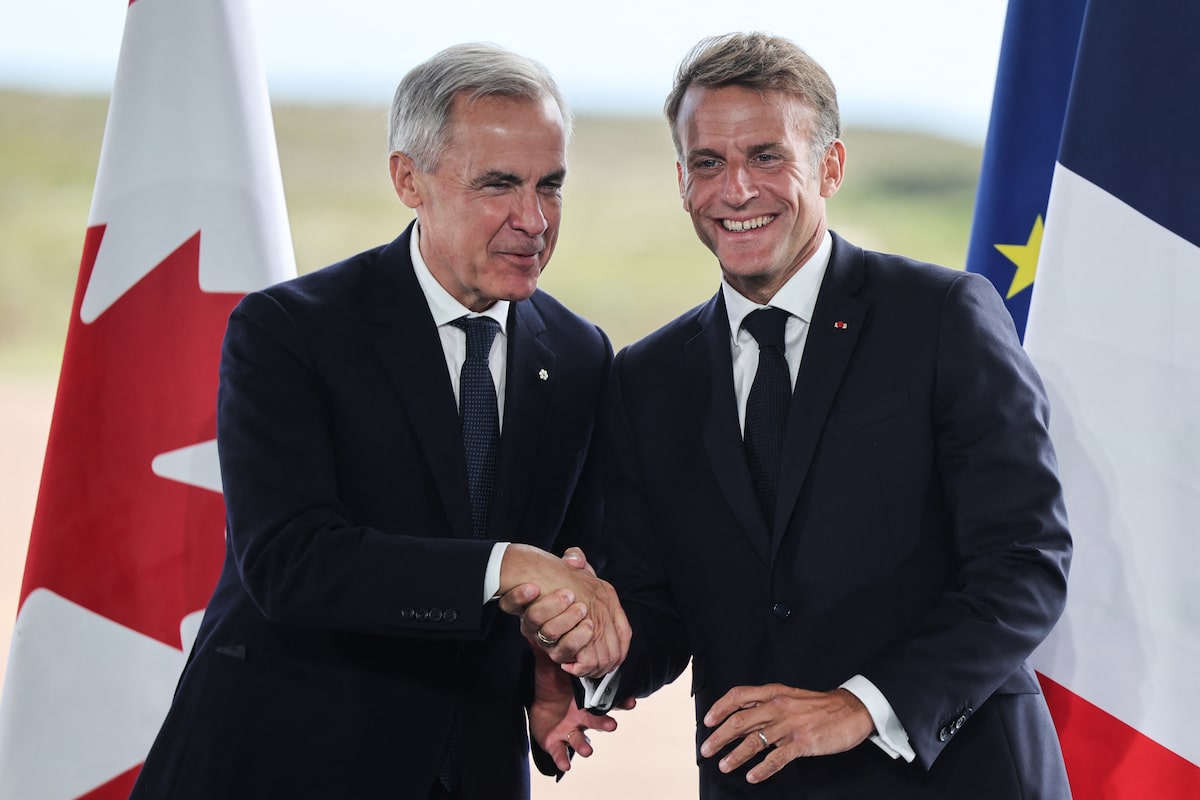
Prime Minister Mark Carney, left, and France’s President Emmanuel Macron hold a joint press statement on the French self-governing territory Saint-Pierre and Miquelon, on Sunday.LUDOVIC MARIN/AFP/Getty Images
Canada and France will start sharing space-launch systems and satellite data reception facilities, Prime Minister Mark Carney announced after a meeting with French President Emmanuel Macron on Saint-Pierre and Miquelon Sunday.
The two leaders − both headed to New York next week for United Nations General Assembly sessions − could have met in Manhattan. But Mr. Carney and Mr. Macron chose to hold a working lunch on the archipelago of nearly 6,000 French citizens located 25 kilometres off Newfoundland and Labrador’s Burin Peninsula.
The meeting was meant as a show of solidarity and confirmation of sovereignty in the face of U.S. President Donald Trump’s threats to annex America’s neighbours. It was also a demonstration of how Canada is deepening ties with other allies as Ottawa stares down an increasingly volatile and protectionist U.S. government.
It takes place only a few days after Canada was offered “associate membership” in the EU and less than two weeks after Mr. Trump, who has made no secret of his desire to control Greenland and Canada, released a social-media post with the U.S. flag covering all of North America, including parts of the Caribbean and the area where Saint-Pierre and Miquelon lies.
“Only a few kilometres separate Canada and France at their closest point,” Mr. Carney said Sunday. “Our values are even closer.“
Carney’s pivot to Europe takes him to French islands off Newfoundland
He laid wreaths with Mr. Macron at a monument to the Free French forces and local volunteers who peacefully seized control of the archipelago in 1941, rejecting the puppet Vichy regime that governed France under the Nazis.
“They acted on principle,” Mr. Carney said of those who rallied to France’s defence during the Second World War. “History remembers those who act. Those who stand up for their sovereignty.”
He said the Canada-France partnership lies at the heart of this country’s broader relationship with Europe.
“France is now Canada’s third-largest export market within the European Union. Strong cultural and linguistic ties unite us − and Canada is proud to host the 2028 Francophonie Summit,” he said, referring to the biennial gathering of countries and regions with linguistic and historical ties to France.
Mr. Carney said he and Mr. Macron intend to strengthen co-operation on space. “We’ve tasked our space agencies and defence ministries to develop and share common infrastructure, including space-launch systems and ground-based reception facilities.
Editorial: Stronger ties with the European Union aren’t a lifeline for Canada
The Prime Minister’s Office explained that the reception facilities are for receiving data from satellites.
Mr. Carney said a regional co-operation commission between Atlantic Canada and Saint-Pierre and Miquelon will conduct joint work on fighting climate change, transitioning to clean energy and promoting economic growth.
He did not mention Mr. Trump by name but talked of how Canada and France are “being shaken by new storms − the upheaval caused by climate change and the erosion of democratic norms and new threats to our sovereignty.”
He said sovereignty today goes beyond feeding, fuelling and defending a country’s population. “It requires secure access to AI, semiconductors, critical minerals, payment systems, clean energy technologies, vaccines and space-based communications.”
Mr. Carney’s trip to Saint-Pierre and Miquelon marks the first time a Canadian prime minister has made an official visit there. Former prime minister Pierre Trudeau made a personal visit in 1971.
Saint-Pierre and Miquelon survives on tourism and government subsidies these days − a remnant of the French empire that once sprawled across North America.
Visa-free travel to be part of Canada-EU talks, Carney says
Locals said they hope the Prime Minister’s visit opens a new chapter in relations between Canada and the self-governing French territory.
Franck Detcheverry, the mayor of Miquelon-Langlade, one of the eight islands that comprise the archipelago, said he supports closer ties between Canada and the EU.
“Europe, I think, needs allies like Canada to do business, to have trade agreements. Europe needs Canada’s riches, and Canada needs a big market like Europe to sell its products, to do business. And we’d rather see them turn toward us than toward Trump – we’re against Trump.”
Mr. Detcheverry said the territory has had a hard time adjusting to the collapse of its fishing industry and restrictions on its ability to harvest seafood.
“For years now, since the 1990s, we’ve had big difficulties with Canada and the fisheries issue. And we, the people of Saint-Pierre-et-Miquelon and the Canadians, we’ve been struggling economically, especially here with Newfoundland right next to us,” he said.
But he remains an optimist.
Ottawa seeks tighter ties with EU without sacrificing sovereignty
“It’s exceptional to see Macron and the Canadian Prime Minister here. And the fact that Canada wants to move closer to the European Union is, for us, maybe good news. We hope that Saint-Pierre-et-Miquelon will make itself heard more with Canadians and that certain issues that we would like to see move forward will move forward.”
Mr. Macron’s visit is only the second time a French president has visited the islands.
“There are people who don’t really like the President – it’s President Macron, and he’s not always popular – but in spite of everything, it’s very rare for a president to come to Saint-Pierre-et-Miquelon,” Mr. Detcheverry said.
The islands are a victim of climate change, and the French government said in a briefing Thursday that among the priorities of Mr. Macron’s visit are discussions about relocating the low-lying village of Miquelon, which is being swallowed gradually by rising seas and worsening storms, as well as the replacement for the sole naval patrol vessel based in the archipelago.
The village is just two metres above sea level. When President François Hollande came here in 2014, he said it was at risk because of rising sea levels. As a result, no more building was allowed, and the government began making plans to move it.
From the archives: What is Europe even for? Decline and tragedy at the heart of the West
Several storms, in particular Hurricane Fiona in 2022, got the project going.
After Fiona, “the government said, ‘Right, we’re going to move,’” Mr. Detcheverry said. “There’s a risk, there’s a risk of huge waves, of marine submersion. There’s a risk of waves going right into the village. So it’s not a good place for houses.”
The village has about 300 homes and 600 residents. So far, 10 houses have been moved.
The French government is buying the houses and paying for reconstruction roughly two kilometres away at a higher elevation − 10 to 50 metres above sea level.
The total cost of the project is about €200-million ($321-million).