
On a hot August morning in the West Bank’s desert, an Israeli teenager performed a backflip into the cool water of an ancient reservoir. It was filled with water diverted from Palestinians’ farms.
The farmers used to grow watermelons, eggplants and cucumbers in the arid Jordan Valley. But in June, their main irrigation source — a pipeline that brought spring water to their crops and a surrounding community — was severed and redirected to the reservoir, according to the farmers and the Israeli military.
During a visit last month, water gushed from the pipe into the pool, where dozens of Israelis were splashing around while others picnicked nearby, trespassing on private land.
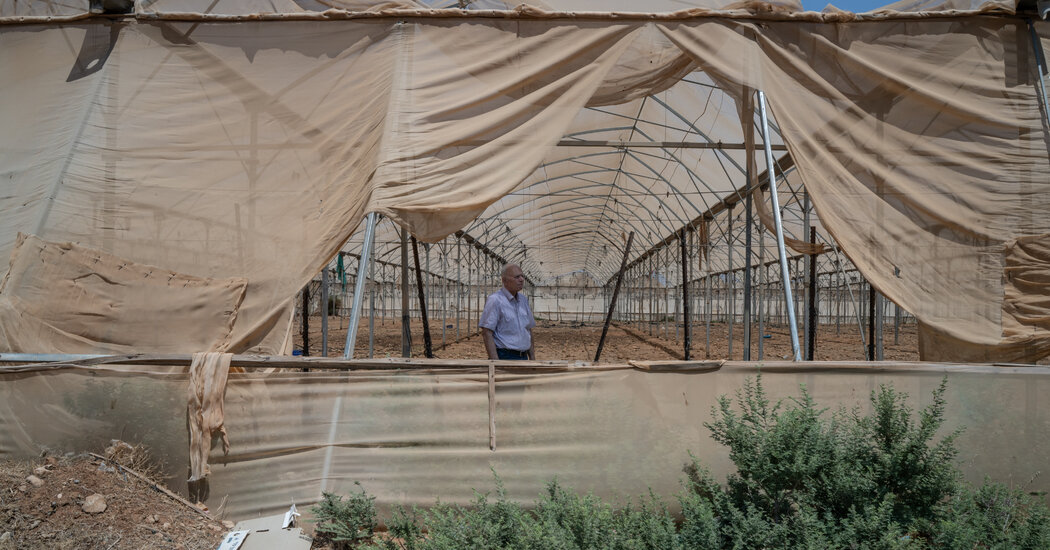
“One morning nothing came out of the pipe,” said Saad Nemer, a soft-spoken 69-year-old farmer, who owns the land the pool sits on with his siblings, and who has since watched his livelihood wither under the desert sun.
In the West Bank, where water is already limited, settlers have vandalized water and sanitation systems at least 80 times so far this year, according to United Nations data. Settlers have also built illegal outposts close to springs, and then intimidated Palestinians who come to bathe or water their livestock there.
The attacks, which often cut off entire communities from running water for days or even weeks at a time, are part of a surge of settler violence in the West Bank. Over the past three years, extremist settlers have violently driven thousands of Palestinians from their homes and set fire to cars, houses and mosques.
Mr. Nemer sought help from the Civil Administration, an Israeli military body overseeing civilian affairs for Palestinians in parts of the West Bank. In a letter to his lawyer in July, viewed by The New York Times, the administration said that the pipeline would be reconnected, but it did not respond to his demand to have the trespassers evicted from his property.
Israeli forces reconnected the pipeline and made “efforts to prevent further damage to the water line,” a military statement said, adding that a fence was erected “to prevent lawbreakers from entering the area.” The military also said that the pool was on private land and that the water diversion was “unauthorized.”
Water did flow back to Mr. Nemer’s fields — but only for a day before it was sabotaged again, he said. On a recent visit to the site, much of it remained unfenced.
“It breaks my heart to see them in our pool,” Mr. Nemer said. He added that he was worried about what would happen if he attempted to reconnect the pipe himself. “I’m afraid that if I go there they will beat me up,” he said.
Settlers from a nearby outpost refused to answer questions about the reservoir.
Some former senior Israeli generals and officials say that Israel’s right-wing government is not doing enough to stop the violence in the West Bank, aimed at ultimately driving most Palestinians out of the territory, which Israel has occupied since 1967.
Most of the people The Times spoke to at the pool said they were Israeli settlers. Many said that knowing the water came at the expense of local Palestinian farms was part of the draw.
“It’s good that this makes life here harder for the Arabs — this country belongs to the people of Israel,” said Ori, 15, a high schooler from Asael, a settlement on the southern edge of the West Bank. “This place is a lot of fun,” he added, sitting with his friends and smoking a hookah pipe.
Israeli flags lined one side of the pool, while a large metal Star of David had been erected on the other. Some Israeli lawmakers are determined to turn the reservoir into a government-run tourist spot and have named the site “Herod’s Pool,” after a Jewish king who ruled the region in the first century B.C. Experts say the pool has never been properly excavated or dated, and its origins remain unclear.
Amichay Eliyahu, Israel’s minister of heritage, said his office would dedicate a million dollars to renovating the site. In a phone interview, he said that “if need be, we could expropriate” the pool and compensate the owners.
A few miles away, Mr. Nemer pulled up old deed documents on his phone that he said showed his grandfather had bought the property, including both fields, the pool and the spring that feeds it, over a century ago.
He also had more recent documents issued by the Israeli Civil Administration that appeared to show recognition of the family’s ownership from the authorities.
Mr. Nemer said the family used to get along well with their Israeli neighbors. In the early 1970s, he and his brother excavated, cleaned and filled the reservoir, he said, welcoming both Israelis and Palestinians to swim in the pool and allowing excess water to flow downhill to irrigate their crops.
The site remained popular for over 15 years, Mr. Nemer said. But after several people drowned there, the family decided in the mid-1990s to drain it, fearing they would be held liable for further accidents.
Then, in 2024, new settlers arrived, Mr. Nemer said, adding that around that time, someone sabotaged his water system. The newcomers spoke to him aggressively, Mr. Nemer said, and one of his workers, Jamal Jarwan, said he had been assaulted that year.
Mr. Jarwan lives on the edge of the Nemers’ property, in a community of about a dozen families.
“They want to kick us out of here,” said one resident, Ayed al-Hayas, 32, referring to the settlers.
A day laborer, Mr. al-Hayas said his family relied on the water for cooking, bathing and livestock. “Without water, there is no life,” he said.