
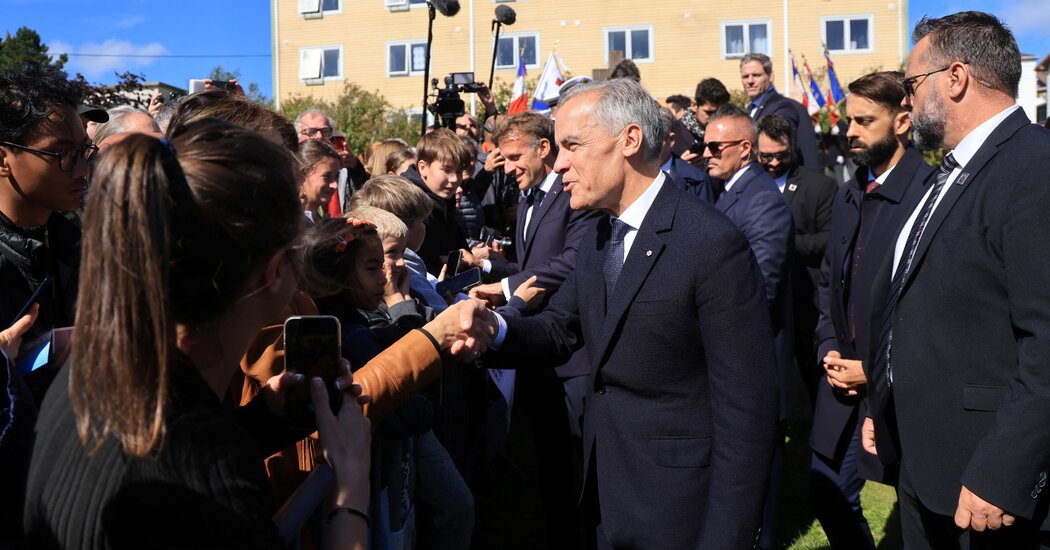
As part of Canada’s effort to knit closer ties with Europe, Prime Minister Mark Carney flew on Sunday to a French island just a ferry ride off Canada’s Newfoundland coast to meet with France’s president, Emmanuel Macron.
The brief encounter on St. Pierre, part of a speck of French territory in North America, comes before the opening of the United Nations General Assembly and days after the European Union invited Canada to become an “associate member.”
Neither leader offered any further details about that offer. (Associate membership is not a category that currently exists in the bloc.) But both men made it clear that the idea is a response to the breakdown in each’s formerly close relations with the United States, brought on by President Trump. Neither Mr. Macron nor Mr. Carney mentioned the president by name.
Instead, Mr. Macron highlighted interests that France and Canada share that the Trump administration rejects.
“We both believe that our two countries are strong, independent nations that wish to remain that way,” Mr. Macron said in a speech following a private meeting. “We both believe in democracy, in the respect for international law, and for free and fair trade, science on which rests our decisions, and of course, the strategic issues around which we work.”
Mr. Carney, for his part, said that “the time has come to tighten our ties.”
“Canada and Europe will build an alliance for the future that will strengthen our collective resilience so we can live the lives we choose, based on the values that we share across Fortune Bay,” he added, referring to the body of water that separates St. Pierre from Canada’s Newfoundland.
Last week Mr. Trump said that a closer relationship between Canada and Europe could be perceived as “a hostile act.”
Mr. Trump has expanded his trade war with Canada by imposing additional 50 percent tariffs on $20 billion of Canadian exports and by banning the entry of some Canadian products. The moves followed the collapse of trade talks between the countries. Mr. Carney has attributed the failure to unacceptable demands from the United States, while Trump administration officials blamed Canada for making last-minute demands.
The president has also continued his social media slights against Canada, including recent posts of maps that overlaid the American flag on Canada, as well as on St. Pierre and the neighboring French island of Miquelon.
In a speech to the European Union last week, Mr. Carney said that a stronger alliance with Europe would preserve Canada’s sovereignty and freedom amid a “ferocious storm.”
The only thing certain about the invitation for associate E.U. membership is that it cannot be full membership. Aside from the E.U.’s legal requirement that members must be in Europe, it would likely be impossible for Mr. Carney, or any other Canadian leader, to sell Canadians on the idea that the best way to protect their sovereignty from American aggression would be to give some of it up to Europe.
And some Europeans — as well as Mr. Carney — appear uncomfortable about using the word “member” at all to describe the new partnership.
Canada and Europe already have a free-trade agreement, so little would be likely to change there. Analysts speculate that the new relationship could align some regulations, make it easier for some people (likely students) to move between continents, or strengthen the ties of financial services across the ocean. Mr. Macron and Mr. Carney both mentioned working together on A.I.
After quickly returning to Ottawa Mr. Carney met in Ottawa with Prime Minister Jonas Gahr Store of Norway, a country with expertise on special arrangements with the E.U.
After Norwegians twice rejected joining Europe in referendums, it is now part of the European Economic Area. That leaves Norway subject to many European regulations, without having any say in how they are implemented. It also contributes money to E.U. funds intended to equalize economic and social programs throughout the continent. Norwegians can travel passport free to E.U. countries.
Afterward, the two men had little to say to reporters regarding any discussion they may have had about Canada joining Europe. Instead they focused on the growing connections between Canada and Norway, which Mr. Carney visited in March. In what Mr. Carney described as Canada’s largest military procurement in its history, his government said in July that it will buy a fleet of submarines from a Norwegian-German joint venture.
When asked by a reporter if Mr. Trump could also see a closer Norwegian-Canadian relationship as a “hostile act,” Mr. Carney said that “deeper ties between NATO allies makes those NATO allies stronger, makes NATO stronger and helps to achieve the common goals of all NATO members very much, the United States included.”