
Photo by Jack Guez / AFP via Getty Images
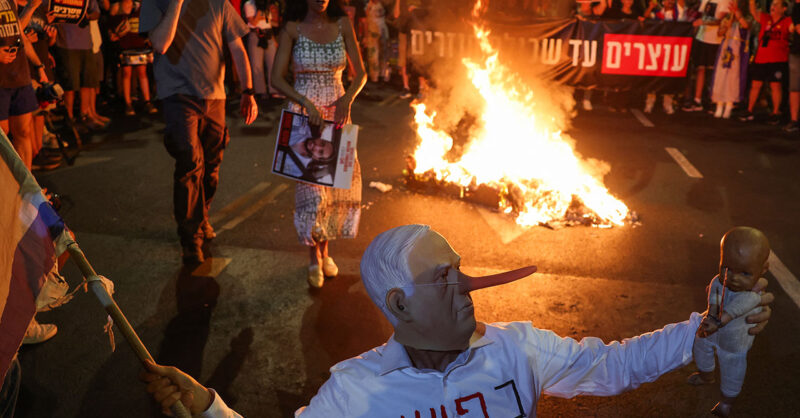
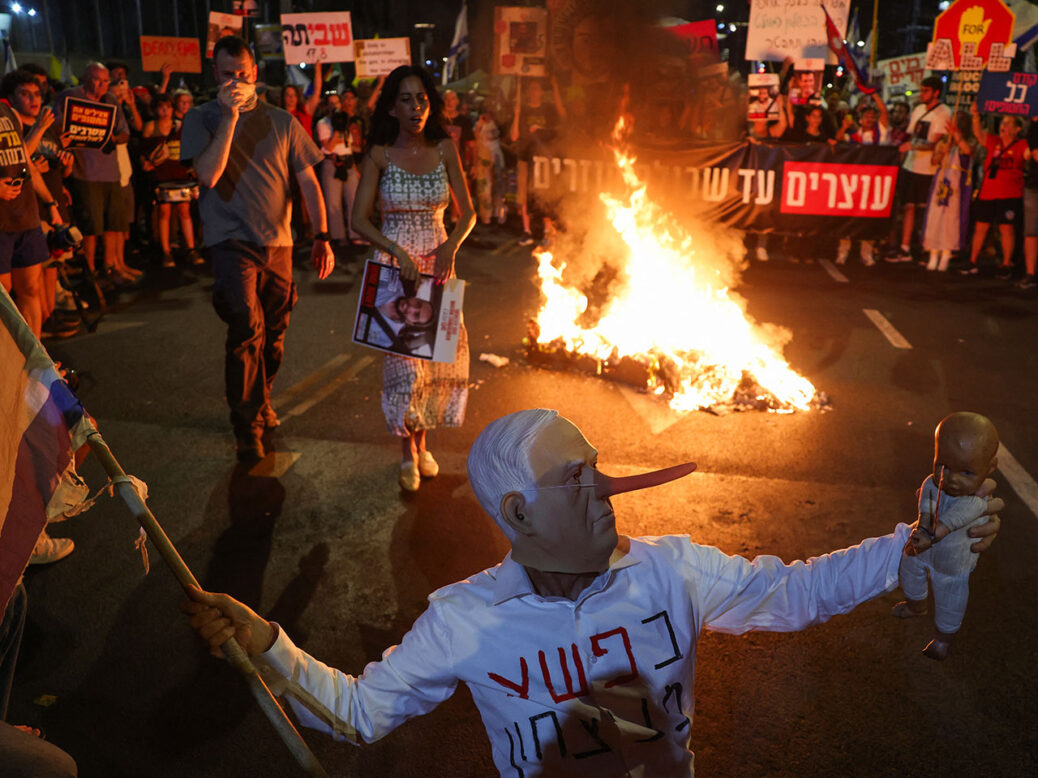
Over the weekend, Israel was roiled by a renewed wave of anti-war strikes and protests. Activists blocked main roads and surrounded the houses of right-wing politicians, dozens of private companies, local councils, universities and trade unions joined together in a general strike, and hundreds of thousands gathered in central Tel Aviv demanding an end to the war in Gaza.
Normally, the Israeli government ignores such protests. But this time, with participants hailing from a broad and varied swathe of Israeli society, its response indicated that they were taking the demonstrations seriously, as they were unusually quick to stress that the protest was toothless. “The campaign, thank God, is not gaining momentum,” wrote the finance minister, Bezalel Smotrich, on X on Sunday morning.
Whether that’s true or not, it’s clear the government isn’t preparing to halt the war anytime soon. On Monday, it was reported that Hamas had agreed to the terms of a ceasefire and hostage exchange, yet the Israeli prime minister Benjamin Netanyahu has so far refrained from accepting it. And as Smotrich and the security minister Itamar Ben-Gvir have both threatened to bring down his administration if a ceasefire is agreed, the government has instead confirmed plans to push ahead with the new offensive in Gaza City, for which is has called up 60,000 reservists. Meanwhile, settler violence in the West Bank has escalated to new heights, and Palestinian citizens of Israel are increasing fearful of their future.
Earlier this month, a meeting took place in Nazareth between senior figures from three Arab political parties – the Balad, Hadash and Ra’am. It was the first such meeting since Ra’am withdrew from the so-called joint list in 2021. The List was founded in 2015 to avoid splitting the Palestinian vote: although the Knesset, Israel’s parliament, is elected via proportional representation, parties need to reach a 3.25 per cent vote threshold to win any seats (this was increased in 2015 by the Likud/Netanyahu government from the previous threshold of 2 per cent precisely to stop Arab and leftist parties from winning representation). By banding together on a single ticket, the list ensured that even if votes for individual constituent parties failed to reach 3.25 per cent, the cumulative vote for all of parties would be more than enough to meet the threshold. Forming this pact wasn’t easy, given the huge ideological differences between the Palestinian parties within Israel: Hadash – the successor of the Communist Party – is secular and socialist; Balad is a Palestinian nationalist party that opposes the state of Israel; and Ra’am is an Islamist party.
The joint list was initially successful, reaching a peak representation of 15 seats at the 2020 election. Yet, the ideological differences within the bloc led to a split ahead of the 2021 election, with Ra’am joining the short-lived Bennett-Lapid coalition (the first time a Palestinian party had formed part of an Israeli government).
The collapse of the List was a fateful decision: at the most recent election in 2022, the disintegration of the List meant that the Arab vote was split, and Palestinian turnout fell due to the decreased likelihood of winning representation: Balad did not win enough votes to qualify for a seat in the Knesset, and Ra’am and Hadash won just five seats each. This proved crucial to the wafer-thin victory of Benjamin Netanyahu, and his return to power as head of a coalition government, featuring the far-right Religious Zionist group for the first time.
But given the events of the past two years – in Gaza, the West Bank, and within Israel itself – there is now a new urgency for Palestinian cooperation. The meeting in Nazareth was to discuss coordination ahead of next Knesset election, scheduled for October next year. The Arab leaders discussed potential cooperation with Jewish Israeli parties, as well attempts by the current Israeli government to proscribe their parties, remove their members from the Knesset, and suppress voting by Palestinian citizens of Israel.

Subscribe to The New Statesman today from only £8.99 per month
The summit also sparked an ominous reaction from Israeli far-right powerbrokers. Ben-Gvir reposted a photograph of the meeting released by the participants, and called for them to be stripped of their citizenship and forcibly removed from the country.
Following the security minister’s threats, the leader of Hadash, Aymen Odeh, told me: “Ben-Gvir is a racist, a fascist, and the ultimate representative of Netanyahu’s government. Every statement he makes is meant to fuel hatred, legitimise violence, and strengthen the campaign of demonisation against [Israeli Arabs, who are] 20 per cent of the population. His words are not only racist, but truly dangerous – because they send the public the message that the lives of Arabs are worth less. [It is he] who should be outside the democratic game – not those who demand basic rights and equality for all.”
Expelling Arab Israelis outright isn’t likely to happen. (Though many prominent Palestinians with Israeli citizenship, such as the rapper Tamer Nafar, are now publicly voicing fears about one day being deported.) However, there is a chance that parties such as Balad and Hadash could be banned from standing at the next election. The Israeli right has attempted such a move before, citing the parties’ “anti-Israeli rhetoric”, but such attempts have previously been blocked by the courts. Yet today, with the judicial system under pressure from a far-right government like never before, it could happen.
In July, an attempt to expel Aymen Odeh from the Knesset — after the politician said he was “happy for the release of hostages and prisoners” — failed by just by 17 votes, with 73 members of the Knesset (MKs) voting in favour. (Only 15 voted against it and 32 abstained.) “The attempt to remove me is a clearly anti-democratic move,” Odeh told me. “Stemming not from any offence, but from the fact that I represent a clear voice against the war, against the occupation, and against fascism. They wanted to outlaw the very idea of Jewish-Arab partnership. But I do not intend to give in: I know that a large [proportion] of the citizens – Jews and Arabs – understand that my struggle is also their struggle, for the future of all of us here.”
Although unsuccessful, the attempted impeachment of Odeh clearly indicates the mood in Israeli politics and shows that the government is willing to ban Arab parties entirely. Not coincidentally, this would have a significant impact on the outcome of the next election, given that if the Joint List had been intact at the last election, Bibi almost certainly would not have won.
Since returning to power in 2022, Netanyahu has shown that he can survive the most unpropitious circumstances and turn disaster to his advantage. He will not be able to avoid a reckoning with the electorate for much longer, whether the election takes place as scheduled next October, or even sooner due to the collapse of his coalition. Given the threat to his political career, and the criminal proceedings for charges of bribery and fraud that would resume should he fall from power, a plan to proscribe Arab parties cannot be ruled out.
“I don’t underestimate that danger,” Odeh said. “But history has proven they cannot erase us. Every such attempt only strengthens us, only makes more democratic people realise how important it is to raise our voices. No matter how much they try, we will be here, standing firm, Arabs and democratic Jews together, against the occupation, against the war of annihilation in Gaza.”
Yet the prognosis does not look promising. The events of the past two years have hardened the hearts and closed the minds of many liberal and moderate Jewish Israelis, while Netanyahu and his coalition have stayed in power all while subjugating the judiciary, firing senior military and intelligence personnel, and expanding West Bank settlements. There is a good chance that, despite Odeh’s optimism, the government will attempt successfully to proscribe the Arab parties. In this case, the future would look bleak for Palestinian Israelis, and for Israel itself.
Content from our partners