
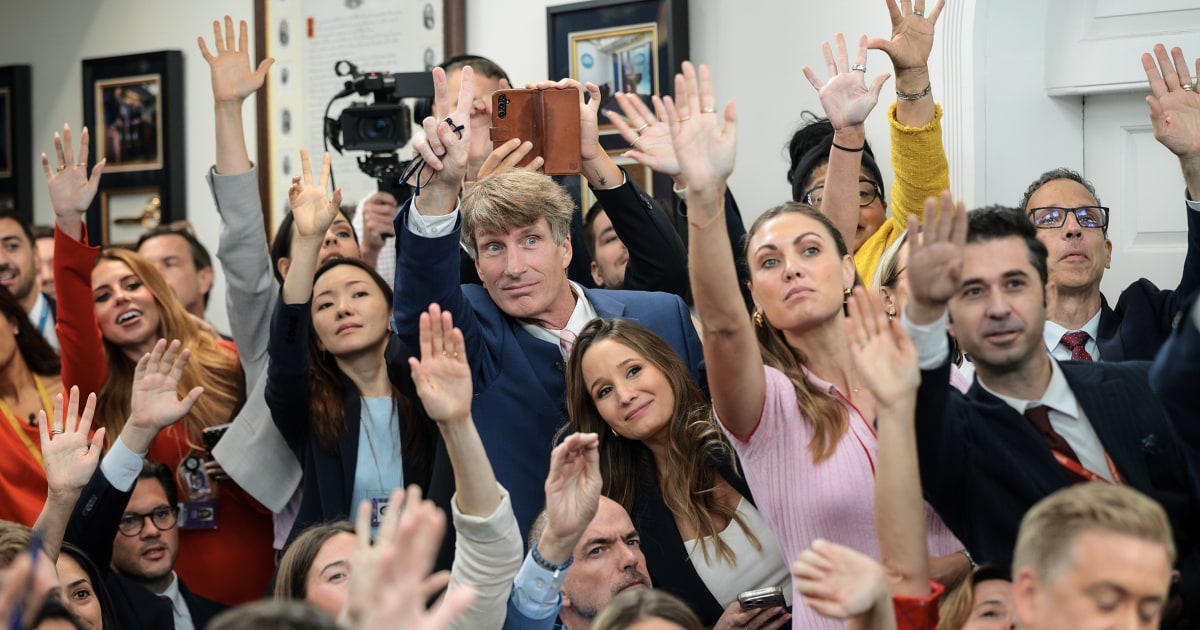
In response to President Donald Trump’s ban on certain media outlets from covering the White House, the Trump administration is now facing a lawsuit as well as a refusal by other TV networks to provide TV pool coverage of the president’s activities on Monday.
Pool coverage is when one network attends an event and then distributes information and media, such as video footage and audio, to other outlets.
Trump’s decision to ban CNN, Politico and MS NOW Friday, delivered on Truth Social, cited what he said was “their constant ‘reporting’ FAKE NEWS!”
A number of high-level White House aides were caught off guard by the announcement on Friday, according to four officials who spoke to NBC News. Trump had discussed wanting to ban specific reporters and media outlets earlier in this term but ultimately chose not to do so or was talked out of it, according to two people familiar with those discussions.
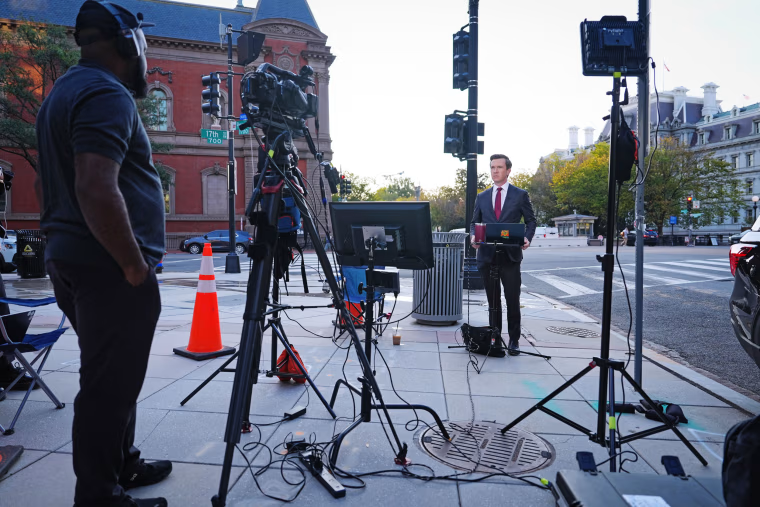 Vaughn Hillyard, White House correspondent for MS NOW, reports Monday from a corner near the White House.Mark Schiefelbein / AP
White House chief of staff Susie Wiles was not at the White House on Friday when the ban was announced, according to a person familiar with the matter, possibly contributing to some of the confusion among staff.
MS NOW reporter Akayla Gardner, CNN’s Betsy Klein and Politico’s Cheyenne Haslett were all denied access to the White House when they arrived to report on Saturday, a day after Trump announced the ban. Gardner said that an MS NOW photographer was also denied access, while one of the network’s producers was allowed onto the White House grounds. It was not immediately clear why their access differed.
Klein and Haslett both had their White House press credentials confiscated when they tried to enter the grounds on Saturday. Workspaces in the White House typically used by CNN and MS NOW sat empty Saturday.
First Amendment experts and the White House Correspondents’ Association which called the turning away of credentialed reporters unconstitutional.
First Amendment lawsuit
The lawsuit from CNN, Politico and MS NOW argues that the president’s move violated the defendants’ due process rights and First Amendment protections for newsgathering and speech.
“This ban could not be a more direct assault on the First Amendment nor a more blatant violation of our most fundamental constitutional principles,” the 27-page filing in the U.S. District Court for the District of Columbia said.
Gardner, Haslett and Klein were plaintiffs in the lawsuit in addition to their networks. Trump, Communications Director Steven Cheung, Secret Service Director Sean Curran and Wiles are the defendants.
Trump, the lawsuit added, “was expressly clear about his viewpoint discriminatory motive.”
The plaintiffs also called on U.S. District Judge Timothy Kelly, who was appointed by Trump in 2017, to issue a temporary restraining order to block the enforcement of the ban and restore reporters’ hard passes, which allow them to access White House grounds.
The three outlets said they were filing the lawsuit “to protect our First Amendment rights and defend the principle that the government does not decide what the press reports or publishes.”
“Without notice or process, the White House revoked our journalists’ credentials because it objected to our reporting,” a joint statement from the outlets continued. “Left unchallenged, this threatens press freedom and the public’s right to independent journalism free from government interference.”
Reached for comment on the lawsuit, the White House press office directed NBC News to Trump’s Truth Social post defending the move Monday morning. In the post, the president called the ban “an assault” on the news media, which he claimed is “a threat to our National Security, and must be stopped, NOW!”
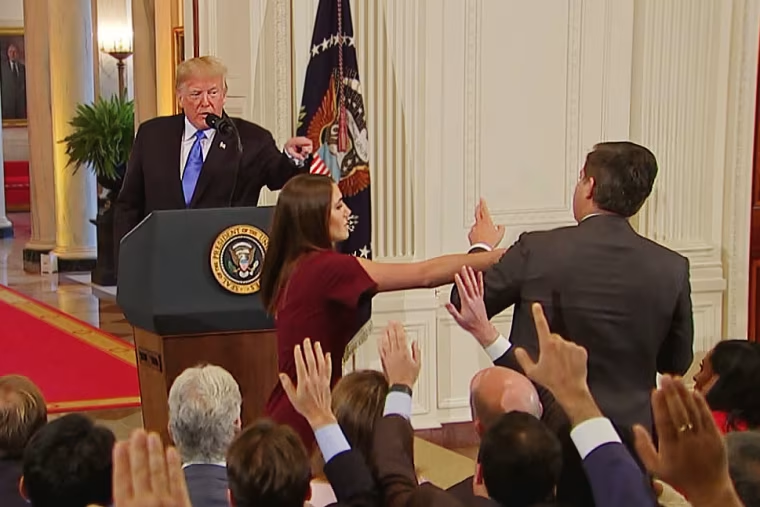 A White House staff member reaches for the microphone held by CNN’s Jim Acosta as he questions Trump in a tense 2018 press conference before the White House revoked his hard pass.NBC News file
Kelly set a Wednesday hearing to evaluate the outlets’ request, and he ordered the Trump administration to respond to the outlets’ claims by Tuesday.
In 2018, Kelly oversaw a similar case when the White House removed press credentials for CNN’s Jim Acosta, then the network’s chief White House correspondent, after a contentious press conference.
Kelly ordered the Trump administration to temporarily return Acosta’s press pass and, days later, the administration relented, and notified Acosta they’d restore his hard pass permanently.
Pool coverage suspended
CNN was scheduled to provide pool coverage of Trump on Monday, an assignment made before Trump said he would ban the network. Media outlets that are part of the pool system take turns providing the camera and crew to film the president’s events for use by journalists around the world.
But after Klein was turned away from White House grounds on Saturday, the White House issued press guidance at 10:55 p.m. ET on Sunday that omitted CNN as the assigned TV pooler for Monday.
The other networks in the TV network pool declined to step in and replace CNN’s coverage, the organizations said, meaning there will be no pooled TV coverage of the president’s activities on Monday.
“The public has a vital interest in receiving accurate, independent information about its government. No administration should restrict a news organization because it objects to its reporting,” the five members of the TV pool — NBC, ABC, CBS, CNN and Fox News — said in a joint statement in response to CNN’s ban.
Print and radio pools are still in place, and TV pools for events for other parts of the administration will continue. CNN, for example, will provide pool coverage of Secretary of State Marco Rubio on Monday.
The networks are all part of a pool system that allows outlets to share reporting and video feeds when space is limited. The system has been recognized by administrations from both parties for decades, and the coverage is used by pool members and subscribers, which includes outlets like Newsmax, One America News Network, C-SPAN and international outlets.
Individual TV networks, including NBC News, continue to provide coverage of White House events that are open to the press, outside of the pool. Outside of events, NBC News reporters continue to report on the administration’s activities.
Swift reaction
Trump has targeted others journalists and outlets he dislikes. He barred The Associated Press from the Oval Office, Air Force One and some events after it declined to call the Gulf of Mexico by Trump’s preferred name, the Gulf of America. The AP sued the administration, and the case is ongoing.
The latest ban is part of a “broader pattern” of the president’s push to hinder press access, Jameel Jaffer, director of the Knight First Amendment Institute at Columbia University, told NBC News.
“President Trump presents it as retaliation against these particular news organizations, but it’s really a move against the public’s right to know, and that’s the way that we should be thinking about it,” Jaffer said.
Administration officials and Republicans defended Trump’s move.
Vice President JD Vance defended the president, telling reporters that Trump was “not banning media outlets.” Trump’s original social media post, though, said he was “banning” the outlets. The vice president also said that Trump’s announcement meant that the administration was not providing the outlets with “special access” if they “engage in what is effectively propaganda.”
Treasury Secretary Scott Bessent said he was not in the Oval Office when the president issued the ban, but said in a CNBC interview Monday that the legacy media “equilibrium is so far out of kilter” and criticized the media for “perceived bias.”
Asked in a Sunday interview on NBC’s “Meet the Press” whether Trump’s move violates the constitution, Sen. John Barrasso, R-Wyo., said no.
“I believe the press has an obligation to report fairly,” the senator said.