
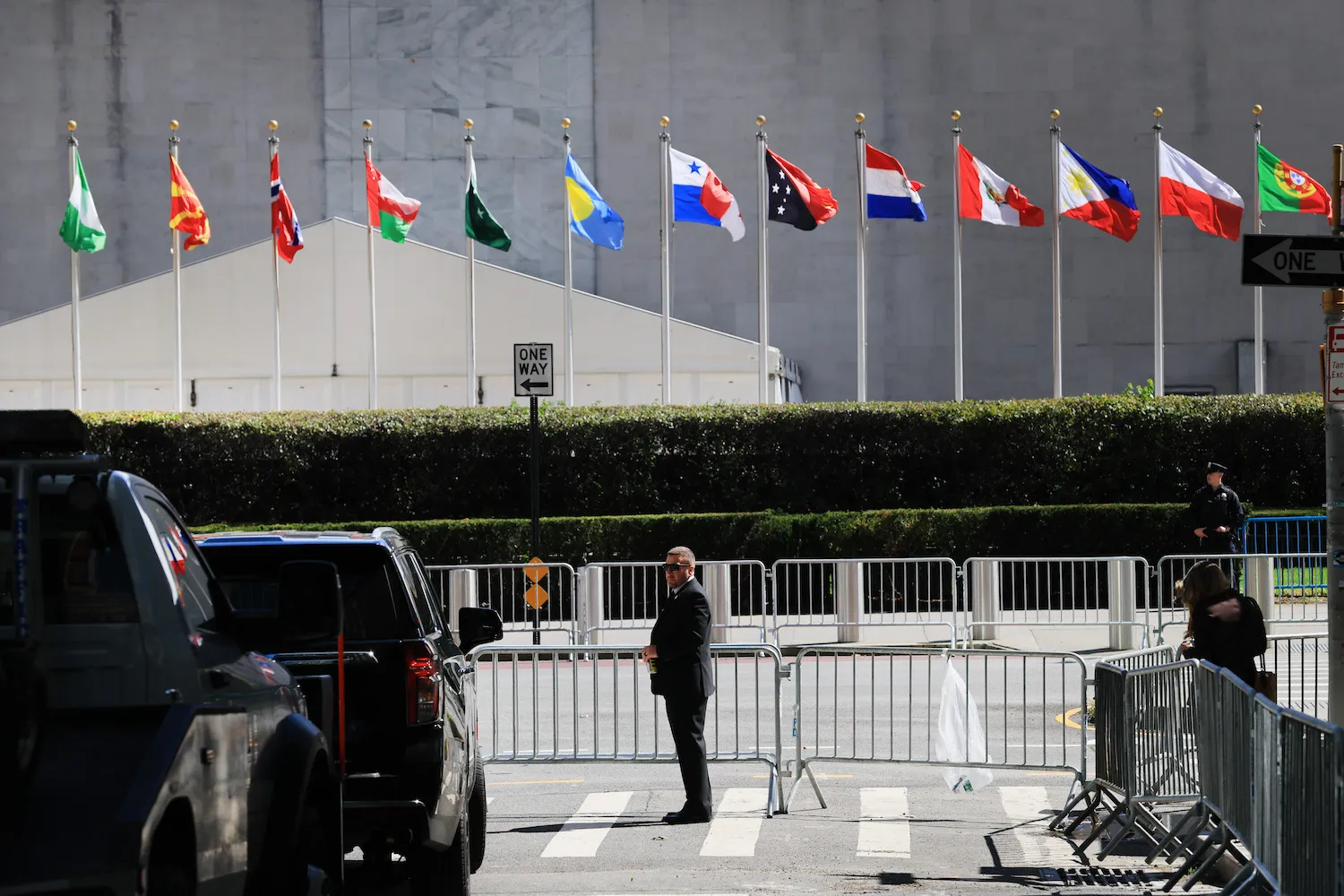
Happy Monday, and welcome to the first pop-up edition of Foreign Policy’s Situation Report, coming to you from the United Nations General Assembly (UNGA) high-level week. Your SitRep co-authors are on the ground at U.N. headquarters in New York City’s Turtle Bay neighborhood with recorders, power banks, and comfortable shoes to bring you all the updates from what is shaping up to be an action-packed week.
Here’s what we’ll be watching as leaders from dozens of countries—including, of course, U.S. President Donald Trump—descend on New York for the world’s biggest annual diplomatic gathering.
Happy Monday, and welcome to the first pop-up edition of Foreign Policy’s Situation Report, coming to you from the United Nations General Assembly (UNGA) high-level week. Your SitRep co-authors are on the ground at U.N. headquarters in New York City’s Turtle Bay neighborhood with recorders, power banks, and comfortable shoes to bring you all the updates from what is shaping up to be an action-packed week.
Here’s what we’ll be watching as leaders from dozens of countries—including, of course, U.S. President Donald Trump—descend on New York for the world’s biggest annual diplomatic gathering.
As always, much of the conversation this week will be dominated and dictated by the United States’ words and actions. Trump, who used his pulpit last year to slam the U.N. and air many of his long-standing international and domestic grievances, is set to address the gathering on Tuesday morning (with hopefully no teleprompter or escalator snafus this time).
Despite Trump’s many criticisms of the U.N., his administration gave the multilateral institution a much-needed boost last week by paying more than $800 million in pending U.S. dues, including a portion of its peacekeeping fees. While that’s a sizable amount, it still leaves Washington’s pending debt to the U.N. at more than $3 billion across the regular budget and peacekeeping functions.
The Trump administration has already pulled out of several U.N. programs, dialed back its contributions to the budget, and pushed the body to shrink its annual budget this year for the first time in the institution’s eight-decade history. “We call it having the U.N. on a diet, getting it back focused, leaner, and back to basics focused on peace and security,” a senior U.S. official said in a briefing ahead of the gathering, speaking on condition of anonymity. “Let’s do less things better.”
Still, U.S. Ambassador to the U.N. Mike Waltz told reporters that there’s “nothing else quite like UNGA,” adding that “you have presidents, prime ministers, foreign ministers, finance ministers, CEOs, diplomats from every country on Earth packed into a few square miles of Manhattan. … That concentration of people creates an extraordinary diplomatic opportunity.”
Trump’s planned meetings include new U.K. Prime Minister Andy Burnham, Japanese Prime Minister Sanae Takaichi, and a pull-aside with acting Venezuelan President Delcy Rodríguez, Waltz said, as well as a meeting with Arab Gulf Cooperation Council (GCC) leaders that is expected to focus on how to end the U.S.-Iran war. Administration officials declined to comment on whether Trump will meet with the Iranian delegation led by President Masoud Pezeshkian.
As for broader engagement with the U.N., Waltz reiterated his statement from last year that the United States has “worked to rebrand it MUNGA, or Make the U.N. Great Again.” (No word on whether there will be more hats, though.)
Sec-Gen sweepstakes. The one thing that’s different about UNGA this year is that it foreshadows the U.N.’s first leadership change in a decade. U.N. Secretary-General António Guterres will step down at the end of this year, having led the institution since 2017. The race to succeed him is now down to seven candidates after former Chilean president and U.N. human rights chief Michelle Bachelet withdrew her candidacy over the weekend via a video posted to her Instagram page, reportedly after a secret straw poll on Friday showed a lack of support.
U.N. Conference on Trade and Development Secretary-General Rebeca Grynspan of Costa Rica emerged as the front-runner in that straw poll, remaining on course to become the first woman to hold the U.N.’s top job.
For more on the challenges facing the next U.N. secretary-general, check out the FP podcast World’s Toughest Job.
AI answers. Few issues have animated the U.N. more in the past decade than the rapid rise of artificial intelligence and its potential dangers. Fears of AI’s threat to humanity hit a crescendo in recent weeks, with several executives from some of the leading AI companies advocating for a pause on advanced model development and calling for a global governance framework for the technology.
Guterres dedicated a significant portion of his final pre-UNGA press conference to discussing those fears, calling for “genuine international cooperation and a coordinated global effort” around the technology.
The big question is whether and how the United States and China—the world’s two largest economies and most dominant AI powers—will show up at the table. Trump is only spending two days in New York before rushing back to Washington on Wednesday to host Chinese President Xi Jinping for a bilateral summit. AI is expected to be high on the agenda for that meeting, with both sides discussing a new U.S.-China AI dialogue on Sunday. That has not been formalized, however, and fundamental disagreements between Washington and Beijing remain.
“I am aware of the geopolitical divides and the temptations they might generate,” Guterres said. “But the world cannot afford a race to the bottom on AI safety.”
SitRep sat down with Amandeep Singh Gill, the U.N. undersecretary-general and special envoy for digital and emerging technologies, to discuss what the U.N. can do with and without those two major powers.
The United States and China “can set the tone for the rest of the world,” said Gill, speaking on the sidelines of a “Digital Cooperation Day” that his office hosted, adding that he was “encouraged” by the focus on AI in the Trump-Xi agenda this week. “This doesn’t mean that the rest of the world has to wait for the U.S and China to do something,” Gill added. “I think that would be taking agency away from 191 other member states of the U.N., many of whom are investing in AI, are developing their own frontier models, and actually care about safety.”
SitRep’s first UNGA celebrity sighting of this year was American actor Joseph Gordon-Levitt, who was appointed as the U.N. global advocate for human-centric digital governance in March. “The decisions we make in this moment are going to have a massive impact on everyone’s lives and the whole future of humanity. I really believe that,” Gordon-Levitt told an audience at the Digital Cooperation Day. “Digital technology should be governed by people and for people.”
And while this is admittedly stretching the definition of “sighting,” John’s interview with acting World Food Program Director Carl Skau (stay tuned for more on that conversation) was apparently delayed because Skau was with the world’s biggest YouTuber, Jimmy Donaldson, aka Mr. Beast.
The opening of the general debate at the 81st session of the United Nations General Assembly kicks off.
Beginning at 9 a.m. ET, over a dozen world leaders are set to address UNGA on Tuesday, including: Brazilian President Luiz Inácio Lula da Silva, Trump, Jordanian King Abdullah II, Turkish President Recep Tayyip Erdogan, Kyrgyz President Sadyr Zhaparov, Qatari Emir Sheikh Tamim bin Hamad al-Thani, Lithuanian President Gitanas Nauseda, Peruvian President Keiko Fujimori, Chilean President José Antonio Kast, French President Emmanuel Macron, Finnish President Alexander Stubb, Grand Duke Guillaume of Luxembourg, and Angolan President Joao Lourenco.
Foreign Policy is also hosting events on the sidelines of UNGA, which you can learn more about via our events page and tune into via the livestream.
John will be in conversation with European Climate Commissioner Wopke Hoekstra and U.S. Assistant Secretary of Energy Audrey Robertson at FP’s Energy Forum on Tuesday, with other prominent speakers including Greek Environment Minister Stavros Papastavrou, U.K. Secretary of State for Energy Security Miatta Fahnbulleh, and Lithuanian Energy Minister Lukas Savickas.
At FP’s Tech and AI Forum on Tuesday afternoon, Rishi will be interviewing Singaporean Digital Minister Josephine Teo and senior executives from TikTok and Zoom. Also speaking at that event will be U.S. Undersecretary of State for Public Diplomacy Sarah Rogers (whom our colleague Sam Skove recently profiled) and Finnish Foreign Minister Elina Valtonen.
FP will also be hosting a live taping of the World’s Toughest Job podcast.
A survey of people from 37 countries published last month by the Pew Research Center reveals that more than half of them view the U.N. favorably, with the highest favorability percentages in Sweden, Indonesia, and Kenya. Israel has the highest percentage of unfavorable ratings, meanwhile, with nearly 80 percent of respondents expressing negative views of the U.N.