
Photo: WorldWideWob via Twitch
A dual tragedy occurred on the evening of September 15 in Chatsworth, a suburban neighborhood in the San Fernando Valley of Los Angeles. First, a speeding SUV slammed into an LA Metro bus, killing two of its passengers. While covering the accident live from above, NBC’s NewsChopper4 went down between two commercial buildings nearby, killing one pedestrian, helicopter pilot George Marciniw, and aerial photojournalist Eliana Moreno. Moreno was a regular fixture in households across L.A. She was among a class of beloved aerial reporters, including KCAL’s Desmond Shaw, ABC7’s Chris Cristi, and FOX 11’s Stu Mundel. In the city with the most infamous reputation for hellish traffic and high-speed police chases, these journalists are seen as local legends who have amassed their own fan bases, thanks in part to an ecosystem of livestream commentators who use their footage.
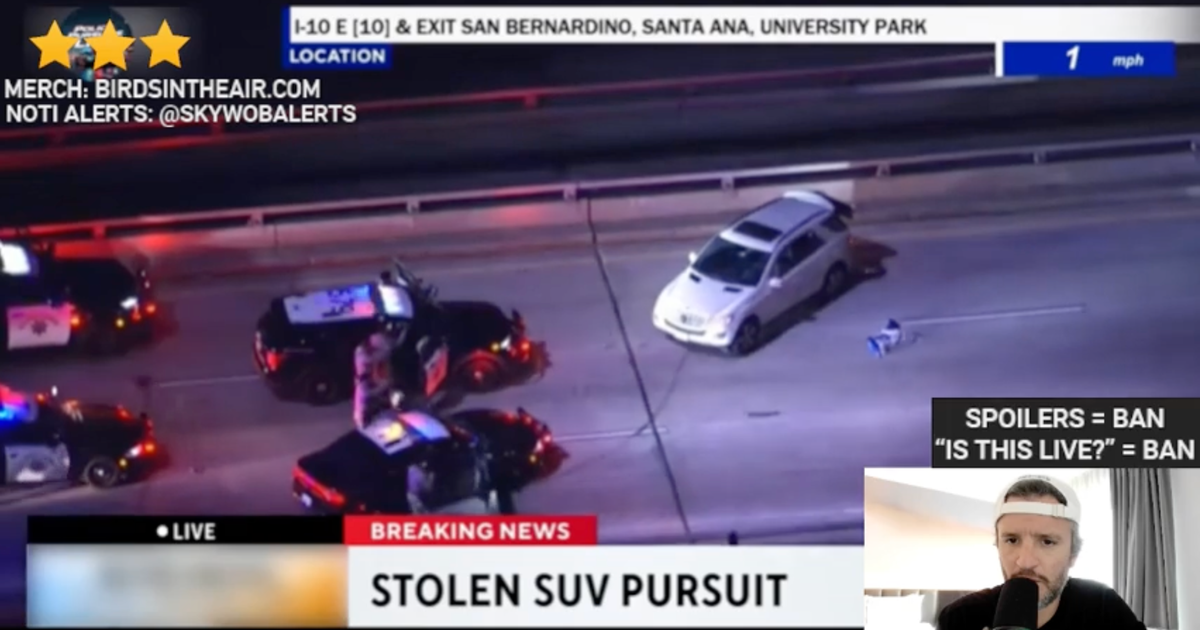
One of the most popular commentators in the genre is Rob Perez, a.k.a. @WorldWideWob, who has been streaming police pursuits for 12 years. According to Perez, his audience for police chases has even eclipsed that of his primary job as an NBA commentator. Despite the dangerous and often violent nature of its subject matter, his Twitch livestream, titled Birds in the Air, is a joyous place filled with passionate fans and long-running jokes. Whether it’s the hijacking of a golf cart, a wig falling off mid-pursuit, or a getaway operation executed so smoothly that it leaves the police standing in the street scratching their heads, Perez’s catchphrase invariably rings true: “It’s always something different.”
Moreno was a fan favorite among Birds in the Air viewers, and last week’s accident was a sobering reminder of how risky her line of work is. The day after the crash, Perez went live to make a statement. “They say time heals all wounds, but Birds in the Air will never be the same,” he said while paying his respects to “our bilingual patron saint of police chases.” In the aftermath of the tragedy, Perez reflected on Moreno’s legacy, the skill of aerial photojournalists, and both Perez and Moreno’s shared passion for this volatile, perilous, yet irresistible intersection of news, service, and entertainment.
How are you coping with last week’s events?
You feel numb to a lot of news, because I’ve watched police chases where people have been killed before, and there’s tragedy all the time if you watch enough local news. The whole reason why they were above in the helicopter to begin with is because an SUV impaled a Metro bus. People died. It was a tragedy in itself, and then this happened. So while it’s certainly devastating, it is on par with being in the grind of day-to-day news. But it is shocking for it to happen to someone who felt as invincible as Eliana. In addition to what happened to Kobe Bryant, it was triggering for a lot of Angelenos.
You don’t ever think about the people in the sky. You think about the ones on the ground that you’re watching as a part of the news. I guess it takes something like this to realize that they’re up there risking their lives every day to bring us news and entertainment. You’re just so used to hearing their voice that you feel like they’re in some protected studio inside the headquarters in Burbank, but they are up there inside a machine that is notorious for failing. You forget that they are in as risky of a position as any of the suspects that they’re covering. That’s what hits me the hardest.
An enthusiasm for watching and commentating on this type of news is something you shared with this cohort of reporters. When did you start watching car chases, and how did that pivot into streaming and commentating?
When I moved to Los Angeles in 2012, people still had cable boxes and watched local news. I’d be in my living room working, and then they’d break into KTLA or KCAL with a police chase, and I just naturally started watching it. I guess I had the idea to stream chases because I was so interested in them, so I thought my audience might find it interesting as well.
Between 2012 and 2015, we did not have the capabilities to livestream like we do today, so I’d take my phone, put it in front of the television, broadcast the chase, and just commentate on top of it. I noticed that there was an appetite for this type of content, especially from those people who don’t live in Los Angeles. It granted them the opportunity to look in on a piece of Los Angeles culture that they may not have even known existed. Then in 2015, in the first Periscope I ever did, I was making pizza rolls talking about the NBA, and I think there were 50 concurrent viewers in there. Then 50 became 150 and grew into what it is today. People didn’t even have the apps on their phones back then, but as social media grew, people got up to speed with it. I kind of ran parallel to the modern evolution of this technology.
I would say that audience has even eclipsed my full-time job, which is talking about the NBA. Most of the people followed me for the NBA and then noticed I started doing police chases. They’re like, “This shit’s awesome.” As the technology evolved, the quality of the stream increased, and the audience continued to grow.
Why do you think people like watching chases?
It’s the unknown — the possibility of anything happening. The fact that it’s live, of course. There’s this weird attraction to potential violence and knowing that you’re safeguarded from it. You get so emotionally invested that you need closure; you need to see the way that it ends. From an entertainment standpoint, people are just so enthralled by the action. It’s almost as if you’re watching the movie Speed, but it’s real life.
What is it that you’re rooting for when you’re watching a chase?
As much of an action junkie that I am personally, I am not rooting for any of these chases to end in a catastrophic T-bone in the middle of Figueroa and 7th in downtown Los Angeles where some poor person’s life has just been ruined. I think ultimately, I want an ending in which the suspects putting people’s lives at risk are arrested or detained without loss of life and with as little inconvenience as possible. But we are intrigued by this, because that’s not the way that the suspects are thinking. They’re trying to get away at any cost, and sometimes that means taking someone else with them. Their brain is not working properly, because the adrenaline is higher than it’s ever been in their lives. You really get to see their true character and what they’re willing to sacrifice to preserve themselves.
Ever since 2020 and what happened to George Floyd, there is also that aspect of seeing when that person finally pulls over and gets out of the vehicle: What’s their race, what’s their gender, and how do the cops treat them? Because this person is XYZ, they got off easy, or why are they using such force on this person? So that’s part of the closure — seeing, once the chase is over, what happens during the actual arrest. Is what I’m thinking in the back of my mind going to be reinforced by what we watch here, or is what I think just an outlier?
If I root for anyone, it’s the helicopter aerial journalists. They, in this weird way, have become like an NBA player on the Lakers. Eliana Moreno was the Kobe of police chasing. That comparison’s tough considering they both went down in a chopper, but the point is we view these aerial journalists as main characters. You’re up there with them for hours. Stu Mundel will tell you a story that lasts 30 minutes while we’re waiting for this SWAT team to show up during a standoff. You naturally get attached to someone that is inside of your household for hours at a time, multiple days a week. Between all the networks, there’s ten to 15 reputable names that police-chase watchers know and can recognize by voice. It can’t be overstated the skill level that these aerial journalists have in the city of Los Angeles. They are so good at holding the shot and transmitting the news so that it’s consumable and enjoyable. We take for granted just how good they are at their jobs. But let me tell you: Eliana stood above the rest.
I’ve seen a couple of folks die on the stream. I’m sure you’ve seen dozens. During nearly every stream, there are close calls. Tuesday’s accident was a reminder of the risks at hand for the people in the ground and in the sky during these operations. Do you have a hard time reckoning with that?
I certainly don’t enjoy showing death, gore, and tragedy. I prefer it not to happen. I’m more intrigued by the strategy that people are processing in real time — how they think they’re going to get away despite a helicopter being overhead. It’s like Grand Theft Auto in real life.
But to your question, I have often considered it, and I’ve definitely censored things in the past. There used to be a 30-second lag between the stream and the cable box, and I would always keep an eye on it in my peripheral and make sure that I wasn’t about to show someone on their phone in the middle of a crosswalk get run over and splattered. Now that I’m broadcasting on Twitch, I have a bot with a graphic onscreen as well as in the chat: “Viewer discretion is advised. Chases have the potential, if not reality, of always being violent.” This content is not made for everyone; I make this loud and clear. If you are not open to the possibility of something tragic happening, please stop watching.
I try my best to put that disclaimer out there, but at the same time, I’ve never considered taking it off of the air. If it’s not on my Twitch stream, it’s on every news channel in Los Angeles. They will show it to you practically uncensored — some more than others. So as long as it continues to be shown on the news and I’m not operating in a way that’s illegal or accessing streams that I shouldn’t be seeing, I feel it’s fair game.
There’s a whole ecosystem of content that surrounds these chases. Local news coverage, your stream, and shows like Live PD are part of this legacy that dates back to the O.J. chase, which supercharged the whole genre. Do you think that the appetite for watching these chases feeds the culture of their existence?
I would say recently the answer to that is yes, because we’ve seen what I consider a lot of clout chases where people know that they’re being watched on the news. You can see them on their phones. They’ll wave to the helicopters. Those make me feel like I could potentially be part of the problem. But there are cases where they have no clue that they’re on television, and it’s important for a reckless driver to be on the news. If I had a family member coming home from work and there’s someone doing 120 miles per hour down the shoulder of the 405, and I know my mother or my brother is on that freeway, I’m going to call them and let them know there’s a crazy person headed their way.
You can understand why they’re broadcast, and then you can also understand why we shouldn’t keep doing this. Since every chase is different, you just never know. And it’s that uncertainty that continues to draw people back.
Eliana was a fan favorite — not just of Birds in the Air but to a lot of Angelenos. What made her so good at what she did?
Her professionalism, her skill level, and being able to broadcast and commentate a chase flawlessly while keeping the camera steady, in focus, and in range while navigating the helicopter. She also had to be able to identify where they are on a map. She had to do this all at once. Plus, she did a bilingual broadcast. She would go back and forth between Telemundo and KNBC like it was nothing. Her talent in being able to speak to all of these different people was something unique. And it was in an industry that is dominated mostly by men. She made it look easy. But above all, it was her passion for doing this. You could hear and feel it through that helicopter headset every time she came on the air.
My biggest takeaway was, even when Eliana was plummeting to her death, she still held the shot of the bus that got impaled. If you watch that terrible video, she keeps it in the frame. I don’t know if that’s intentional or not, but it just speaks to her career and how she always found a way to prioritize the delivery of the news over everything else. There’s a reason why these characters in the sky are so popular and intriguing to us on the ground.
She was just so good that it was entertaining and informational, and it met every standard of what’s necessary in being an aerial journalist. She was always delivering in the moments that it was necessary. She was just such a constant, and I can admit we took that for granted until this tragedy occurred.
What’s your emotional state around going back to streaming chases?
There seems to be a consensus now, where the audience understands that there is a risk not only with the officers on the ground and the suspects who are participating in a pursuit but also the newscasters above who are bringing us this stream in the first place. And that type of feedback has inspired me to continue on. I also think it is something that Eliana would want. She was such a fan of hard news and journalism, and she would understand that the world needs to go on and the people need their updates on silly matters as well as serious matters.
I think the best way to celebrate her and honor her legacy is to always remember the contributions that she made, to not only my particular stream but the police-pursuit audience community in general, and always have her in the back of our minds as we continue on. Birds in the Air is going to continue. The stream will be a little bit more somber for a little while as we continue the grieving process, but as long as they’re on the news, I’m going to continue to stream them.
Sign up for the Vulture Daily
An entertainment newsletter for the pop-culture obsessed.
Vox Media, LLC Terms and Privacy Notice