
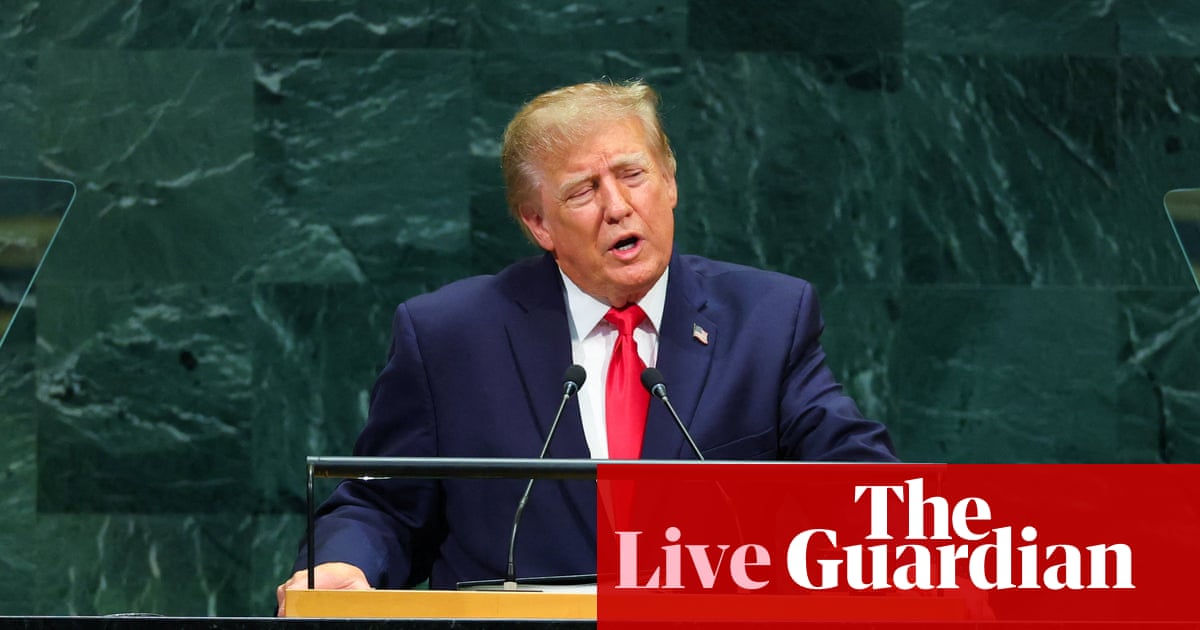
Trump’s UN remarks – in summary
Trump opened his speech to the UN by commemorating the nation’s 250th anniversary and focusing not on international issues, but touting his domestic record. Tax cuts, stock market highs, crime rates, and immigration enforcement, to name a few.
He once again framed the war he launched on Iran earlier this year with Israel the same way he has to his domestic audience — as a necessary conflict to addressing a long-ignored threat. The United States, Trump said, had acted to prevent Iran from obtaining a nuclear weapon, while other countries ignored the issue.
Trump then re-issued his threat to “annihilate” Iran and “drive them into Hell” if the regime didn’t capitulate and make a deal.” He touted his version of the war: one in which the US had defanged Iran militarily and driven the country to the brink of economic collapse. And hedged by saying he was confident Iran would make a deal after the US midterm elections – an argument he’s made to US voters.
Trump said he was “working closely with the leaders of Russia and Ukraine” to end the disastrous war. “It’s going to happen, I think, more quickly than people understand,” he said. The US president said he had signed into law “a powerful new law” on sanctions, and “if necessary, I will have to use them.” He added: “It’s time to stop the killing.”
Trump defended his administration’s actions in Latin America – including the midnight raid to arrest former Venezuelan president Nicólas Maduro, and the oil deal he struck with his more US-friendly successor, Delcy Rodriguez. “To the victor belong the spoils,” Trump declared, justifying the deal that will funnel a share of the nation’s immense oil wealth into the US treasury.
Defending his drone strikes on boats in the Caribbean and the Pacific, Trump equated the cartels he claims to be fighting with Islamist terrorist organizations. “The cartels are the ISIS of the western Hemisphere – not good people,” he said. “Like ISIS, they should be killed, exiled or detained as enemy combatants without the possibility of release, which is what we’re doing.”
He accused Mexico of being effectively controlled by the cartels, and said it was “unacceptable” for the US to share a border with a nation under such conditions. “So Mexico must reclaim control of its soil from the enemies of humanity,” Trump said.
Trump also pointed to regime change in Cuba. “My administration is also seeking a fundamental change in the situation in Cuba, where the communist regime is under great pressure, the biggest pressure they’ve ever been under,” he said. “It’s an absolutely failed state. It’s failing.”
Trump said the US has reached “an unprecedented agreement” on Greenland, with the Kingdom of Denmark. He said the deal – to be formally signed shortly after his speech – “gives the US permanent control over security and all of the needs on that territory” and that the US will build two “very major” military bases in Greenland.
Trump said he would reject any calls for a “globalist scheme” to control artificial intelligence, and made an impromptu pitch to world leaders to call the technology “super intelligence” or “SI”. Amid mounting fears over the dangers of AI as some, including leaders in the industry, call for international regulation on the technology, Trump said he would not hinder its growth. He said he believes will be “bigger than the industrial revolution,” and vowed the US would lead on AI. “We’re only going to encourage superintelligence.”
Key events
35m ago
Trump’s FBI killed corruption probe into Susan Collins’ campaign: report
2h ago
Trump strikes warm tone in meeting with UK prime minister
3h ago
Members of US delegation met Iranian leadership at UN, Trump says
3h ago
Trump endorses a US embargo on diesel exports in conversation with Zelenskyy
3h ago
Trump, Zelenskyy speak to reporters at the United Nations
3h ago
Vance, Oz announced removal of 760,000 Obamacare enrollees, alleging fraud
4h ago
Donald Trump to CNN at UN general assembly: ‘You shouldn’t be here’
5h ago
Trump praises Delcy Rodríguez, Venezuela’s interim president, before their planned meeting
5h ago
Trump hails ‘tremendous’ relationship with Denmark, Greenland as he signs Greenland deal
5h ago
Trump’s UN remarks – in summary
5h ago
Trump, Danish and Greenlandic leaders to speak at Greenland deal signing ceremony
5h ago
US will build two ‘very major’ military bases as part of new Greenland deal, Trump says
6h ago
‘Time to stop the killing’ in Ukraine, Trump says
6h ago
Trump points to goal of regime change in Cuba
6h ago
Trump on Venezuela: ‘To the victor belong the spoils’
6h ago
‘It’s going to happen … more quickly than people understand,’ Trump says on ending Russia’s invasion of Ukraine
6h ago
Trump threatens to ‘annihilate’ Iran and ‘drive them into Hell’ if regime doesn’t cave
6h ago
Trump touts actions against Iran in address to UN General Assembly
6h ago
Trump addressing world leaders at the United Nations
7h ago
Trump’s message to Putin: “settle the war”
7h ago
Head of the United Nations warns of spiraling global conflict ahead of Trump’s address
7h ago
Republican senator calls for probe into Trump Jr’s oligarch-funded wedding, crypto
8h ago
Trump on concerns about depleted US munitions: ‘It’s not true’
9h ago
Democrat says ICE blocked her oversight visit to country’s largest detention camp
9h ago
Trump seeks ‘massive’ Belarus fertiliser deal amid Canada trade war
10h ago
Trump and Mamdani appear friendly after ‘wide-ranging’ meeting at Gracie Mansion
10h ago
US TV networks suspend White House pool coverage over Trump media ban
10h ago
Trump set for UN meetings with war on agenda as speech looms
The United States is withholding a visa for Sudan’s de facto leader Abdel Fattah al-Burhan ahead of his scheduled Thursday appearance at the United Nations general assembly, Reuters reports, citing Sudanese and other sources who believe the move is tied to Burhan’s opposition to a US-backed ceasefire proposal.
“We in the Sudanese government express our deep regret because this is a violation of the UN Convention and international law,” a senior Sudanese source told Reuters, adding that Burhan had postponed his trip as he awaited official notice of the visa denial.
The country’s UN ambassador has asked UN secretary-general António Guterres to intervene. Although Burhan, Sudan’s army chief, has attended the UN general assembly before, the country is preparing to have foreign minister Mohieldin Salem stand in for him on Thursday.
In a statement, UN spokesperson Stéphane Dujarric told Reuters that Guterres is “deeply concerned that a visa has reportedly not yet been issued.”
Speaking at the sidelines of the UN general assembly, Donald Trump said his diplomatic representatives – real estate investor Steve Witkoff and the president’s son-in-law Jared Kushner – had “a very productive meeting today” with Iranian mediators.
While addressing a meeting of the Gulf Cooperation Council – a security alliance comprised of leaders from Saudi Arabia, Qatar, Kuwait, Bahrain and Oman – Trump suggested his team could reach a peace deal with Iran. Trump has claimed that the war with Iran, which began in February, would only last a few weeks.
According to Iranian state media, the country’s foreign minister Abbas Araghchi met Witkoff to discuss conditions for reopening the Strait of Hormuz.
Updated at 16.31 EDT
Trump’s FBI killed corruption probe into Susan Collins’ campaign: report
The FBI under Trump killed an anti-corruption probe into Susan Collins, the Republican senator from Maine, stemming from a convicted former defense contracting executive’s claims that he’d paid off Collins’ campaign in exchange for government contracts, ProPublica reported Tuesday.
The report by ProPublica presents evidence that Kao contributed campaign funds in return for Collins steering funds toward Kao’s company, Navatek. Kao, facing criminal charges, began sharing details on an alleged scheme with the FBI to skirt campaign finance laws to contribute to Collins’ campaign treasury, ProPublica reported.
Annie Clark, Collins’ deputy chief of staff, denied the allegations in a post to social media.
“The seven-year-old allegations made against Senator Collins and her staff in this piece are categorically false,” Clark wrote. She said that Collins’ campaign cooperated fully with the FBI, and that ProPublica was amplifying false and “outlandish” allegations Kao made while trying deflect blame for his own crimes. “There have never been any allegations of wrongdoing by the Collins for Senator campaign, and the campaign was never the target of the FBI investigation.”
ShareTrump strikes warm tone in meeting with UK prime minister Andrew Sparrow
Trump also met earlier this afternoon with the the United Kingdom’s new prime minister, Andy Burnham, with whom he appeared to enjoy a solid rapport – a divergence from his at-times testy relationship with Burnham’s predecessor in the role, Keir Starmer.
“I think he’s going to be a great prime minister,” Trump said of Burnham. “I think he’s got a lot of assets on his side.”
Trump added: “We talked about everything from Rolls-Royce to energy, immigration. We covered a lot.”
Donald Trump shakes hands with Andy Burnham during a bilateral meeting on the sidelines of the 81st United Nations General Assembly in New York on 22 September. Photograph: Brendan Smialowski/AFP/Getty Images
One point of tension in an otherwise cordial exchange: the Chagos Islands deal, a proposal by Keir Starmer’s goverment to give Mauritius sovereignty over the Chagos Islands, on condition that the US and the UK can continue to operate the Diego Garcia military base there for at least another 99 years.
“I don’t support it,” Trump said. “I think it’s a terrible deal.”
At one point the relationship between Trump and Starmer was good. But it worsened as Starmer started to criticize Trump publicly on issues like his proposal to annex Greenland, and his claim British troops avoided frontline action in Afghanistan. And the full rupture came when Keir Starmer refused to allow the US to use British airbases for attacks against Iran at the start of the war.
Updated at 15.40 EDT
Members of US delegation met Iranian leadership at UN, Trump says
During a press conference alongside Volodymyr Zelenskyy, Trump said some members of his team met today with the Iranian delegation, a meeting that he said lasted three hours and “went very well.”
Trump left the exact nature of the exchange – what was discussed, and what progress, if any, was made toward a deal – unclear, but said it was a “a very good meeting.” He then repeated his threat delivered to the assembled world leaders in an address earlier that morning that Iran had to choose between “potential greatness or obliteration.”
“They had a very good meeting, and they have another one scheduled in the near future,” Trump said, teasing future conversations with Iran.
Steve Witkoff, Trump’s special envoy to the Middle East, and Jared Kushner, his son-in-law-turned-Middle East diplomat, sat alongside the president. Both declined to share specifics of the meeting.
“I feel very good right now,” Witkoff said when asked how he felt after the initial meeting.
“How will you feel tomorrow?” a reporter pressed him.
“I think very good,” he said.
Updated at 14.15 EDT
Trump endorses a US embargo on diesel exports in conversation with Zelenskyy
President Trump appeared to support the increasingly loud calls from some members of his party to halt the export of US diesel fuel, whose skyrocketing price has begun to ripple out through the American economy and stung Republicans ahead of the upcoming midterm elections.
“I’ve called for that too, I’ve said, ‘let’s not send out the diesel’,” Trump said, when asked about the outcry from his fellow Republicans.
He then turned to Treasury Secretary Scott Bessent, sitting at his side, who said the Trump administration is evaluating the feasibility of a full or partial plan. Trump declined to share a timeline for when such a ban could come down.
The subject was raised after a reporter mentioned Ukraine’s attacks on Russian oil infrastructure, which Trump was quick to point out had damaged global diesel supplies. (The conflict between the US and Iran, which Trump launched in February alongside Israel, has also strangled global energy markets.)
“It is a serious hit on the Russians,” Trump said. “It’s also a very serious hit on the price of diesel.”
Updated at 14.01 EDT
Trump, Zelenskyy speak to reporters at the United Nations
Trump is now fielding questions from reporters alongside Volodymyr Zelenskyy, the president of Ukraine.
“I think they’re going to make a deal,” Trump said, when asked what, if anything, Ukraine would have to give up to end the war. “I think’s somethings’ going to happen.”
The Ukrainians, Trump said, were “very capable people” with – and a nod here to the man sitting beside him – “very capable leadership.”
Updated at 13.55 EDT
Vance, Oz announced removal of 760,000 Obamacare enrollees, alleging fraud
At a joint press conference on Tuesday, Vice President JD Vance and Mehmet Oz, administrator of the Centers for Medicare and Medicaid Services, announced that the federal government was removing 760,000 enrollees from Affordable Care Act insurance marketplaces.
Those 760,000 marketplace enrollees – representing 4 percent of all Americans who obtain coverage there – were allegedly receiving benefits they weren’t qualified to get, or were not real people at all, per Vance. The vice president said the action will save $2.2 billion “for the essential services for which is meant to go.”
The removals, first reported by the Wall Street Journal, were carried out by Vance’s White House task force aimed at eliminating fraud. Critics have accused that group of primarily targeting blue states.
“This is what the fraud task force is all about,” he said.
Vance said that an additional 419,000 enrollees suspected of similar violations were undergoing further review. He accused the previous Biden administration of incentivizing healthcare brokers to enroll more people in the program while inadequately vetting for fraud.
Updated at 13.36 EDT
Donald Trump to CNN at UN general assembly: ‘You shouldn’t be here’
Donald Trump told a CNN reporter at the UN general assembly on Tuesday that he was “surprised” the outlet was covering him, saying it ‘shouldn’t be here’ after he banned the network alongside Politico and MS Now from the White House on Friday.
“The United Nations allowed us in, sir,” a CNN reporter replied, when Trump began to protest the outlet’s presence.
“You should not be here covering me,” Trump shot back. “You said you weren’t gonna cover me, you shouldn’t be covering me.”
CNN, alongside MS Now and Politico, have sued the Trump administration for the White House ban, and other outlets in the president’s standard TV pool have paused their duties in solidarity.
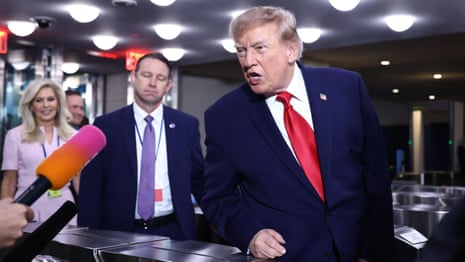 ‘You shouldn’t be here,’ Donald Trump tells CNN at UN general assembly – videoShare
Updated at 12.36 EDT
Trump praises Delcy Rodríguez, Venezuela’s interim president, before their planned meeting Tom Phillips
In his remarks to the UN earlier, Donald Trump hailed his new relationship with Nicolás Maduro’s successors in Venezuela, after the capture of the South American dictator during the US raid on 3 January.
“In January, at my direction, the United States military conducted a massive military operation penetrating deep into the Venezuelan capital, Caracas …. and arrested the outlaw dictator – a real criminal, Nicolás Maduro,” Trump said, as Venezuela’s interim leader, Delcy Rodríguez, sat listening in the audience.
Rodríguez, formerly Maduro’s vice president, has been a more pliant partner to the US in Venezuela, helping broker a lucrative deal granting the Trump administration access to the country’s immense oil wealth.
“We’re working closely with the leaders of Venezuela to forge a much better future for the Venezuelan people. Last month we signed the largest oil deal in history – covering 65 billion barrels of oil which will benefit both Venezuela and the United States enormously,” Trump added.
Trump is slated to meet personally with Rodríguez later today.
ShareTrump hails ‘tremendous’ relationship with Denmark, Greenland as he signs Greenland deal Jakub Krupa
At the Greenland deal signing ceremony, Trump said it “has been an amazing journey with tremendous people” with Danish prime minister Mette Frederiksen and Greenland’s PM Jens-Frederick Nielsen.
“We’re going to have a tremendous relationship, a secure relationship,” he said.
He thanked them for the deal, and says they will be working “very hard” on its implementation.
He said the deal has been “long in the making” – “many decades, probably centuries” – and it will be “tremendous for Europe and for the US and for everybody.”
Donald Trump, Mette Frederiksen and Jens-Frederik Nielsen attend a trilateral signing event regarding a deal on Greenland’s security. Photograph: Kylie Cooper/Reuters
Speaking next, Denmark’s Frederiksen said “This deal is good for the United States. It’s good for Greenland, for Denmark, for the Nato alliance, and therefore also good for Europe.”
Frederiksen said any adversaries “will not be allowed to get any control or significant influence in Greenland,” adding that the agreement “underlines the importance of the Nato alliance.”
In tricky, carefully worded paragraphs, she said the agreement “recognises the US defining historical and ongoing contributions to the security and defence of Greenland,” but it also “respects the sovereignty and the territorial integrity of the Kingdom of Denmark, as well as Greenland’s right to self-determination.”
“I think everybody knows that we live in difficult times where we have to show our strength. If we let ourselves be divided as allies, then we do our votes a favour. We will do everything we can to prevent that from happening.”
Then, Greenland’s Nielsen said it is “a very important day for our security” that “builds on 85 years of security cooperation” since the second world war.
He stressed that “this is not only an agreement about us, but an agreement with us” and called it “a win-win”.
“It takes into account the people of Greenland, our rights, our livelihoods and the development of our country. This has been a key priority for us throughout this process,” he said, saying this is why Greenland “insisted on engaging in a constructive dialogue.”
“Greenland matters for North American security and for transatlantic security. And this agreement reflects that we understand our responsibility and act accordingly,” he said.
He continued:
“Nato matters. We believe that it is vital to keep Nato strong, also in the Arctic, where the alliance has a key role to play.
This agreement should put to rest any doubt today and in the future about where Greenland’s loyalty lies.
Our commitment to this alliance and to the security we build together is not in question. We are, have been, and will remain a steadfast friend of the United States and a part of the western alliance. Your security is our security, and our security is your security.”
ShareTrump’s UN remarks – in summary
Trump opened his speech to the UN by commemorating the nation’s 250th anniversary and focusing not on international issues, but touting his domestic record. Tax cuts, stock market highs, crime rates, and immigration enforcement, to name a few.
He once again framed the war he launched on Iran earlier this year with Israel the same way he has to his domestic audience — as a necessary conflict to addressing a long-ignored threat. The United States, Trump said, had acted to prevent Iran from obtaining a nuclear weapon, while other countries ignored the issue.
Trump then re-issued his threat to “annihilate” Iran and “drive them into Hell” if the regime didn’t capitulate and make a deal.” He touted his version of the war: one in which the US had defanged Iran militarily and driven the country to the brink of economic collapse. And hedged by saying he was confident Iran would make a deal after the US midterm elections – an argument he’s made to US voters.
Trump said he was “working closely with the leaders of Russia and Ukraine” to end the disastrous war. “It’s going to happen, I think, more quickly than people understand,” he said. The US president said he had signed into law “a powerful new law” on sanctions, and “if necessary, I will have to use them.” He added: “It’s time to stop the killing.”
Trump defended his administration’s actions in Latin America – including the midnight raid to arrest former Venezuelan president Nicólas Maduro, and the oil deal he struck with his more US-friendly successor, Delcy Rodriguez. “To the victor belong the spoils,” Trump declared, justifying the deal that will funnel a share of the nation’s immense oil wealth into the US treasury.
Defending his drone strikes on boats in the Caribbean and the Pacific, Trump equated the cartels he claims to be fighting with Islamist terrorist organizations. “The cartels are the ISIS of the western Hemisphere – not good people,” he said. “Like ISIS, they should be killed, exiled or detained as enemy combatants without the possibility of release, which is what we’re doing.”
He accused Mexico of being effectively controlled by the cartels, and said it was “unacceptable” for the US to share a border with a nation under such conditions. “So Mexico must reclaim control of its soil from the enemies of humanity,” Trump said.
Trump also pointed to regime change in Cuba. “My administration is also seeking a fundamental change in the situation in Cuba, where the communist regime is under great pressure, the biggest pressure they’ve ever been under,” he said. “It’s an absolutely failed state. It’s failing.”
Trump said the US has reached “an unprecedented agreement” on Greenland, with the Kingdom of Denmark. He said the deal – to be formally signed shortly after his speech – “gives the US permanent control over security and all of the needs on that territory” and that the US will build two “very major” military bases in Greenland.
Trump said he would reject any calls for a “globalist scheme” to control artificial intelligence, and made an impromptu pitch to world leaders to call the technology “super intelligence” or “SI”. Amid mounting fears over the dangers of AI as some, including leaders in the industry, call for international regulation on the technology, Trump said he would not hinder its growth. He said he believes will be “bigger than the industrial revolution,” and vowed the US would lead on AI. “We’re only going to encourage superintelligence.”
ShareTrump, Danish and Greenlandic leaders to speak at Greenland deal signing ceremony
We’ll hear from Donald Trump, Denmark’s PM Mette Frederiksen and Greenland’s PM Jens-Frederick Nielsen shortly, as their (delayed) event on the Greenland deal is about to get under way.
My colleague Jakub Krupa is covering that over on our Europe live blog, and I’ll bring you all the key developments here too. You can also watch along here:
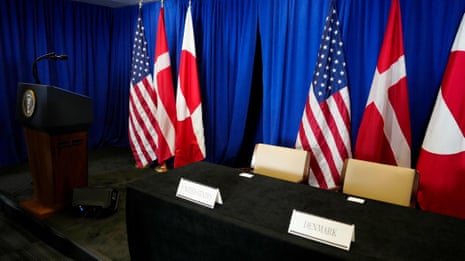 Trump along with representatives from Denmark and Greenland sign security deal – watch liveShareUS will build two ‘very major’ military bases as part of new Greenland deal, Trump saysJakub Krupa
There wasn’t much targeted criticism of Europe in Trump’s speech this year – no doubt, much to the relief of many European leaders in attendance or following from overseas.
His comments on European security (through the Greenland deal), Nato and plans to push for an end to the Russian invasion of Ukraine will likely be seen as a positive development – even if they lack any much detail.
But let’s not celebrate too early and see what he says when he appears with the Danish and Greenlandic leaders shortly.
To recap, Trump spoke about the “northern frontier”, which seems to be his new phrase for Greenland.
He said the US has reached “an unprecedented agreement” on this, with the Kingdom of Denmark, “an incredible, beautiful country.”
He said the deal – to be formally signed shortly after his speech – “gives the US permanent control over security and all of the needs on that territory.”
“We will have the complete ability to do what is necessary to defend the American continent, and also Europe and other places. No US adversary will ever be permitted to establish a military presence in Greenland any more, or make sensitive investments there without our express written approval.”
He said the US will build two “very major” military bases in Greenland.
“By expanding America’s footprint in the Arctic and North Atlantic, this deal also protects Europe in addition to America and greatly protects them.”
Updated at 11.25 EDT
Trump has concluded his address to the United Nations.
Trump said he would reject any calls for a “globalist scheme” to control artificial intelligence.
He also made an impromptu pitch to world leaders to call the technology “super intelligence,” or “SI,” rather than artificial intelligence.
This comes as mounting fears over the dangers of AI has prompted some, including leaders in the industry, to call for international regulation on the technology.”
But Trump said he would not hinder the growth of technology he believes will be “bigger than the industrial revolution,” and vowed the US would lead on AI.
“We’re only going to encourage superintelligence.”
Updated at 11.07 EDT