

A 700-year-old female skull found in a Chinese cemetery is the world’s first archaeological example of punitive nose amputation, according to a new study. The middle-aged woman survived the ruthless punishment, which may have been administered for stealing or for adultery.
“We believe this woman was a kind of cast-off after death. She was buried face-down, suggesting a discriminatory attitude,” study co-author Qian Wang, a biological anthropologist at Texas A&M University, told Live Science in an email. “Her burial, alone, in a place without her family or community, could be a decision of disapproval.”
Latest Videos FromLive Science
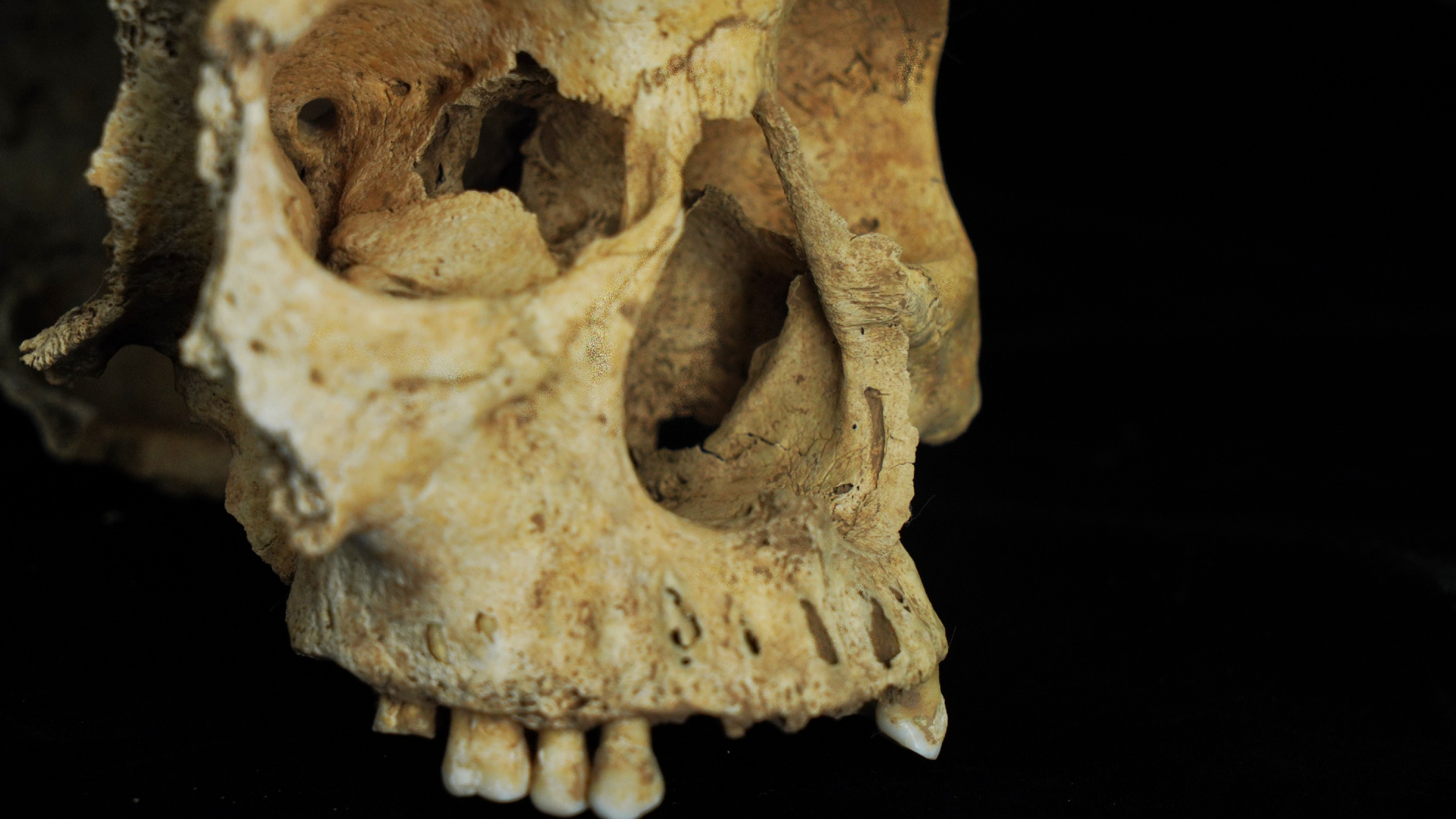
Several bones inside the nose show signs of healing, indicating that the woman lived for several years after the punishment occurred.
(Image credit: Qian Wang, Texas A&M University College of Dentistry)
You may like

Examples of the Chinese character for nasal amputation, which includes a knife on the left or right side of the nose.
(Image credit: Qian Wang, Texas A&M University College of Dentistry)
Zhou, Y., Zhang, C., Yan, F., Wang, Q. (2026). First skeletal evidence of facial mutilation as a form of punishment from ancient China (1298-1404 CE): A unique archaeological case of nasal amputation in Yuan-Ming Dynasties. Journal of Archaeological Science: Reports. https://doi.org/10.1016/j.jasrep.2026.106031