
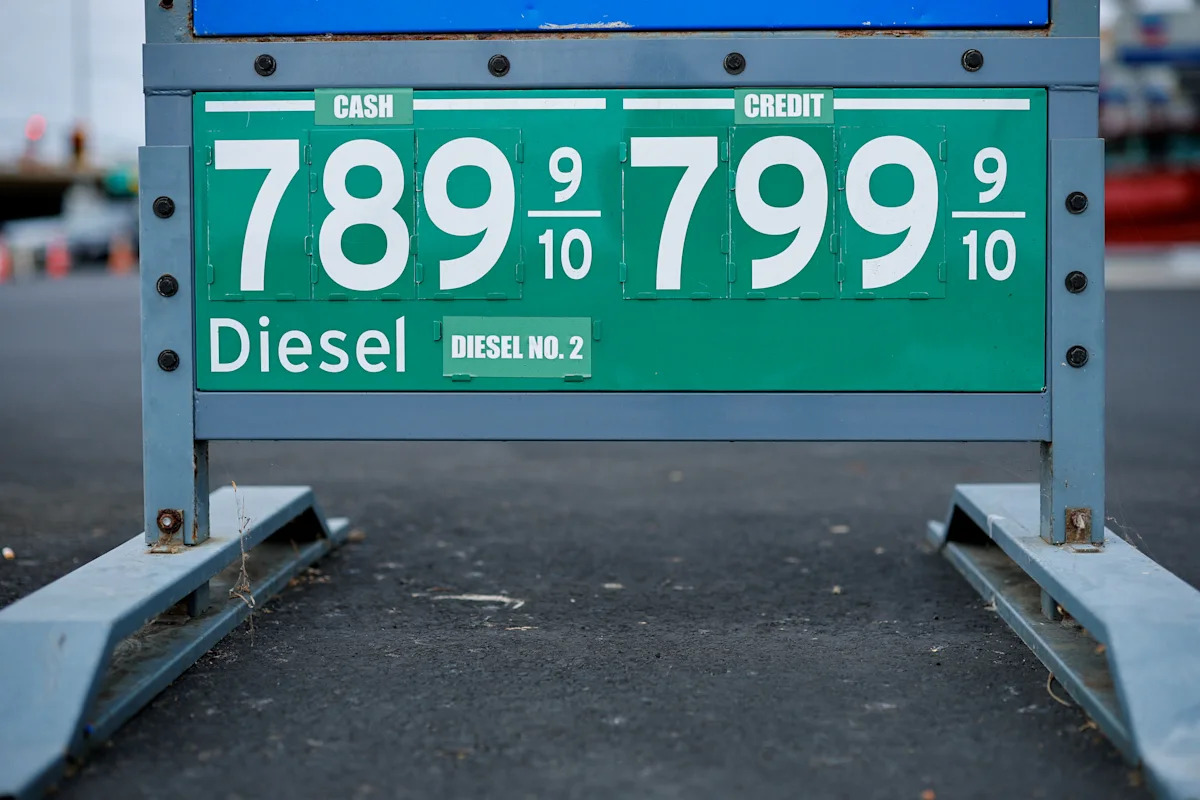
Diesel prices have surged since the start of the Iran war, putting pressure on businesses facing substantially higher costs for the workhorse fuel of the US economy.
Seeking solutions ahead of midterm elections critical for the Republican Party’s control of Congress, President Trump and the White House are reportedly preparing a 90-day diesel export ban as the administration faces increasingly loud calls from the farming lobby, Republican lawmakers on Capitol Hill, and other constituencies to get a handle on fuel prices that have reached all-time highs.
Yet doing so is likely to be much more complicated and more economically disadvantageous than the White House may be hoping, according to a growing chorus of fuel experts, economists, and market watchers — even as there appears to be little short-term prospect of an end to the Iran war.
“[Trump] does seem to want to do something to respond to calls for relief,” Tobin Marcus, head of US policy and politics at Wolfe Research, wrote to clients. Yet, “the White House is clearly aware that a ban could have unintended consequences.”
 US diesel prices have crossed all-time highs. · Yahoo Finance
The US currently produces 5.3 million barrels per day (bpd) of diesel fuel, a distillate created by refining crude oil. Roughly 3.6 million bpd of that is kept in the US to meet domestic demand for the fuel, per RSM Research data, while the remaining 1.67 million bpd is exported abroad, accounting for around 18% of the world’s diesel supply.
As of Wednesday, the White House is reportedly preparing to implement a 90-day diesel export ban, according to reporting by Politico, which would run roughly through the end of the year if implemented within the following days or the next few weeks.
The theory behind a full or partial export ban goes like this: By keeping diesel inside the country, domestic supply will rise, putting downward pressure on prices as there’s more diesel to go around. Moscow has since July enforced an export ban on diesel inside Russia in an attempt to subdue domestic prices, as the Ukrainian military’s strikes on Russian refineries have caused price hikes and shortages throughout the country.
Read more: Find the best credit cards for buying gas
While the idea could work in the US in theory, economists and oil market experts argue that such a ban could create more problems than solutions.
The first is free-market correction, Joe Brusuelas, chief economist of RSM US, wrote to clients on Wednesday. A ban intended to artificially lower distillate prices would lower revenues throughout the US energy industry, he argued. If that were to occur, he said, energy firms would likely rein in their production levels until prices reach a new equilibrium, thereby only displacing — instead of addressing — the price dynamics.
Story Continues
“The recent loose and undisciplined talk of imposing an export ban on diesel to address the growing affordability challenges is another example of what at first appears to be a good idea, but [upon] closer examination is not,” Brusuelas wrote.
 An aerial view shows the sprawling BP refinery on Sept. 8, 2026, in Whiting, Ind. (Scott Olson/Getty Images) · Scott Olson via Getty Images
The White House will also struggle to address the dislocated nature of diesel production in the US, said GasBuddy petroleum analyst Patrick de Haan.
The largest share of US diesel production occurs along Louisiana’s Gulf Coast, the heart of the US refining complex, while shortages are emerging throughout the Northeast and West Coast. With overland pipelines already operating at or near full capacity, excess fuel supplies traveling from the Gulf to the coasts must be transported by water, adding time and expense.
While the Jones Act — which requires that products moving between US ports be transported by US ships crewed by US workers, adding shipping and labor costs — has been waived by the White House since March, prices have remained at all-time highs. US diesel prices averaged $6.52 per gallon on Wednesday, per AAA.
Yet perhaps the largest problem for the administration — and the one that will be the hardest to surmount — is the global nature of oil product pricing. While the US produces a large amount of fuel, the shares allocated to domestic demand versus exports are largely determined by the prices a refiner can fetch in either market.
The abrupt slowdown in exports of distillates from the Middle East amid the Iran war, alongside a large-scale Ukrainian military campaign targeting Russia’s refining sector, removed significant capacity from the global market. Prior to Moscow’s 2022 invasion of Ukraine, Russia was responsible for roughly 10% of the world’s diesel exports.
Despite reported calls from Trump to Ukrainian President Volodymyr Zelensky to seek other targets, Ukraine’s military on Monday struck a major oil refinery in Moscow, which has now reportedly been taken offline.
As a result of those disruptions, US exports of distillate fuels such as gasoline and diesel have surged, growing by as much as 40% compared to the same period in the year prior, as exporters found buyers willing to pay higher prices abroad.
A Walmart logistics semi-trailer cargo truck is parked behind a retail facility in American Fork, Utah, on Sept. 20, 2026. (Charles-McClintock Wilson/NurPhoto via Getty Images) · NurPhoto via Getty Images
“Supplies leave because the world is paying more, not because politicians are forcing them to,” Gas Buddy’s de Haan wrote. “An export ban would shove that diesel back into a domestic market that’s already well supplied, risking refinery run cuts, while doing nothing about the global shortage that is actually the mechanism leading diesel prices to record levels.”
The US has instituted an export ban before, in the wake of the Arab oil embargo in 1973 and 1974, which sent gasoline prices soaring and forced Americans into pump station lines that could stretch for several hours. Responding to the crisis, the US Congress passed the Energy Policy and Conservation Act of 1975, directing the president to largely ban the export of domestically produced crude oil.
Yet studies by the Brookings Institution and other research firms have shown that the ban did little to ease daily price pressures for Americans and likely drove producers to cut back on their output. That law was repealed in 2015 following the US shale boom that sent domestic oil production surging.
“In an environment of rising prices, the price controls incentivized refiners to withhold gasoline and sell it later at higher prices, rather than selling it today,” said Samantha Gross, director of the Energy Security and Climate Initiative at Brookings.
A diesel ban, Rabobank global strategist Michael Every wrote, “wouldn’t be a lasting solution to higher US prices if markets operate freely in an integrated global system.”
That has left the White House in a bind: Do nothing and watch prices continue to rise as growing discontent rises among key constituencies, or institute a ban and risk triggering a market correction that may only temporarily dislocate the problem while risking longer-term damage.
Jake Conley is a breaking news reporter covering US equities for Yahoo Finance. Follow him on X at @byjakeconley or email him at jake.conley@yahooinc.com.
Click here for in-depth analysis of the latest stock market news and events moving stock prices
Read the latest financial and business news from Yahoo Finance