
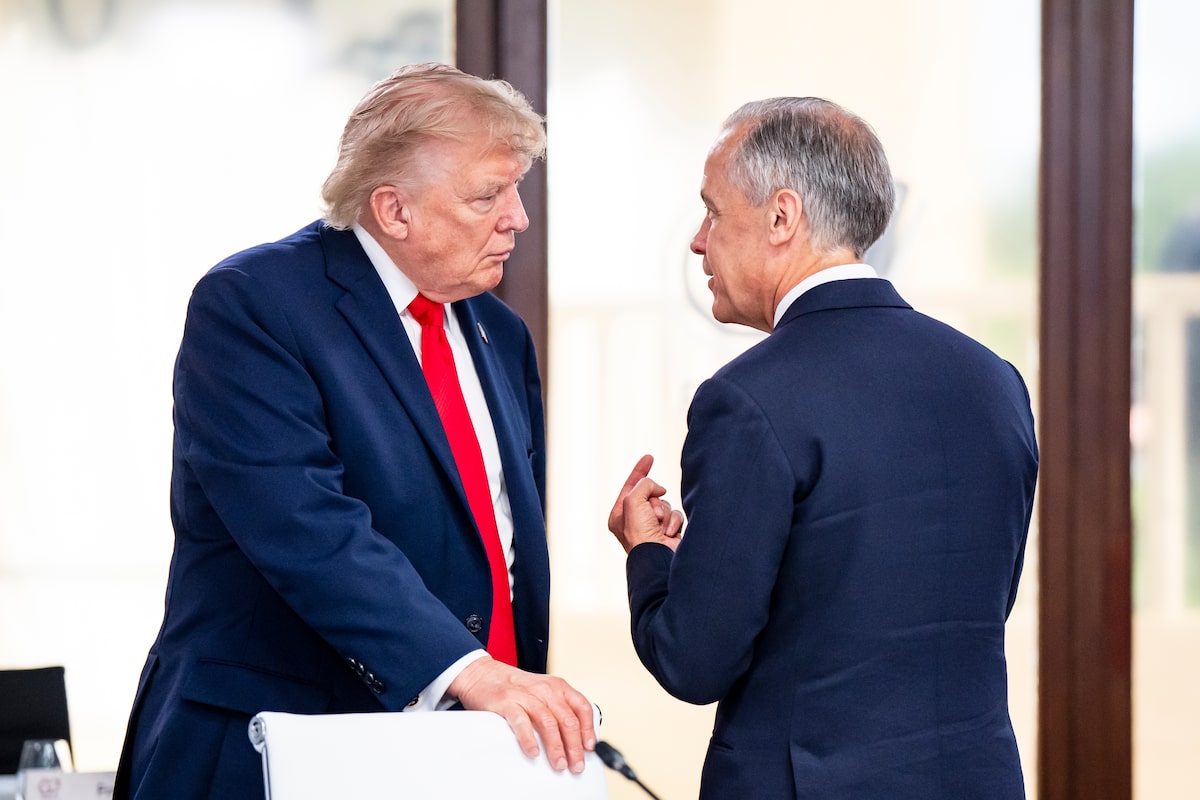
Prime Minister Mark Carney speaks with U.S. President Donald Trump at a working luncheon during the G7 summit in Evian-les-Bains, France, June 16.Christopher Katsarov/The Canadian Press
The White House says U.S. President Donald Trump has done “more than anyone” to protect Canada from threats, after Prime Minister Mark Carney’s recent comments that he has prepared for the unlikely risk of U.S. military action against Canada.
When asked by The Globe and Mail on Thursday about Mr. Carney’s comments, Anna Kelly, principal deputy press secretary at the White House, said he should be grateful for Mr. Trump’s assistance in defending Canada.
Mr. Carney told The New York Times this week, after being pressed on whether he took Mr. Trump’s threats to make Canada a 51st state seriously, “that he had carefully examined the possibility of a U.S.-led military invasion.”
The Times said the Prime Minister characterized the probability of such action by the United States as “extreme tail risk.” This is a term used in finance and risk management, and refers to a very rare event that would cause enormous damage, but is so unlikely that people tend to ignore or underestimate it.
Ms. Kelly said that Mr. Trump has, in fact, been safeguarding Canada. “President Trump has done more than anyone to protect the great people of Canada,” she said in an e-mailed statement on Thursday.
Carney prepared for risk that Trump might order military action against Canada, report says
She cited Mr. Trump’s Golden Dome project, which aims to combine all of the U.S.’s existing missile defence systems and expand them, including with interceptors in outer space, to better the threat of counterballistic, cruise and hypersonic missiles. She said the Golden Dome would “secure both countries.”
She also argued that Mr. Trump’s proposals for a trade deal with Canada amount to protections for the country.
Canada walked away from the trade-deal bargaining table with Washington in August. Mr. Carney at the time said the United States was offering a “bad deal” that “asked too much and offered too little” for this country.
Ms. Kelly said Mr. Trump offered “an extraordinarily generous trade agreement to level the playing field for American farmers and workers.” She urged Canada to sign a trade agreement with Washington: “Prime Minister Carney should thank President Trump for defending his country and make a good deal to benefit Canadian and American citizens alike.”
The Globe reported in January, citing senior government sources, that the Canadian Armed Forces have modelled a hypothetical U.S. military invasion of Canada and the country’s potential response, which includes tactics similar to those employed against Russia and later U.S.-led forces in Afghanistan.
Military models Canadian response to hypothetical American invasion
Speaking to reporters in Ottawa on Thursday, Defence Minister David McGuinty played down Canadian preparations for U.S. military action.
“It is normal. All militaries in the world spend time analyzing risk scenarios,” he said.
Asked to assess the probability of a U.S. attack, Mr. McGuinty said it is a “tail risk, as the Prime Minister said.”
Mr. Carney’s decision to discuss these preparations comes as he is locked in a costly trade war with Mr. Trump that is hurting consumers and businesses on both sides of the shared border.
The United States began collecting 50-per-cent duties on roughly $28-billion of Canadian goods on Aug. 22, and Canada matched the tariffs dollar for dollar starting after Labour Day. These retaliatory tariffs are on top of existing U.S. levies on Canadian steel, aluminum, autos and lumber that were earlier imposed by the U.S. President.
Mr. Trump, who told journalists in 2025 he would be willing to use “economic force” to coax Canada into political union with the U.S., has repeatedly referred to this country as the “51st state,” and to Mr. Carney as “governor.”
As The Globe reported in January, the two senior government officials said that in the modelled invasion, Canadian military planners expect American forces to overcome Canada’s strategic positions on land and at sea within a week, and possibly as quickly as two days.
Canada does not have the number of military personnel or the sophisticated equipment needed to fend off a conventional American attack, they said. So, the military envisions unconventional warfare, in which small groups of irregular military or armed civilians would resort to ambushes, sabotage, drone warfare or hit-and-run tactics.
With a report from Stephanie Levitz