
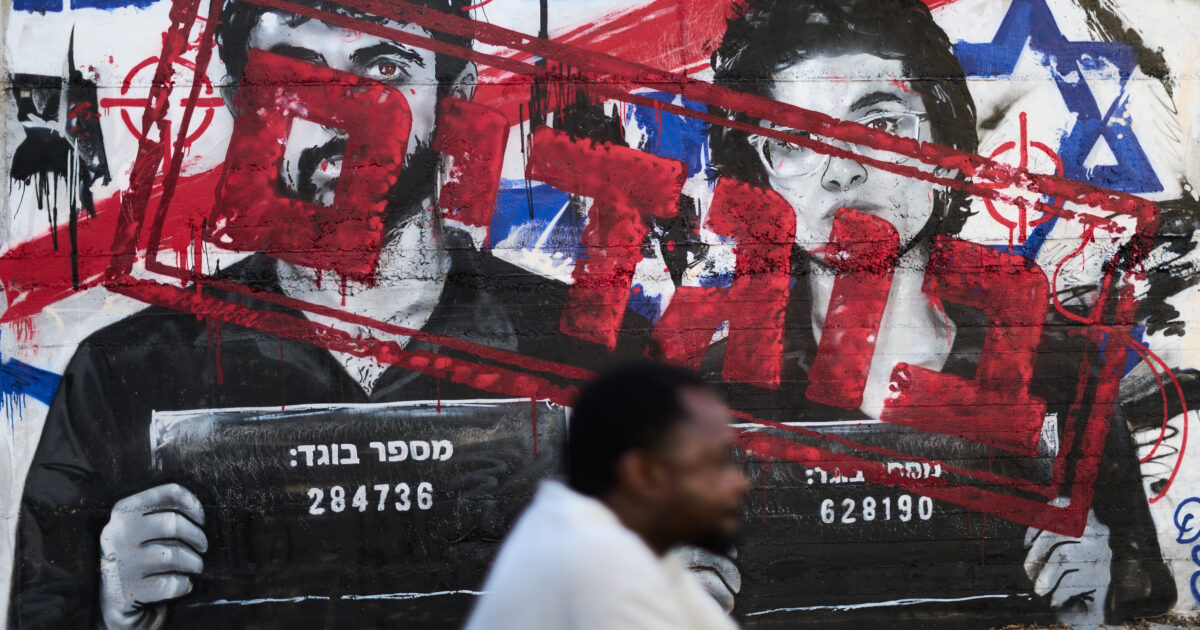
It’s obvious, after watching NAZA, the new documentary about Israel’s slaughter of civilians in Gaza, why the movie has driven the Israeli public insane—and why Israel’s prime minister is seeking to revoke the citizenship of the film’s directors, Yuval Abraham and Rachel Szor. This is a radicalizing film. It is a film that will change how Americans think not just about the Israeli government, but about Israelis themselves.
On Wednesday, the Jewish Currents news desk attended a preview screening of NAZA in downtown Manhattan. When the lights came up at the end, the theater was silent. What could you say?
There are few new factual revelations in NAZA. The reporting in the film has appeared in articles Abraham and his colleagues have published in +972 Magazine, Local Call, and The Guardian about how Israel used artificial intelligence to generate expansive target lists in Gaza, and then loosened the rules of engagement to allow for a startling number of civilian deaths in pursuit of even low-level targets. Palestinian reporters in Gaza have been documenting the destruction those policies have wrought since the start of the genocide.
What’s new is the video footage of the interviews, mostly with Israeli intelligence officers, on which the reporting was based. In silhouette, these young Jewish people explain the mechanics and the experience of committing genocide.
The film has its US premier this weekend at the New York Film Festival and will play in US theaters starting next week. Abraham announced Thursday that it will be available online for free next month. You should make sure to see it. I spoke after the screening with our news editor Natasha Soffer-Roth and Alex Kane, our senior reporter.
Josh Nathan-Kazis: I feel very shaken by the movie. I don’t know where to start.
Natasha Soffer-Roth: What really stood out to me was the extent of the information gathering they describe in the film, the vast knowledge that the Israeli military apparatus has about everything that is happening inside Gaza: who lives where, where they sleep at night, what they’re doing during the day. These Israeli soldiers are acquainted with the most intimate details of people’s lives. They’re looking at people’s family photo albums, they’re hearing them on the phone. We know Israel has been gathering this kind of information on Palestinians in Gaza and the occupied West Bank for decades. We also know that this kind of information gathering can be the ground floor of a genocide.
JNK: The soldiers talk about how in order to authorize a strike on a target’s house, they want to get confirmation that he’s home. So they listen to what’s going on in the house through the phones of the targets’ families. They talk about hearing the last moments in these homes, the kids watching TV. Before they kill everyone inside.
Alex Kane: The film absolutely debunks the entire Israeli propaganda playbook that they deployed after October 7th: We warn civilians when we’re going to strike, we don’t try to harm civilians. The entire Israeli reasoning for how moral their army was in Gaza completely falls apart. Because as the film shows, deliberate killing of civilians was baked into the army’s programs.
It’s a portrait of an army and a society that has fully descended into bloodlust, which is what a genocidal society does. This is not unique to Israel. This is what happens during a mass murder that an army is carrying out. And this is a portrait of an elite doing it.
NSR: To [your] point, Alex, about the extent to which this deconstructs so much of Israel’s propaganda around the morality of its army: I think that explains how splenetic the Israeli reaction to NAZA has been. This is an anaphylactic response. The body politic cannot absorb it.
JNK: Some of the officers try to justify their actions. One of them, when Abraham asks if he raised any objections, says: “My role is technical.” He says he wasn’t allowed to express a moral position. For the society that executed Eichmann to have these people, each of them in their own way, justifying themselves, saying they were not the decision makers, or they were technical staff, or they were building the system and not actually carrying out the killings . . .
The other piece of it that you raise, Alex, is that many in liberal Jewish communities in America like to imagine that the blame for Israel’s worst offenses falls to the settlers or working-class Mizrahim or whoever. But the point of this movie is that most of these guys, these intelligence officers, are not Orthodox. They’re not settlers. They live in Tel Aviv. They are the elite. They call themselves liberals. And as [Abraham] says in the film, they’re the ones responsible for the most Palestinian death.
AK: [It’s] not Ben-Gvir.
JNK: Not Ben-Gvir! And these guys never would have voted for him!
AK: On the argument that these soldiers are cogs in the machine, on the one hand I agree with you, Josh, that we should problematize this attempt [by these officers] to deflect. But it’s also true—I’m struggling with this point—but they are cogs.
JNK: So was Eichmann!
AK: Totally. I don’t want to live in a world in which moral responsibility of an individual becomes beside the point. But when one officer says, “If I wasn’t there, someone else would do it”—he’s totally right. Which I think is—I guess I’m struggling—what do you do? Are they to blame?
JNK: Yes! Yes, and!
I felt very angry throughout the beginning portion of this film. And then the end is devastating. The movie ends with these extended, lingering clips from Gaza. For the first hour and ten minutes, you see these guys sitting on a rooftop in Tel Aviv, describing what they did in largely technical terms. And then, in the last few minutes, the movie shows you what that meant. You see a man crying into a collapsed building, looking for his dead children . . .
NSR: It’s absolutely harrowing.
JNK: It feels like it could be a radicalizing film.
NSR: I’m reminded of an article that my friend and colleague Lisa Goldman wrote for +972 Magazine a number of years ago after some footage emerged of mista’aravim, Israeli undercover forces, who dressed up to look like they were Palestinians taking part in a protest, and then in the middle of this protest suddenly pulled their guns out and started shooting people, and they shot a Palestinian teenager directly in the leg, point blank. The Israeli army admitted that they did this, and +972 published a report about it, and the site still had floods of complaints from readers questioning whether that was what had really happened. So Lisa wrote a follow-up about this response, and the headline was, “When People Can’t Believe Their Eyes, It’s Usually Ideology.” And so it’s just a matter of, are people going to believe their eyes?
AK: They’re not, they’re not. They’re not. The people at the center of the Jewish establishment, they’re so deep in this that there’s no way that they would—are they even going to see this film? Probably not. I wish that they would.
NSR: I want to have a conversation with them about it.
JNK: I mean, I wrote Tuesday about how the rabbi at Central Synagogue in Manhattan, Angela Buchdahl, gave a Kol Nidre sermon about how she wants to “rescue the word Zionism.” It just feels so detached.
NSR: Actually, at certain points during the movie, that line from her sermon popped into my head about how in Israel, “Children order ice cream in the language of our prophets.” It’s just so, so, detached.
JNK: I don’t hear people speak Hebrew every day, but I just spent a whole day in the synagogue on Yom Kippur praying in Hebrew, and listening to people pray in Hebrew, and praying for redemption or whatever. And then, you know, to listen to these people explain their role in a genocide—
NSR: In the language of our prophets.
JNK: In the language of our prophets! It’s so jarring.
NSR: It’s something I’ve heard Israelis on the radical left struggle with. They struggle with speaking Hebrew themselves, because to them this is a language of occupation and violence and military orders, and it just feels difficult to feel the words in their mouth.
JNK: Natasha, you used to work at +972 and you’ve edited Yuval Abraham’s work. What do you make of his role? He’s really the only person you really see throughout the whole movie. Everybody else’s face is shrouded, but he’s really there, he’s squatting on the roof with them, he’s sitting, he’s talking.
AK: And he’s blunt! On the one hand I was like, obviously you worked so hard to get access to these people, and you’re pressing them so hard on camera, don’t you worry that you’re going to make them leave? On the other hand, maybe not, because they want to unburden themselves.
NSR: This is a cliché, but people are very direct in Israel. There isn’t any skirting around the subject. Even if it’s a harsh thing, people just say it. But none of that is to take away from Abraham. He has been working for years on these stories, and he’s a very skillful interviewer. He has a way of getting people to open up to him, whether they’re Palestinian or Israeli. He’s been doing very, very deep reporting up and down the region for a long time.
AK: Abraham was publishing this reporting in real time, and a number of mainstream US outlets also reported on these very same phenomena. And the Biden administration knew all of this. I’m reading Akbar Shahid Ahmed’s new book Crossing the Red Line [about the Biden administration’s enabling of the Israeli war on Gaza]. I’m guessing there were people in the administration who saw these reports and some of them were trying to run this up to the president and say, this is what we’re arming, this is what they’re doing. And instead of cutting off the flow, they did a whole song and dance about, well, the IDF should be more careful, we’re working hard to get humanitarian aid in. And just watching this film and thinking about what the White House was doing at that same time is quite chilling.
JNK: The Nazi Holocaust starts out as the obvious subtext of the film, but then at the end, one of the interviewees says something like, I went to Poland as a kid, and I didn’t understand how the Germans would do it, and now I understand. And he says: “I still believe the Nazis were evil, but what does that make me?”
AK: It feels like the movie is doing wonders in breaking this taboo of not comparing Israel to Nazi Germany. And I have long held up that taboo myself. I always thought that it was unhelpful and that it was inflammatory. And it is inflammatory. But it’s not just inflammatory.
NSR: I think that the taboo-breaking is more for the diaspora. We know that the Israeli right compares Palestinians to Nazis. But it’s also not uncommon for the Israeli left to compare the Israeli far right to Nazis.
AK: When people say “Nazis,” in the popular imagination it’s the Brownshirts, the Stormtroopers. And this is not that. And that wasn’t Nazi Germany either, right? It was also Nazi Germany’s intellectual class; the elite were complicit in the Holocaust as well.
NSR: And I think that goes back to the earlier point about watching this film and seeing how the perpetrators are characterized, and how they characterize themselves. They can’t be exceptionalized as somehow not representative of Israeli society. In fact, they’re held up as the best of Israeli society.
JNK: Is there anything else to say about this state that chose to use a computer program with a high error rate to select its targets, and then set the number of people you could kill as collateral damage at 20 in most cases, and far higher in some situations?
NSR: I mean, that’s the core of it, right? Total dehumanization. When one soldier in the film said, “We erased history,” he was talking about the fact that they would bomb buildings, set fire to others so all the memories and possessions of whoever lived there, well, they were going up in smoke as well. But it was just such a strapline for the rest of the film. Of grappling with history, and choosing to take all the wrong lessons from it.