
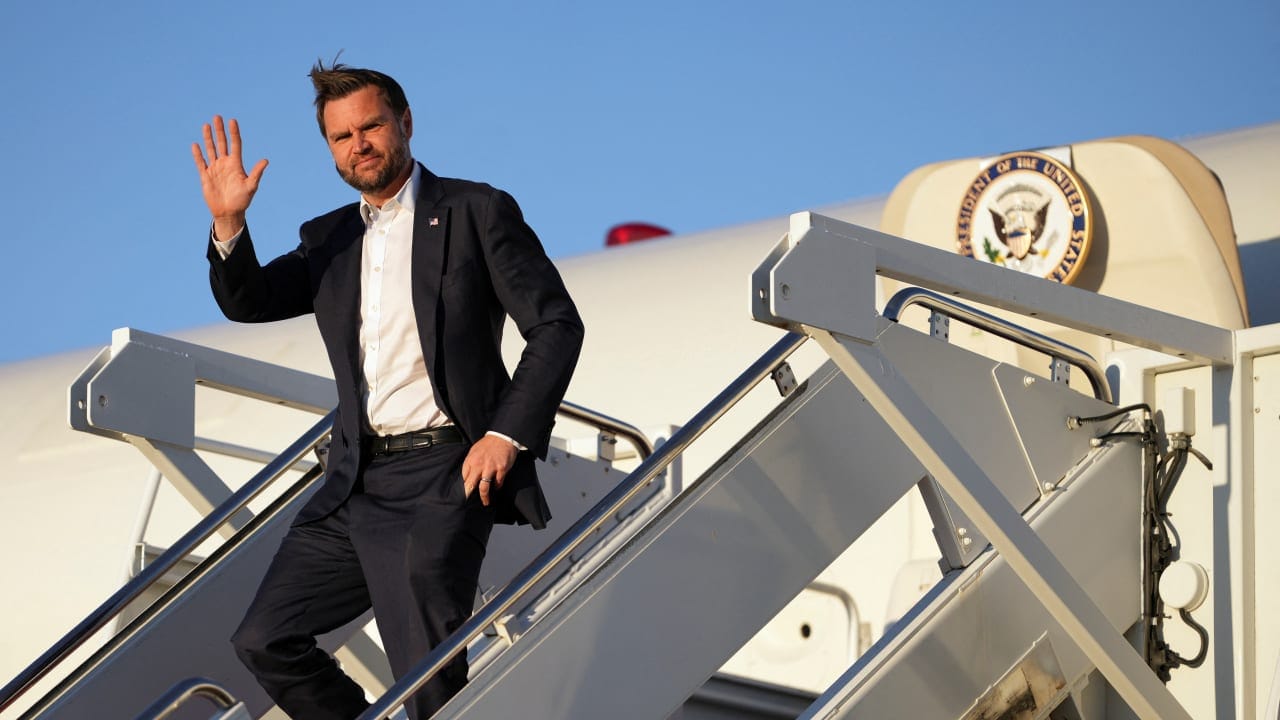
At the All-In Summit this week, US Vice President JD Vance claimed that President Donald Trump, “more than frankly any president in the last 40 years,” has shown “a willingness to actually part ways with Bibi Netanyahu” when American and Israeli interests diverge.
Never mind that Benjamin Netanyahu first became prime minister only 30 years ago. Vance was asserting that 40 years of US presidents bowed to Israeli interests and that Trump broke that pattern.
It would not be the first time this year Vance made a claim about the US-Israel relationship that does not hold up to even the slightest fact-check.
In June, around the time of the signing of the Islamabad MOU with Iran, at a White House briefing, Vance falsely claimed that members of the Israeli cabinet were “personally attacking” Trump. There is nothing of the sort on the public record.
He then added that, “Anybody in Israel who thinks their biggest problem is the president of the United States needs to wake up and smell the reality of the situation in that country.” It was a classic strawman. Is there anyone in Israel who thinks that Trump is Israel’s “biggest problem?”
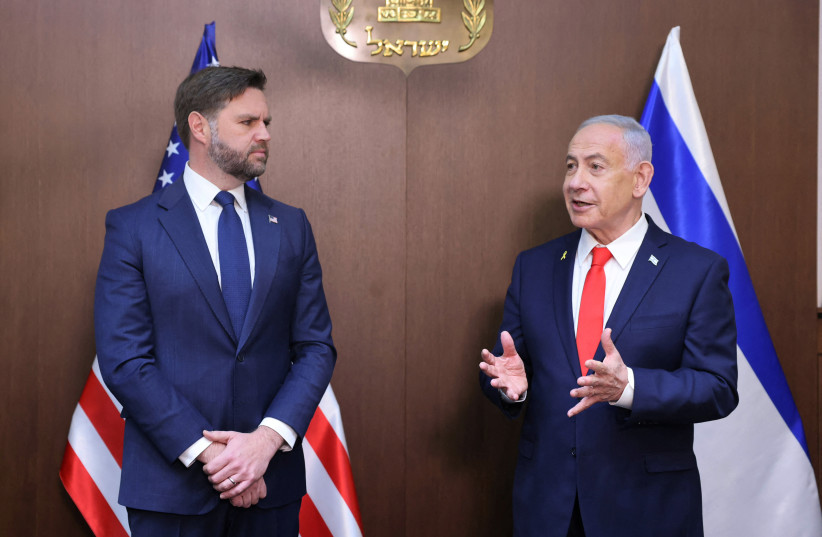 PRIME MINISTER Benjamin Netanyahu and US Vice President JD Vance meet at the Prime Minister’s Office in Jerusalem last month. US politics has transformed Israel into a volatile symbol of domestic partisan identity, the writer asserts. (credit: MARC ISRAEL SELLEM/THE JERUSALEM POST)
While not a strawman, this latest 40-year claim is a specific, checkable historical assertion that does not survive even the slightest scrutiny.
Ronald Reagan suspended delivery of F-16 fighter jets already promised to Israel after Israel’s 1981 strike on Iraq’s Osirak reactor, and did so again during the 1982 Lebanon War. He then pushed an $8.5 billion AWACS sale to Saudi Arabia through Congress over the furious objection of the Israeli government and AIPAC.
George HW Bush’s administration conditioned $10 billion in loan guarantees – money Israel needed to absorb Soviet immigrants – on a settlement freeze in 1991-92, with secretary of state James Baker publicly telling Jerusalem to call Washington “when you’re serious about peace.”
This diplomatic tension is widely credited as a factor in Yitzhak Shamir’s 1992 election loss.
George W Bush, arguably the most pro-Israel president before Trump, refused Israel’s 2008 request for bunker-buster bombs and overflight rights to strike Iran’s nuclear program. It was a direct “no” on the single policy issue Israel considered existential.
Barack Obama pursued the Iran nuclear deal over open Israeli objection, and a month before leaving office, let UN Security Council Resolution 2334 pass by abstaining rather than vetoing it. The resolution declared Israeli settlements a “flagrant violation” of international law. Every prior president had used the veto for exactly this purpose; Obama did not.
Joe Biden, in 2024, paused a shipment of 2,000-pound bombs over the planned Rafah operation and threatened to keep withholding weapons if Israel proceeded.
What Vance is likely pointing to is Trump’s public irritation over Israel’s September strike on Hamas leadership in Doha and his pressure on Netanyahu to sign the Gaza ceasefire. Perhaps he was referring to Trump’s criticism of Netanyahu on the final day of the 12-day war or a disagreement over the ceasefire of April 8 of this year.
But unlike the aforementioned list from earlier presidents, these are disagreements over tactics and timing within shared strategic goals. And it must be noted that while they were made public on Truth Social, Israel paid no real price for these policy divergences.
One thing can be said for Vance, though it does not really answer the question he raised. Aaron David Miller, a veteran State Department negotiator, has argued that Trump, in the October 2025 Gaza deal, got Netanyahu to bend in a negotiation in a way Bill Clinton and Barack Obama never managed.
Miller cited Clinton’s own exasperated line after his first Netanyahu meeting in 1996, wondering, “Who’s the [expletive] superpower here?”
Fair enough. Trump did, in fact, get Netanyahu to bend. But using that to assert that Trump uniquely pushed back on Israeli interests is absurd in light of the record of previous presidents.
Vance is either ignorant of the historical record or is deliberately misleading his audience. Either way, what is most disturbing is what his latest “40 years” comment concedes.
Vance’s incorrect premise
To call Trump the first president “willing to part ways” asserts that every other president did not, that they simply went along with whatever Israel wanted, American interests notwithstanding. Here, Vance is promoting the ahistorical premise that Israel has been quietly steering US Middle East policy for decades, with American presidents as junior partners until Trump arrived to set things right.
Vance has said as much explicitly. At a Turning Point USA event at Ole Miss in late October, a student asked him about donor Miriam Adelson’s contributions to Trump’s campaign as a driver for the administration’s pro-Israel policies.
His answer: “So when people say that Israel is somehow manipulating or controlling the president of the United States, they’re not manipulating or controlling this president of the United States.” He emphasized the word “this.”
Vance did not tell the student who asked the question that the premise that Israel controls American presidents is false. He accepted it, and merely carved Trump out as the exception.
That is the conspiratorial “America First” case against Israel in its purest form, circulated for years on the fringes of the president’s own coalition: that the tail wags the dog, that Washington’s Middle East policy has been outsourced to Jerusalem.
Vance is not arguing against that claim. He is promoting it – twice now – and insisting only that this particular president happens to be immune.
A vice president trying to defend the US-Israel relationship should be rebutting that idea, not ratifying it. In trying to praise his boss, Vance has instead told the anti-Israel conspiracy theorists that he is one of them.
The writer is the executive director of Israel365 Action and co-host of the Shoulder to Shoulder podcast.