
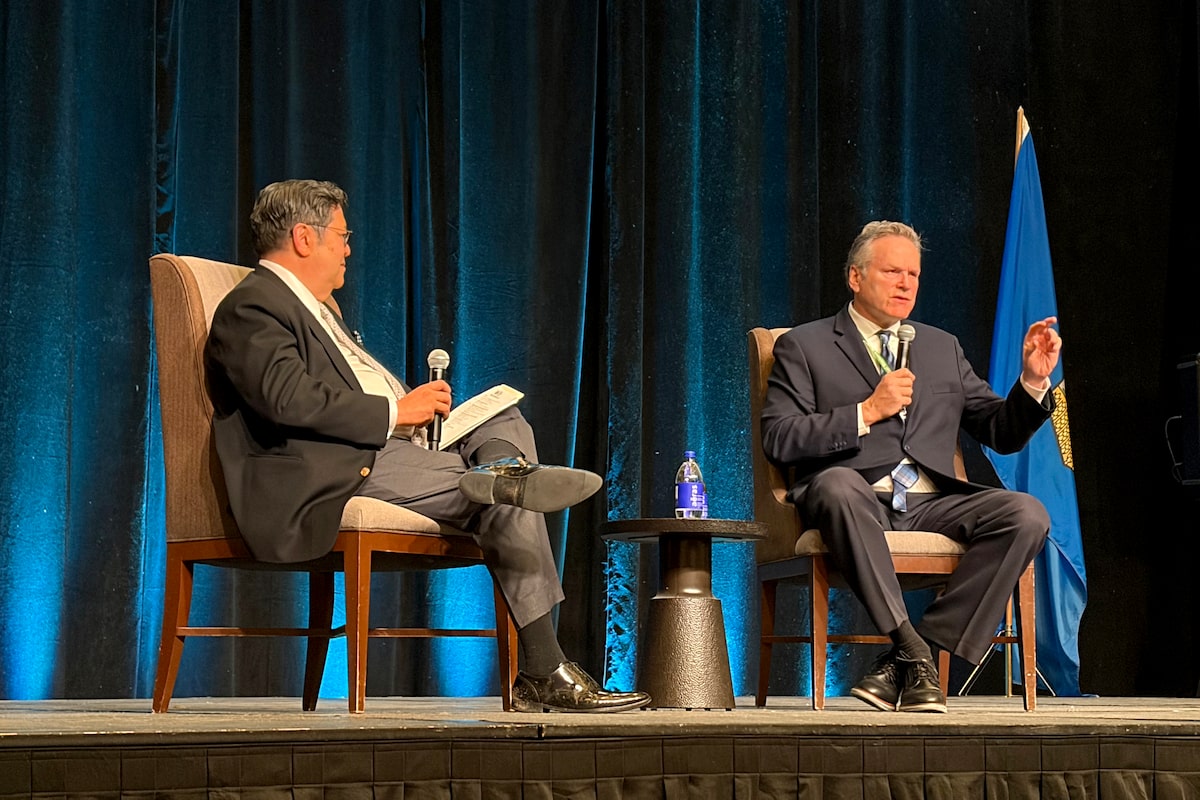
Alaska Gov. Mike Dunleavy, right, speaks on stage alongside Gary Mar, president and CEO of the Canada West Foundation, in Banff, Alta., on Friday.Lauren Krugel/The Canadian Press
Alaska’s Republican Governor, Michael Dunleavy, said he was stunned to hear that Prime Minister Mark Carney had been planning for the risk, however remote, that the United States might invade Canada.
Mr. Dunleavy, who endorsed Donald Trump for president in 2023, told a Banff, Alta., business audience Friday that military action against Canada is unthinkable to him or the average American.
Earlier this week, Mr. Carney told The New York Times, after being pressed on whether he took Mr. Trump’s threats to make Canada a 51st state seriously, “that he had carefully examined the possibility of a U.S.-led military invasion.”
The Times said the Prime Minister characterized the probability of such action by the United States as “extreme tail risk.” This is a term used in finance and risk management, and refers to a very rare event that would cause enormous damage but is so unlikely that people tend to ignore or underestimate it.
Mr. Dunleavy said the 1995 John Candy movie Canadian Bacon was the last time Americans ever thought about the idea of invading Canada.
“The idea that America would attack Canada is shocking to the average American on the ground,” the governor said. “You have to understand: Shocking. Like, I was stunned that was even contemplated.”
Trump has done ‘more than anyone’ to protect Canada, White House says
Mr. Carney has compared the current trade dispute sparked by the United States with an economic war. Mr. Trump’s tariffs are designed to persuade manufacturers to move their steel, aluminum and auto operations to the U.S. from Canada.
“You’re at war when you get attacked. We got attacked,” the Prime Minister said in August, the day after Canada walked away from trade negotiations. Mr. Carney at the time said the United States was offering a “bad deal” that “asked too much and offered too little” for this country.
Mr. Dunleavy rated the chances of a U.S. invasion as nil.
“Pennsylvania has a better chance of being invaded by West Virginia. I just want to make sure you guys understand that. There’s zero chance,” he said.
“The conversations about invasion, the conversations about any harm at all to Canada from America is so far off the radar screen.”
He said he understands that the rhetoric from Mr. Trump’s administration has caused great concern in Canada.
The President, who told journalists in 2025 that he would be willing to use “economic force” to coax Canada into political union with the U.S., has repeatedly referred to this country as the “51st state,” and to Mr. Carney as “governor” of this country.
“The disputes at the top – we see it. The average American is just saying to themself, ‘Whatever that is, we’ll get that figured out’,” Mr. Dunleavy said. “We understand, many of us, it’s more real to Canadians. We have to have, I think, a little better understanding of that, a better understanding of why there’s concerns about even discussions about potential invasion.”
Amid shifting political winds, Canada gets more of the spotlight on the UN’s stage
He said he sees Canada and the United States as brothers from the “same mother,” not adversaries, noting how close Alaska is to its neighbour.
“There’s no state that has a longer border with Canada, and there is no state that is more entwined – I mean our road to Alaska goes through Canada. We helped pay for that road,” the governor said. “We have, many transboundary agreements with British Columbia and Yukon. I was just on the phone with your Premier from Yukon. We see ourselves as one.”
He said each side helps the other during forest fires and avalanches.
“So, I think we’re going to get through this. I know we’re going to get through this.”
Jody Thomas, who served as national-security and intelligence adviser to the prime minister in Justin Trudeau’s government, played down the military planning as standard procedure.
“Canada has to look at every scenario – that’s what you expect your armed forces planners to do, and your national-security planners. You look at every potential,” Ms. Thomas said.
The Globe and Mail reported early this year, citing senior government sources, that the Canadian Armed Forces had modelled a hypothetical U.S. military invasion of Canada and the country’s potential response, which includes tactics similar to those employed against Russia and later U.S.-led forces in Afghanistan.
She said the rhetoric from the U.S. is worrisome.
“I think the threats and the language coming out of the United States are concerning, and all Canadians should be concerned about it – that trade policy as it exists today from the United States by definition weakens us,” Ms. Thomas said.
“So we have to do exactly what Prime Minister Carney and his team are doing, which is invest in ourselves, stand up for what matters for Canada, and be prepared to walk away from the table – politely, with integrity – to do what’s right for our country.”
She underlined the importance of infrastructure investment in Canada as a bulwark against economic attacks.
“The stronger we are economically, the more national infrastructure we have, the more we do ourselves, the more secure we are. And it’s for those reasons that I believe that our national security and our economic strength are inextricably linked.”