
This is a rush transcript. Copy may not be in its final form.
AMY GOODMAN: This is Democracy Now!, democracynow.org. I’m Amy Goodman. We are broadcasting from London.
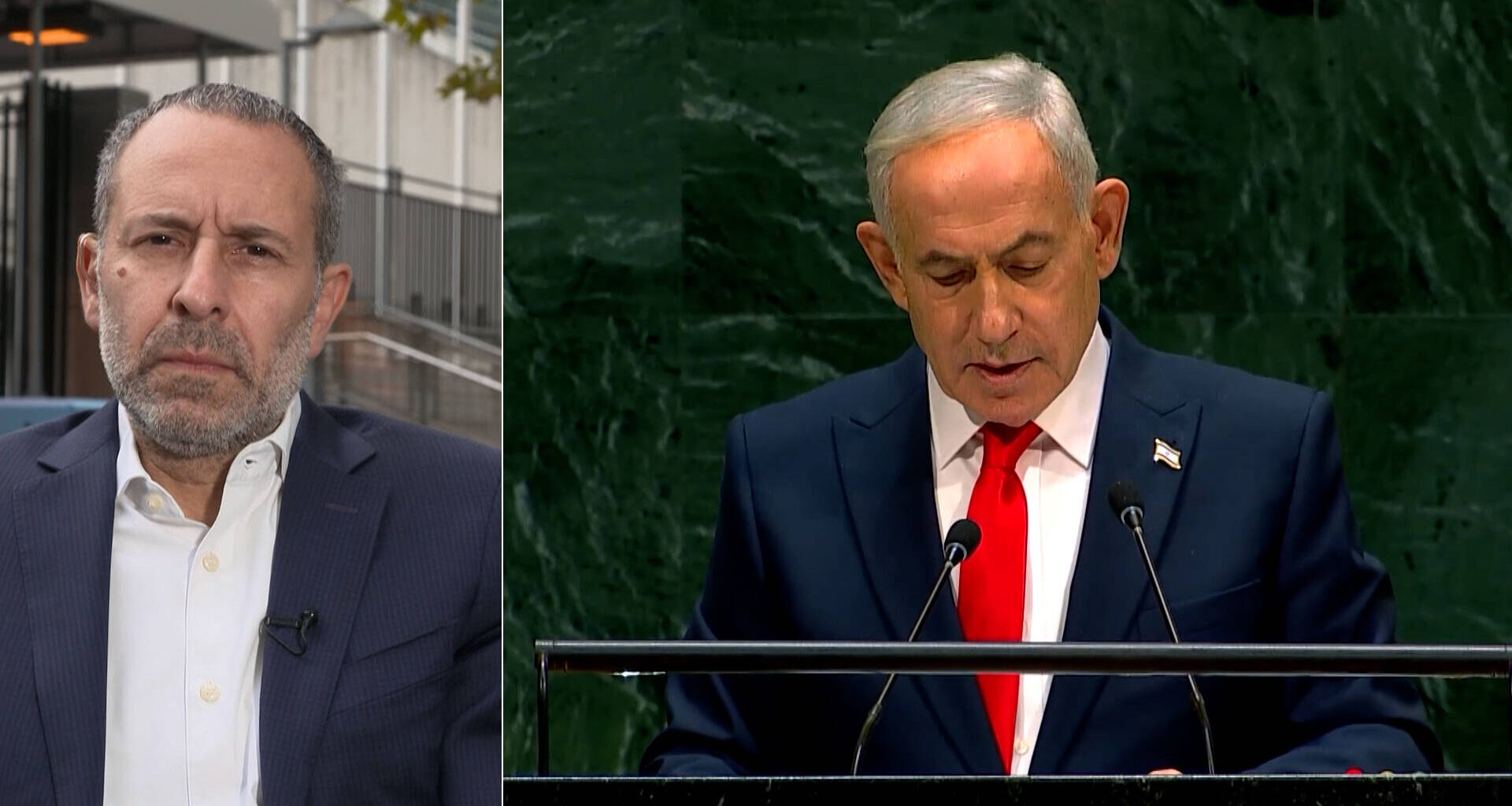
As the protest took place outside the United Nations, Israeli Prime Minister Benjamin Netanyahu delivered a defiant speech to a half-empty chamber at the United Nations General Assembly Thursday, after dozens of delegations walked out in protest at the start of his address.
Netanyahu assailed his critics as antisemites and lavished praise on President Trump for joining Israel’s strikes on Iran.
PRIME MINISTER BENJAMIN NETANYAHU: In this battle against the barbarians, we’ve had no greater partner than President Trump. I thank him. I thank him for his bold leadership. He boldly confronted an enormous danger to America, Israel and the world.
AMY GOODMAN: In his speech, Israeli Prime Minister Benjamin Netanyahu also lashed out at his critics, including New York City Mayor Zohran Mamdani.
PRIME MINISTER BENJAMIN NETANYAHU: Mr. Mamdani, you tried to stop me from coming here. You tried — you tried to silence me. Well, you can’t silence me. You can’t silence the truth. And here’s the simple truth — here’s the simple truth: Israel didn’t commit genocide; Israel prevented genocide. And that’s exactly — that’s exactly what Mr. Mamdani’s Hamas buddies would have done to us, had we not stopped them. They would have killed every last one of us.
AMY GOODMAN: For more, we go now to the United Nations, where we’re joined by Daniel Levy, president of the U.S./Middle East Project, a former Israeli peace negotiator under Israeli Prime Ministers Ehud Barak and Yitzhak Rabin.
Welcome to Democracy Now! It’s strange, Daniel, for you to be in New York and for me to be in London, where you usually are. But if you can start off by, overall, responding to Netanyahu’s address?
DANIEL LEVY: Well, this was the grotesque figure that we have become familiar with on the international stage, and we saw that in all its appalling lack of profundity yesterday here on this stage. I would say, Amy, that we understandably focus on the person of Netanyahu, but this goes so much deeper. We may not have him on the stage next year — we’ll see what happens in the Israeli elections — but the sad truth is it’s not just about Netanyahu, that human rights for Palestinians, that a change in approach in policy, that ending genocide, apartheid and occupation are not on the ballot in Israel’s election. No Zionist party is standing on a fundamentally different platform.
And perhaps it’s easy to understand why, when Netanyahu can get away with this, when Israel is treated with impunity, where you have — look, you had more leaders here talking in quite a strong way about their opposition to what Israel is doing, but that needs to be translated into action, if we’re going to see change.
There’s a meeting today here that I will be joining of the Hague Group, led by South Africa, to hold Israel accountable, to have an arms embargo so Israel can’t continue these crimes, to stop complicity of states in Israel’s illegal occupation, illegal settlements. But unless you see those measures, I don’t think we’re going to see change.
And, of course, it’s unsurprising that Netanyahu should offer the kinds of words he did, when just a couple of days previously the president of the United States stood there and talked about annihilating Iran, and when elsewhere in the building you’ve had equally grotesque presentations by Kushner, Blair, the guy they’ve appointed as governor of Gaza, Mladenov, who have been offering us these slideshows of how you’re going to privatize construction projects in Gaza, when the daily suffering, killing, prevention of desperately needed supplies for Palestinians, the continued occupation of Israel there, that’s all ongoing.
So, what I’m saying is, yes, the grotesque person of Netanyahu, but let’s also understand why he can get away with it. It’s the impunity that so many are complicit in.
AMY GOODMAN: In his speech in the United Nations General Assembly, Netanyahu downplayed violent settlers in the West Bank as “young juvenile delinquents.” This is what he said.
PRIME MINISTER BENJAMIN NETANYAHU: They try to murder us, thousands of attempts per year on families, peaceful families driving along the roads. They shoot at pregnant women. They shoot entire families. Of course, none of this is covered in the international press or in the social media. None of it. None of it. What they cover is a handful of young juvenile delinquents, about 150 in number, who go — who throw stones, who chop down olive trees. Occasionally they do — they fire up. They lit some fires. I can’t stand that. I won’t stand for vigilantism. We’re a country of law. So we put our Shin Bet on them.
AMY GOODMAN: Daniel Levy, can you respond to what Netanyahu is — how he is describing the settlers on the West Bank?
DANIEL LEVY: Well, it’s very on brand for him to take this to its most extreme place by calling this a handful of juvenile delinquents. But actually, Netanyahu here is more closely aligned with many who talk about this as if the problem is settler violence. And here we have to understand that, yes, there is an issue there, but there is no such thing as a settler militia, as a settler, as a settlement, without the state of Israel. The problem is not a few, as he calls them, juvenile delinquents. The problem is the policy of the state and the government that he leads and that for decades has confiscated Palestinian land, displaced Palestinian people, built these settlers, armed the settlers, put the military in, prevented Palestinians from moving freely, connected these settlements to infrastructure, to water, to sewage. So this isn’t about a few juvenile delinquents, and it’s also not a broader question of settler violence. This is the policy of the government of Israel.
And shortly after that, if I may, Amy, he then turned not only — look, this was a domestic election broadcast in many respects, OK? Israel is in an election. It was — it was primetime TV. But he then turned beyond the Israeli electorate, and he turned to Jews around the world. And this is really important, because he said Jews should be proud of what Israel is doing. And you know what?
AMY GOODMAN: On —
DANIEL LEVY: We are seeing increasingly — can I — can I finish the thought? Carry on, Amy. Sorry.
AMY GOODMAN: Yes. No, no, go ahead.
DANIEL LEVY: Sure. I just want us to acknowledge here that there is nothing in what Israel is doing for Jewish people to feel proud of. That’s not a Jewish ethic. That’s not a Jewish value. And that is why, whether it’s Jewish Voice for Peace and others — and you were just referencing their demonstration — that is why there is an ever-growing and more significant cohort of Jewish people saying, “Do not claim to speak in our name. What you are doing is a blip in Jewish history. And actually, what you told us yesterday, and what you proved to us, is that the Zionist project, as you have lived it out, is not only a moral failure, but it is a practical failure,” because Netanyahu kept repeating, “We will win. We have no choice” — permanent war. You do have a choice. You can end occupation, apartheid and genocide. And Jews around the world, whether New York or anywhere else, have a choice not to align with those policies.
And that’s why you see that more Jews are aligned with the mayor of New York, who Netanyahu gave a tirade against. And we saw Mayor Mamdani with his dignity and his profound humanity with his video of planting an olive tree with Palestinian family. More Jews align with Mayor Mamdani than they do with that grotesque character and the policies that he represents, Netanyahu.
AMY GOODMAN: I wanted to go to the U.N. Secretary-General António Guterres, who said Israeli actions in the occupied West Bank raise the specter of ethnic cleansing.
SECRETARY-GENERAL ANTÓNIO GUTERRES: Violence, displacement and settlement expansion by Israel in the occupied West Bank are bulldozing the path to peace and raising the specter of ethnic cleansing. We cannot allow the two-state solution to disappear before our eyes.
AMY GOODMAN: The significance of the U.N. secretary-general saying this in addressing the U.N. General Assembly?
DANIEL LEVY: Look, we should be focused on the fact that under international law, everything we’re seeing there is a violation. You have U.N. independent commissions of inquiries that have made the designation that this is ethnic cleansing. We have that inquiry and elsewhere that has made the designation that these are — these are violations of the Genocide Convention. South Africa has a case at the International Court of Justice. Israel is already in violations of provisional measures that were issued to avoid genocidal crimes, and Israel has not done any of that.
And so, the crucial thing is to translate those words, whether it’s the words of Guterres, whether it’s the words of many of Israel’s allies in the West when they took to this podium, whether it’s the words of so many leaders in the Global South, that said that if you can’t uphold international law on this case, then the edifice, the structure of international legality is going to collapse. We have to translate that from words at the podium of the United Nations to policies which impose an arms embargo, which end the complicity in funding and financing Israel’s illegal settlements, for instance. Every Israeli bank is involved up to their eyeballs in investments, in loans, in mortgages, and you have to disentangle that from the international financial system. It will only happen if there’s more pressure, like the people out on the streets yesterday, like what we saw, by the way, in the U.K., where I normally am, where you are now, Amy, where after years of public pressure, you see a U.K. government that is beginning to move in significant ways in that direction. And that’s what’s going to change things; unfortunately, not more empty rhetoric here.
AMY GOODMAN: And talking about grassroots actions, the mayor of New York, Mayor Zohran Mamdani, planted olive trees at Gracie Mansion, planted them alongside Palestinian families from Gaza who had lost loved ones. Your final comments, Daniel Levy?
DANIEL LEVY: I think that is precisely the kind of dignified, responsible, peace-loving approach that should be taken and that should stand in contrast to what the Israeli prime minister offered us yesterday. And, you know, he’s shown that you can do that. You can have that olive tree planting at Gracie Mansion, and you can have the fantastic, very moving video that he released on the Jewish New Year, on Rosh Hashanah. You can straddle those divides if you believe in the universality of humanity rather than in the narrow warmongering of an ethnosupremacist state led by Prime Minister Netanyahu.
AMY GOODMAN: Daniel Levy, I want to thank you for being with us, president of the U.S./Middle East Project, former Israeli peace negotiator under two Israeli prime ministers, Ehud Barak and Yitzhak Rabin.
Coming up, Varsha Gandikota, executive secretary of the Hague Group, now sitting outside the United Nations. Stay with us.
[break]
AMY GOODMAN: Voices of protesters yesterday outside the U.N. protesting Israeli Prime Minister Benjamin Netanyahu.