
President Donald Trump‘s undeclared war against Iran is damaging America in many ways – including the precarious rise in our national debt, higher interest costs, sharp prices increases for food and gas, and the uncertainty the war creates for our states’ National Guard. The Pentagon is taking nurses, firefighters and police officers from our communities for an undetermined time to serve in overseas combat.
When the president orders the National Guard into combat without congressional authorization, governors have a responsibility to act to protect their guard units and uphold Article I, Section 8, of the U.S. Constitution, which clearly assigns war-making powers to Congress.
We are urging all states to pass the versions of the Defend the Guard Act, which would prohibit governors from releasing their states’ guard units into unauthorized combat.
Currently, according to a number of U.S. senators, members of the National Guard are experiencing extended deployments for the Iran war without knowing when they can return home to their families. Overall, the Pentagon has deployed guard units from about 25% of U.S. states (Arkansas, Connecticut, Louisiana, Mississippi, Nevada, New Hampshire, Ohio, Tennessee, Vermont, Virginia, Washington and Wisconsin).
For some guard members, this has meant back-to-back deployments following participation in regime-change operations in Venezuela.
Trump wastes billions deploying National Guard troops to DC | Opinion
Communities need National Guard close to home
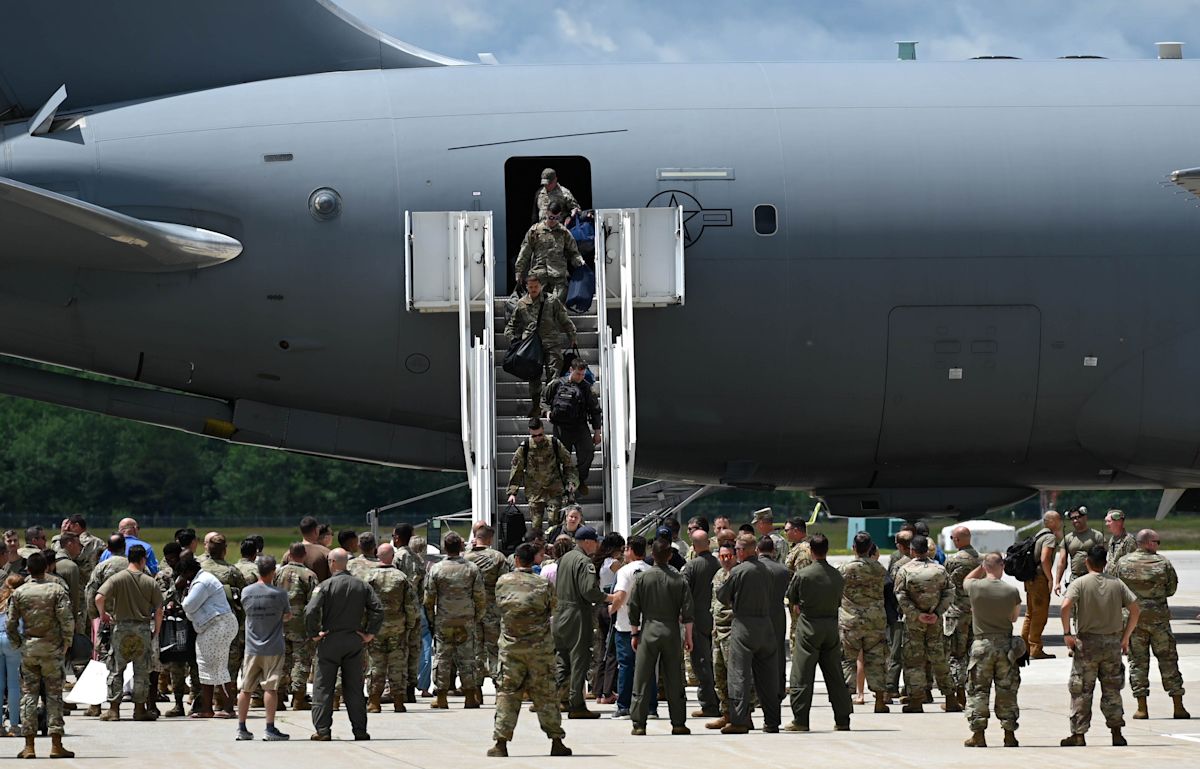
Airmen from the 157th Air Refueling Wing stationed at Pease Air National Guard Base in Newington, New Hampshire returned home after being deployed in late February 2026 to support “Operation Epic Fury,” the start of the war in Iran.
When guard units are fighting overseas, they are unavailable to address the needs of the people in their home states. A powerful example of this was when Hurricane Katrina struck the U.S. gulf coast in 2005, and many Louisiana National Guard personnel were unavailable because they had been mobilized and shipped to the war in Iraq. The results were catastrophic.
Now, two decades later, the Trump administration is wasting both financial and human resources on a continuing war that was never approved by Congress. The real tragedy is that guard members are risking their lives because of presidential overreach.
Those guard members should be back in their states, doing their civilian jobs and staying prepared for the next disaster.
Trump isn’t sending in National Guard to make us safer. It’s to intimidate us. | Opinion
States can push back against federal overreach
Defend the Guard legislation is gaining momentum with an unusual coalition that has been formed in more than 30 states and with success in the New Hampshire House of Representatives, Virginia House of Delegates, Arizona Senate and Idaho Senate.
While the state bills have yet to be signed into law, they have drawn support from a wide array of organizations including some chapters of the American Legion, the American Civil Liberties Union and several state Republican Party affiliates.
There is a history of governors refusing overseas deployments. In the 1980s, a bipartisan group of governors, including Rudy Perpich and Madeleine Kunin from our states of Minnesota and Vermont, withheld, or threatened to withhold, consent for the release of their states’ National Guard for military training during the Central America crisis.
Congress subsequently eliminated the gubernatorial veto over training missions overseas. This was reinforced by a unanimous Supreme Court decision, Perpich v. Department of Defense, which tailored its opinion narrowly around training missions, knowing that combat operations are already addressed under Article I, Section 8 and the requirement for a declaration of war.
Opinion alerts: Get columns from your favorite columnists + expert analysis on top issues, delivered straight to your device through the USA TODAY app. Don’t have the app? Download it for free from your app store.
The war powers resolution most recently failed narrowly in the Senate, 49-50, during a Sept. 24 vote. Both the U.S. House and Senate have previously approved war powers resolutions to cease hostilities against Iran, which have drawn public support, but have failed to bring the war to an end. Congress must take more decisive action.
States, with the passage of Defend the Guard legislation, will be able to prohibit the National Guard from being deployed for unauthorized combat.
This legislation is designed to preserve the constitutional allocation of power when the federal government fails to do so. Ultimately, states must prevent the abuse of power, and Defend the Guard gives them the necessary tools.
Howard Dean is the former Democratic governor of Vermont and former chair of the Democratic National Committee. Arne Carlson is the former Republican governor of Minnesota. Isaac Evans-Frantz is the director of Action Corps.
You can read diverse opinions from our USA TODAY columnists and other writers on the Opinion front page, on X, formerly Twitter, @usatodayopinion and in our Opinion newsletter.
This article originally appeared on USA TODAY: Trump doesn’t have the right to send National Guard to Iran | Opinion