

Listen to this article
Estimated 4 minutes
The audio version of this article is generated by AI-based technology. Mispronunciations can occur. We are working with our partners to continually review and improve the results.
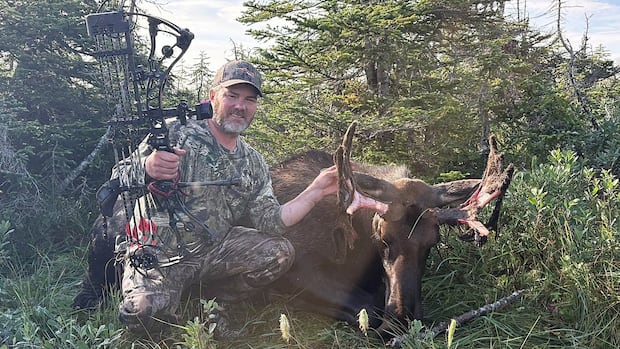
Jason House has harvested 23 bull moose during his 33 years as a hunter, with several of those animals sporting quite impressive headgear — and all taken by bow.
The 52-year-old from Daniel’s Harbour on Newfoundland’s Northern Peninsula comes from a long line of avid big game hunters. He hunts bulls and only bulls, even when in possession of an either-sex licence, as he was earlier this season in Harbour Deep, Moose Management Area 3, where he arrowed what he thought was a respectable seven-pointer.
Imagine his surprise though, when he turned the animal on its back and part-way through the paunching process discovered “it had no male parts.”
House was working from the neck down with his knife when he noticed the animal’s nipples were quite long.
He glanced back at the antlers that were shedding velvet, “and I said, ‘What the hell is going on here?’ Then I noticed that his other stuff was missing. I said to my son, Colby, ‘Look at this,’ and he said, ‘Wow, it’s a cow!’”
Sightings ‘extremely rare’
The first question that comes to mind, of course, is just how unusual is this.
It was put to the province’s Department of Forestry, Agriculture and Lands.
“Sightings of this nature are extremely rare,” said a department official, adding, “Since 2004 there has only been one recorded observation of what appeared to be a female moose with antlers in the province.”
As to what may have happened, the official noted biologists in both the department and in other jurisdictions have studied the phenomenon and raise two possible causes.
“Rare endocrine disorder, ovarian dysfunction, or elevated testosterone may cause a female moose to grow small, sometimes misshapen antlers that may retain their velvet,” said the official.
“Occasionally, due to accident, a male moose may be castrated but still grow antlers. These antlers may grow normally or may be deformed or misshapen.”
The department hasn’t received an official report of this moose, so biologists have yet to examine the animal. The Wildlife Division says it welcomes reports from residents or hunters who have observed similar situations and encourages them to share information by emailing WildlifeSightings@gov.nl.ca.
At just over 100 pounds per quarter, this moose wasn’t the largest of House’s career by any means, but it was “certainly the most interesting,” he chuckled.
Besides its antlers, what led him to believe all along that it was a bull, “was that it came for the calls and tree scraping.”
They had seen and were trying to close the ground on five animals far in the distance one evening, but as darkness was closing in, the animals disappeared into the forest.
“We spotted him/her around six the next morning and we got to her around seven …She slowly worked toward us as we scraped and made a few calls, but in the meantime, a small bull and a cow came in pretty fast from up over a ridge.”
“I don’t shoot cows,” House said. “I have nothing against people taking cows and I even hunt with people who do. It’s just my personal preference. The cow/bull that I did get kinda had us fooled though.”
Download our free CBC News app to sign up for push alerts for CBC Newfoundland and Labrador. Sign up for our daily headlines newsletter here . Click here to visit our landing page .