
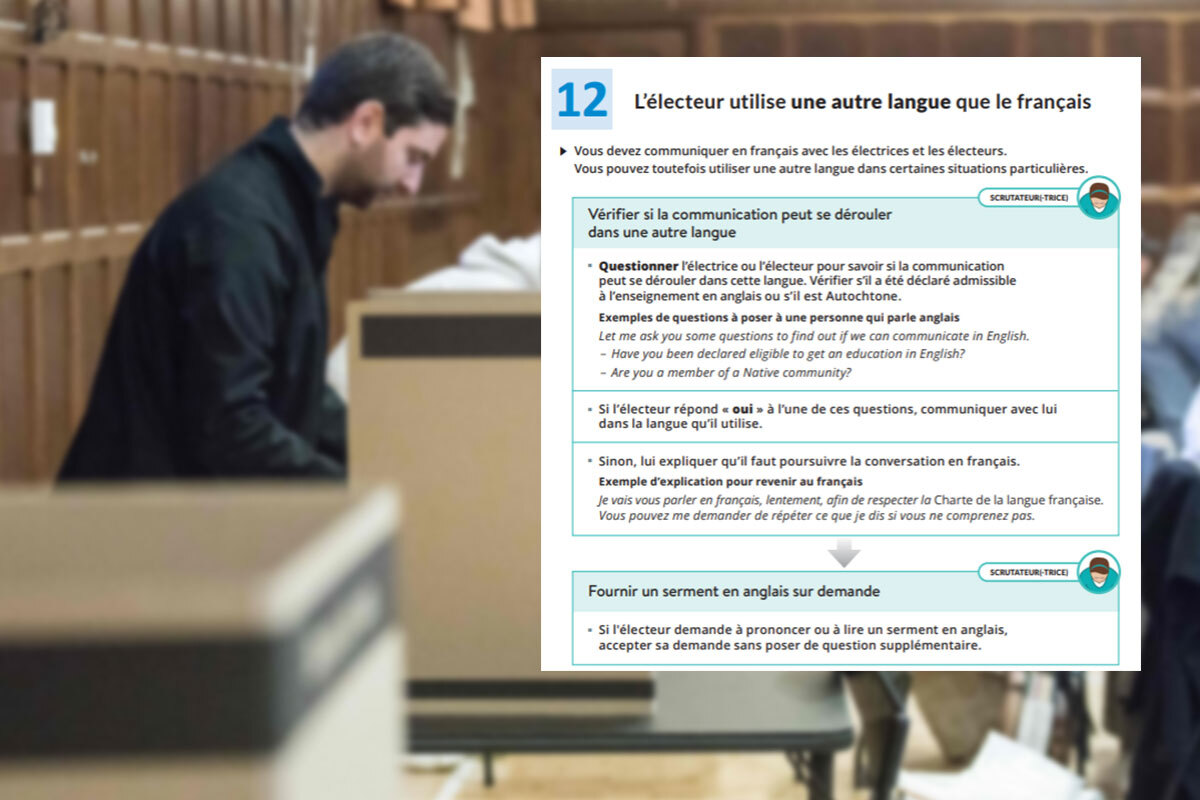
Élections Québec is telling polling staff to only speak French with voters unless they have a right to English education or are Indigenous.
The news comes as Quebec is seeking leave to appeal a court ruling on French-only election voter cards.
“It’s not our decision; we must respect the law,” Élections Québec spokesperson Julie St-Arnaud-Drolet said in an email statement about the directive to staff, pointing to Quebec’s Charter of the French Language. “We rely on the person’s statement and do not require any certification or other proof.”
In the Élections Québec directive to polling staff, one section explains what to do if the voter speaks a language other than French.
“Ask the voter if communication can take place in that language. Check whether the voter has been deemed eligible for English-language education or is a member of an Indigenous group,” the directive says.
“Examples of questions to ask someone who speaks English:
“Let me ask you some questions to find out if we can communicate in English.
“Have you been declared eligible to get an education in English? Are you a member of a native community?”
If the voter responds “yes” to one of the questions, the poll station worker is instructed to communicate with them in the language they use.
“If not, explain to them that the conversation must proceed in French,” the directive says, giving the worker an example of how to pivot the conversation back to French.
“I will speak to you in French, slowly, to respect the Charter of the French Language. You can ask me to repeat what I say if you do not understand.”
English-language rights group TALQ says the directive demonstrates that Élections Québec is willing to go as far as erecting barriers to democratic participation in the name of protecting the French language, “and that is scary,” director general Sylvia Martin-Laforge said in an interview.
“The eligibility certificate was for education, not for any other service or right,” Martin-Laforge said.
“The decision of the (Quebec Superior) Court maintaining that electoral information be sent in both English and French — this directive would violate the spirit of the law,” she added.
Geoffrey Chambers, the lead plaintiff in the lawsuit against the province on voter cards, says the directive “puts the election at risk” of chaos at the polling tables.
“Having lost in the other matter, they should have understood that this was equally egregious violation of civil rights and going to compromise the election,” he said in an interview.
Chambers said he is certain this issue will soon be litigated, and planned to send a mise en demeure to the director general of Élections Québec and the Minister of Justice on Friday.
“It’s intended to intimidate and compromise a certain part of the population, and it’s just plain wrong.”

Leora Schertzer is a reporter at the Montreal Gazette who thrives on the chase. Whether it’s producing a documentary about sewage or investigating a Nazi gold scandal, it’s the novelty and adrenaline that keep her in this challenging industry. Send her tips at lschertzer@postmedia.com.
lschertzer@postmedia.com
The Gazette’s On Quebec Politics newsletter by Andy Riga breaks down key election issues, from polling shifts to legislative manoeuvring to ideas circulating in francophone commentary that don’t make it into English-language coverage.
To sign up, visit this page and check the box labelled “On Quebec Politics” before providing your email address.
Editor’s Picks