
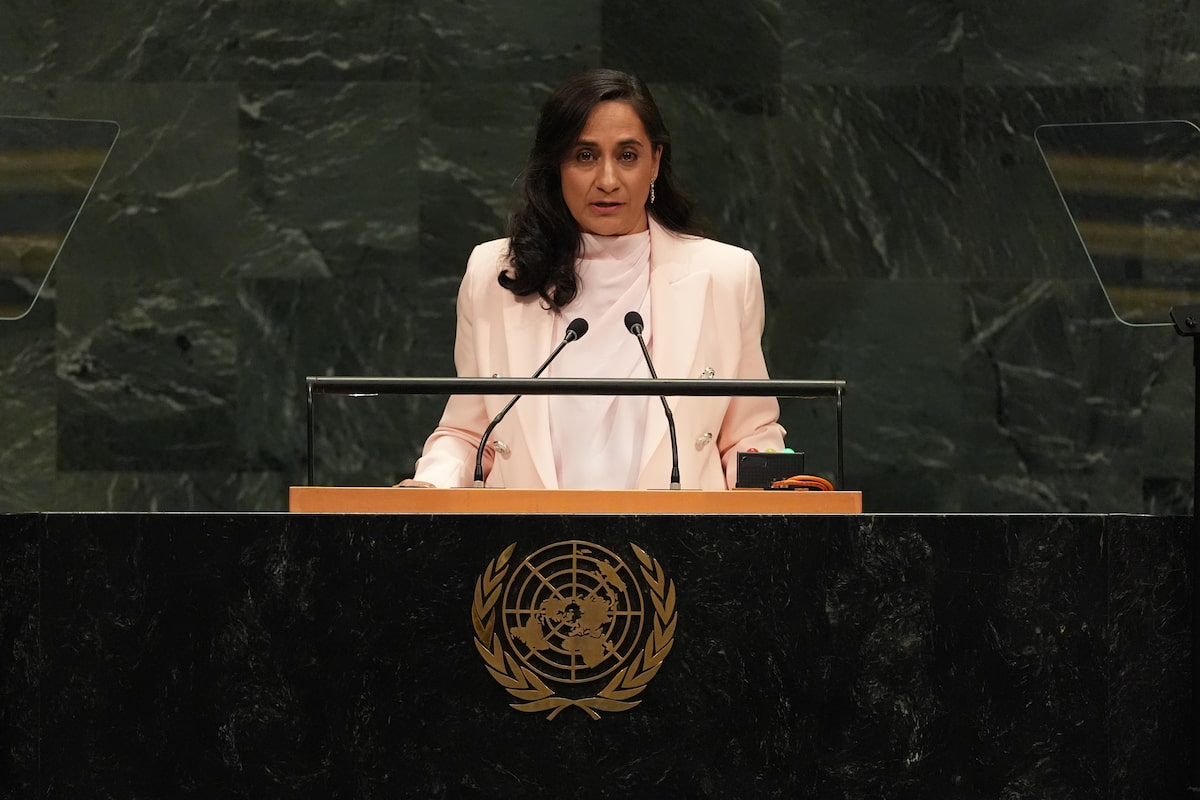
Minister of Foreign Affairs Anita Anand speaks during the 81st session of the United Nations General Assembly at UN headquarters on Saturday.Heather Khalifa/The Associated Press
Canada is reducing its economic reliance on the United States by diversifying its ties, including renewed partnerships with China and India, under a policy of “values-based realism,” because Ottawa “can no longer afford to be overly reliant on any one partner,” Foreign Affairs Minister Anita Anand told the United Nations on Saturday.
The Foreign Minister’s speech to the UN General Assembly reflects Prime Minister Mark Carney’s government’s efforts over the past 18 months to rebuild ties with Beijing and New Delhi after years of diplomatic disputes.
Ms. Anand, echoing Mr. Carney’s January speech at the World Economic Forum, talked of how to thrive in a “new age of disorder” where “great powers are walking away from global economic co-operation, and dismantling economic integration.”
The United States under the Trump administration has grown deeply protectionist and unpredictable, imposing significant tariffs on allies and rivals alike in an effort to drive manufacturing back to U.S. territory.
She did not name the U.S. when criticizing great power behaviour. Nor did she discuss the costly trade war between Ottawa and Washington that escalated recently after Mr. Carney walked away from what he called a “bad offer” in negotiations with U.S. President Donald Trump that would undermine Canadian sovereignty and destroy major industries.
Carney, other world leaders launch effort to spur middle power co-operation
The U.S. followed this suspension of trade negotiations with more tariffs and product bans on Canadian products.
“Great powers want the rest of us to accept what we are offered,” Ms. Anand told the UN.
She said Canada is already succeeding in diversifying away from business on this continent, where the U.S. is this country’s biggest customer.
“Canadian exports to markets outside North America have significantly increased,” Ms. Anand told the UN in French.
“We are diversifying our ties, and building stronger relationships with new and old partners alike, so that our people can enjoy peace and prosperity.
She spoke positively of the U.S. three times in her speech, but in terms of security. She welcomed Secretary of State Marco Rubio’s convening of the Arctic Seven earlier this week – countries except Russia that have Arctic territory – and the recent agreement among Greenland, Denmark and the U.S. on Arctic security. In French, she thanked the U.S. for supporting the gang-suppression force in Haiti.
Ms. Anand said Canada “will pursue a policy of values-based realism.”
She signalled Canada sees itself as a convenor of middle powers in an age of rupture.
In his speech to the World Economic Forum in Davos, Mr. Carney said the postwar rules-based international order has broken down. Great powers now use tariffs, financial systems and supply chains as tools of coercion, he said, and institutions such as the World Trade Organization, the UN and the COP climate process are under threat.
Opinion: Carney’s Davos speech diagnosed the problem. His EU speech lays out the cure
“Understanding the world as it is, we will make the right choices for Canadians, while being guided by our values,” Ms. Anand said.
She said “values-based realism” means diversifying Canada’s ties and working with “trusted partners” on emerging technologies, critical minerals, defence production, and clean and conventional energy. It also means leading “other middle powers to act collectively and decisively.” She described the current moment as “a rupture, not a transition.”
In her speech, Ms Anand signalled Canada sees itself as a convenor of middle powers in an age of rupture.Eduardo Munoz/Reuters
The speech named China and India as partners, saying Canada is “building renewed partnerships with large economies like India and China.” It did not mention China’s human-rights record like Canadian officials under former prime minister Justin Trudeau did or allegations of foreign interference conducted by China and India that dominated Mr. Trudeau’s latter years in office.
Back in 2022, for instance, then-foreign minister Mélanie Joly told the UN General Assembly in her speech that a UN report on China’s Xinjiang region contained “credible accounts of abuses that constitute crimes against humanity.”
India’s PM Modi expected to visit Canada in December to sign trade deal, envoy says
On Saturday, Ms. Anand noted at the UN that Canada has secured more than 20 new economic and defence partnerships in the past year. She also said this month’s Canada Investment Summit produced nearly $500-billion in new financing commitments.
Ms. Anand said Canada’s commitment to NATO is “ironclad.” She said Canada allocated more than $80-billion to defence in last year’s budget, now spends more than 2 per cent of GDP on defence, and is “building toward NATO’s 5 per cent pledge by 2035.”
She called Iran “the principal threat to peace and security in its region” and pointed to sanctions she announced this week. She said Canada will again lead the General Assembly resolution on human rights in Iran.
On the Middle East, she said: “Israel’s right to exist is not up for debate. And the right of the Palestinian people to self-determination in a state of their own is also not up for debate.” She said Israeli settlements in the West Bank are illegal under international law. She noted that Canada said this month it intends to restrict trade in goods from them. She said Hamas “must play no role in the governance of Palestine.”
She reaffirmed Canada’s support for the International Criminal Court. She asked member states to back Canada’s bid for a seat on the UN Human Rights Council for 2028 to 2030.
Ms. Anand said Canada will favour “issue-based coalitions” of countries and is working with more than 30 countries in the Coalition of the Willing to support Ukraine. She said she will co-host a conference in Toronto next week with Norway and Ukraine on the return of Ukrainian children, detained civilians and prisoners of war.
“Though some would build higher walls and retreat from international engagement, we believe that long-term partnerships are the way to prosperity and security,” Ms. Anand said. “And though some would rather ignore the rupture that we see before our eyes, we are willing to see the world as it is.”