
Not even the most pessimistic forecasts of the reality of playing Israel could have foreseen a day as abject and rancorous as this.
It began at 9.56am, when the FAI press officer sent a WhatsApp message to an Irish journalist to say Ireland’s press conference, due to start in 19 minutes, would be postponed by around two hours until after their 11am training session. Uefa’s match delegate learned about the delay at the same time as the media. At 10.40am, the Israel FA press officer told us that the Irish training session would be delayed, as he had been told that the Irish team had not yet left the team hotel.
The Irish players would not leave their hotel for another four-plus hours. They were holed up together in a fraught meeting, arguing about whether they should play Israel. The players met on Friday in Pristina to come to a collective stance as to what to do around the match. An eleventh-hour boycott was not on the agenda – instead they planned to air their views and come to a unified position around the prematch protocol such as handshakes. They planned to draft and publish a statement after the meeting, in advance of the Saturday morning press conference.
The meeting was tense and acrimonious, running so long that the FAI delayed the departure of their charter flight to Hungary. Saturday dawned and still the players’ statement had not been published. It needed unanimous sign-off, and unanimity did not exist. Gavin Bazunu declined to approve the statement when asked by the FAI to do so on Friday night, telling them he would talk to them on Saturday morning. Bazunu awoke on Saturday and sought a meeting with Hallgrímsson, and told him he did not want to be involved in the Israel game. Bazunu said he did not want to withdraw from the squad and would make himself available against Austria next Thursday, but his conscience would not allow him to face Israel.
Bazunu’s decision led some players to consider whether to withdraw with him. The total number of players who considered withdrawing is not yet known, with conflicting numbers emerging across the day. At 12pm, with the Irish squad still in their hotel, the Irish media abandoned the stadium to pitch up outside the team hotel. A few Israeli journalists came in tow.
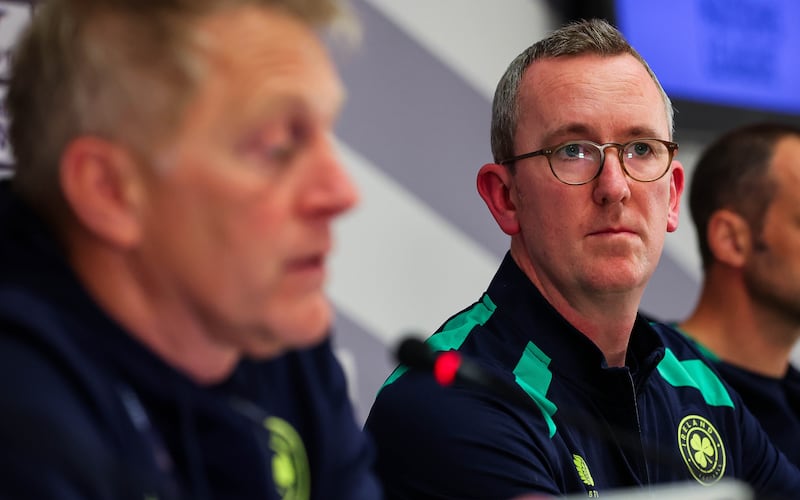 FAI chief executive David Courell at the press conference before the Israel game. Photograph: Ryan Byrne/Inpho
TV cameras and microphone stands were assembled outside the hotel door, while the team bus stood outside, empty aside from its local driver, who looked bored and perplexed. At one point an FAI security guard came out to the bus driver, told him something, and returned to the hotel.
When we asked him whether the team would be going to training, he theatrically shrugged his shoulders to tell us he didn’t know.
Armed police outside the hotel erected a cordon in front of the assembled press, while FAI security smiled half in apology as they escorted hotel guests inside. A couple of local fans sat outside with sour faces, flicking listlessly through the Irish player photographs they had brought along in the hope they would get autographed. We looked at a glossy photo of Caoimhín Kelleher holding the Premier League trophy in a Liverpool shirt and told her that she had picked a bad day to go autograph hunting. An Irish fan hung in the background to the whole scene, wearing a white Irish jersey and a black-and-red cap bearing the logo of the Kosovan Liberation Army.
Journalists sweated beneath the fierce sun and sighed the strange sigh of weary disbelief that is the mark of people who watch the FAI for a living. We wondered whether the FAI would become the first sporting organisation in history to boycott something accidentally; not so much taking a stand as a stumble. Our phones rang with requests from international media outlets, asking what was happening and whether the game would go ahead.
Having met with chief executive David Courell and then among themselves, the players sat in meetings with Hallgrímsson and staff. At 1pm, the players emerged from their conclave, barely visible to us through the narrow gaps between partitions in the window. The players spoke with their families, friends and agents seeking their counsel as to what to do. Some asked how withdrawing from the game might affect their careers at club level. One source close to an Irish player said that the situation had become so difficult that the Irish Government should step in and make the decision for the players. Some turned on Bazunu, one of whom is understood to have abused him directly to his face.
Finally, at 2.20pm, an Israeli journalist yelled to us that the Israel FA had been told the Irish team would be training at the stadium at 3.45pm. After hours of ignored calls and messages, the FAI communications department confirmed this when we asked them, adding that the press conference would be held 15 minutes prior. They did not confirm whether the game would go ahead.
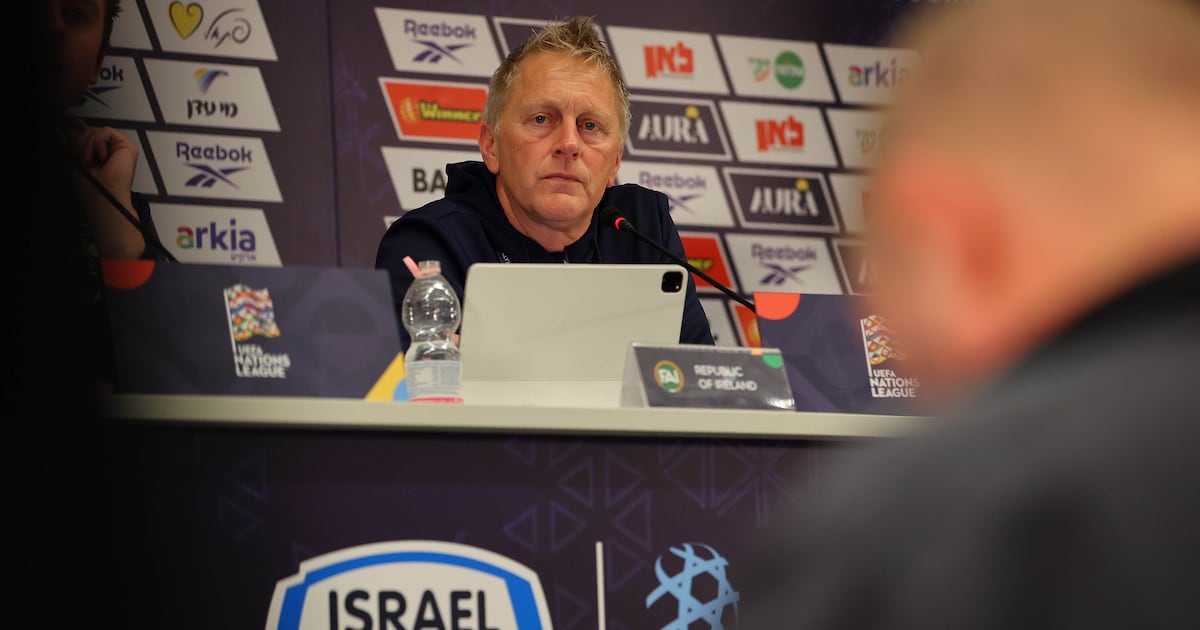
The media scrambled into Ubers back to the stadium where at 3.30pm, Heimir Hallgrímsson finally appeared. He was accompanied not by a player but by CEO David Courell and director of football John Martin. President Paul Cooke, the head of the delegation and the elected representative of the FAI’s General Assembly, was nowhere to be seen, consistent with his message to the Irish press back on Wednesday that it would be “unlikely” that he would do media this week. That no member from the FAI board on whom this decision rests appeared before the media is breathtaking.
Courell read from a prepared statement, apologising for the delay to the press conference. He explained that one player had said that morning that they did not want to be involved in the Israel match – he did not name Bazunu – and that this led to another round of talks among players as to what they should do. Courell described Bazunu’s decision as “a new variable that required time and deliberation among the squad.”
Courell said that at around 90 minutes earlier, the players balloted on whether to proceed with the game. He said there was a “a significant majority” in favour of playing the game, and so the game would go ahead. He persistently refused to divulge the precise result of the vote. When one journalist said he understood that the vote was 14 in favour and eight against and asked if that was true, Courell replied, “a significant majority can be open to interpretation.”
Courell also said the players would not be speaking to the media at all for the rest of the international window; would make a charitable donation that will be supplemented by the FAI; that the players would wear black armbands during the game in recognition “for all lives lost in the conflict”; and that they would refuse to shake hands with the Israeli players and coaching staff.
John Martin sat hunched and silent to Courell’s left, while Hallgrímsson sat to his right, looking wan and almost dissociated. The manager spoke in a low, abashed tone, and when harangued with questions by Israeli media, he was left alone to answer questions about Hamas and his decision to work in Qatar, and later about Ireland’s 1936 match against Nazi Germany.
None of Courell, Martin, nor the press officer stepped in. Hallgrímsson resiled from his use of the word genocide last week, saying he was echoing a slogan used by one of the boycott advocacy groups, “don’t play ball with that word.” His comments, he said, were intended to convey that playing against Israel did not endorse their politics. It was an excruciating scene, with Hallgrímsson at one point talking his way into an endorsement of some social reforms led by the late Emir of Qatar.
We asked Courell how the FAI had allowed it all to come to this, and whether he believes his position as CEO was still tenable. He launched into an epic filibuster – at one point explaining the concept of the FAI’s general assembly for the benefit of the Israelis present – before he eventually revealed the FAI had spoken to around 30 players in advance of the camp to gauge their feelings on playing Israel. They based this list on players’ recent record of caps, and Bazunu was not among the people to whom the FAI spoke.
Hallgrímsson then revealed that he had not spoken to Bazunu in advance of the camp after he was named in the squad. Hallgrímsson said last week that he had spoken to every player he called up and asked for their feelings on playing Israel, but now he said he had only spoken to the outfield players. So, extraordinarily, neither the head coach nor an executive at the FAI had a conversation with Bazunu in advance of this week to ask him about how he felt about playing Israel.
Shortly after the press conference ended, the Irish players appeared on to the pitch for training, five hours and 15 minutes later than billed. The Uefa match delegate asked the stadium staff to put the standard 15-minute countdown on the stadium screens to indicate the portion of the session to be open to the media, and then punched the air in relief.
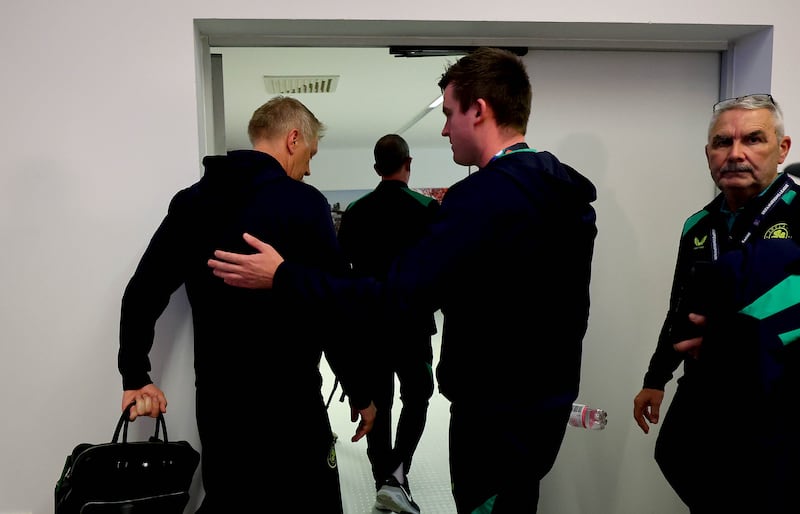 Heimir Hallgrímsson with communications manager Kieran Crowley after the press conference. Photograph: Ryan Byrne/Inpho
Israel turned up exactly on time for their press conference at 6pm, with their head of communications reading his own pre-prepared statement. He said the FAI and the Irish players had belatedly come to the right decision, as “the separation of football and politics must be maintained,” adding that Uefa, the Israel FA, and the FAI had “stood together” to avoid the politicisation of football.
He said the Israelis would be offering their hands to the Irish players on Sunday night, and added an addendum that Israel has asked Uefa to reverse the sending off against Austria of their player Saied Abu Farchi, who got a second yellow card for grabbing the corner flag and making a gesture that some interpreted as mimicking a rifle. The Israel FA said he was actually pretending to make a snooker cueing action, “like the legendary Ken Doherty.”
The chief result of all of this is that Ireland will play Israel on Sunday night, but the ramifications of this abject day will be long-lasting, and the toxicity of the fallout may come to rival Saipan.
Bazunu has been left brutally isolated, any semblance of squad unity has been utterly sundered, the head coach looks bewildered, matchgoing fans are already voicing their disgust, and the FAI has been humiliated before the watching world.
There is genuine anger towards Bazunu by some members of the Irish squad and staff for his decision, as if his withdrawal was responsible for this chaos; that without his decision they would have arrived at a satisfactory compromise to continue the FAI policy of merely trying to get through this mess without too many mishaps.
But Bazunu is not responsible for any of this, because everything that happened across this day of infamy is a direct consequence of a serious lack of leadership from the Government, Uefa, and ultimately the FAI. All of these bodies allowed the most bitterly contentious news story of modern times to cascade down upon a group of players, forcing them to wrestle with their conscience and careers beneath a torrent of extreme public criticism and pressure, and all before the eyes of the world.
The FAI hoped to wing their way through this fortnight but today collided with its brutal reality. The fallout is only beginning.
Irish football has once again shown the world the importance of leadership by its unforgivable absence.