
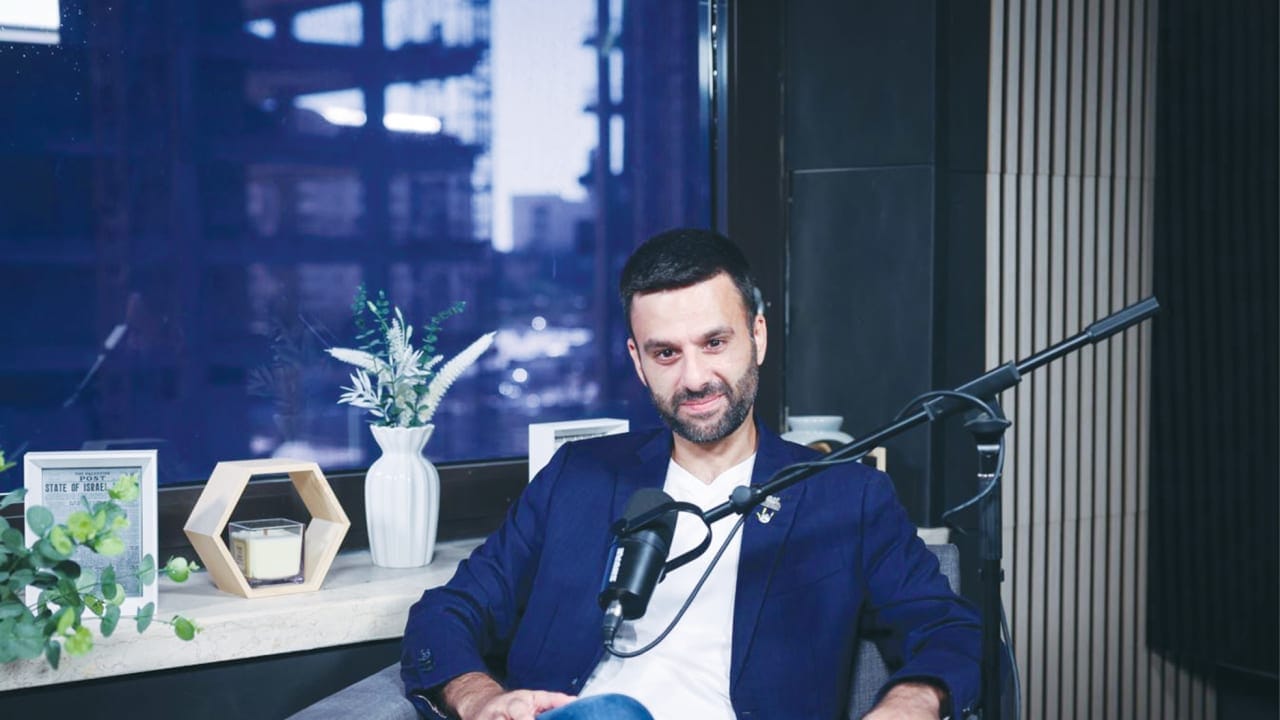
Arab-Israeli partnership has emerged as a key issue ahead of Israel’s first elections since the October 7, 2023, Hamas attacks.
Yoseph Haddad, a leading Arab-Israeli activist, is running for the Knesset in the second slot on the new People of Israel party list, behind chairman Brig.-Gen. (res.) Ofer Winter. The right-wing party has endorsed Prime Minister Benjamin Netanyahu.
In a recent interview with The Jerusalem Post, Haddad spoke about the importance of Arab-Israeli partnership, his political redlines, and his vision for bringing new faces into the Knesset following October 7.
“We’re going to be the surprise of this election,” Haddad told the Post.
He said he firmly believes the party will pass well over the threshold, securing its spot in the next Knesset.
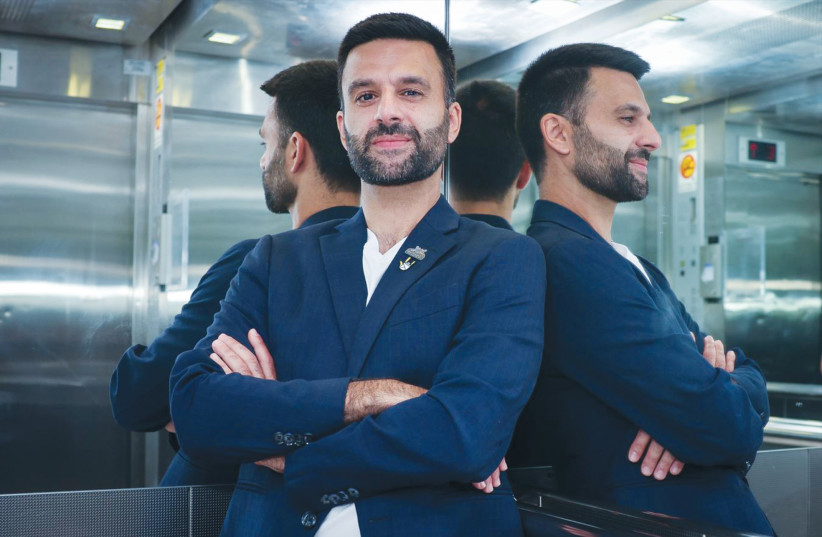 ‘AS AN Arab, as a Christian, as an Israeli, with all those identities which strengthen each other,’ Haddad prefers the term ‘partnership’ to ‘coexistence.’ (credit: MARC ISRAEL SELLEM/THE JERUSALEM POST)
Recent polling has shown the People of Israel party hovering just above the electoral threshold, at around five seats.
Haddad is a vocal supporter of Israel, advocating consistently for the country on news outlets and social media. He has also gone on numerous international speaking tours.
Especially after the October 7 attacks, Haddad’s online platform grew rapidly, and he became a prominent voice on social networks, often appearing as a guest on TV programs across the country.
Haddad was seriously wounded in the Second Lebanon War in 2006, while serving in the IDF.
He established a nonprofit foundation, Together Vouch for Each Other. It calls for connecting Arab society with Israeli society at large and for finding solutions to the issues of Arab society.
“As an Arab, as a Christian, as an Israeli, with all those identities that strengthen each other, I’m entering politics and bringing everything I’ve been doing over the last 10 years into Israeli politics,” Haddad said of his decision to run on the People of Israel Knesset slate.
Jewish-Arab partnership over coexistence
When asked about coexistence between Arabs and Jews in Israel, Haddad immediately rejected the term, saying he prefers to speak of “partnership.”
“I hate this word, ‘coexistence,’” Haddad said. “You’re not going anywhere. I’m not going anywhere. You don’t like me, I don’t like you – but since we’re not going anywhere, let’s live in coexistence.”
He said that the term “coexistence” may be more appropriate for describing Israel’s relationship with neighboring countries such as Jordan and Egypt, but that when it comes to Arab citizens of Israel, he prefers the concept of partnership.
“Partnership is something that exists in Israel,” he said, before giving an example of what he described as Jewish-Arab partnership during the October 7 attacks.
Haddad pointed to an Arab Israeli from Rahat who was working as a bus driver at the Supernova music festival on October 7. Haddad said he helped save more than 30 Israelis, all of them Jewish.
“When he was asked why he didn’t run away, he said, ‘I’m an Israeli, and there were Israelis there. Why would I run away?’” Haddad explained. “That’s partnership, not coexistence.”
Combating Arab sector crime rates
On the rise in crime in Arab society during the government’s term, Haddad said that while he largely disagrees with the approach of National Security Minister Itamar Ben-Gvir, who oversees the police, he believes responsibility for the situation also lies with leaders in Arab society.
“We have shared responsibility,” Haddad said. “I know that my country has responsibility. I also know that the leaders of Arab society and Arab society have responsibility as well.
“Bottom line, you have hundreds of Arab Israelis who were killed because of crime. The office that’s supposed to make sure that those numbers do not spike and arrive at that place didn’t do the job.”
Haddad also said Arab community leaders have a responsibility to cooperate with authorities and work to improve conditions in Arab society.
“They’re not doing it. They’re responsible, too,” he said. “Hopefully, when I reach the goal, and we will be as close as possible to where the decisions are being made, we’re going to affect them [the decisions], and we’re going to change them – including the situation with Arab-Israeli society in terms of protection and violence. That I promise you.”
New faces in the Knesset
The party has sought to bring together people who were never in the Knesset or part of the political or security failures surrounding the October 7 attacks.
“We’re the only party in Israel today that has only new faces, new spirit, new people,” Haddad said.
Despite the party’s emphasis on bringing new faces into politics, it has backed Netanyahu for prime minister rather than rival candidate Gadi Eisenkot, who leads the Yashar party.
When asked whether this support for Netanyahu was contradictory, Haddad said there is an “ideological gap” between him and Eisenkot.
He said that, ideally, he would want entirely new candidates for prime minister, to replace Netanyahu, but he argued that such a scenario is not realistic.
“What I’m saying is, look at the map. If it was up to me, all 120 [members of Knesset would go home. Let’s bring a full new 120. We’re saying that realistically it’s not possible,” Haddad said.
“So I’m acting only based on what’s going on and based on the fact that we are a right-wing Zionist patriotic party.”
Arab party redlines
Regarding the two main Arab-led lists running in the election – the Joint List and Ra’am – Haddad drew a firm redline against partnering with either party and sharply criticized their positions.
The Joint List includes Hadash, Ta’al and Balad, which agreed to run together.
“All those three different parties do not even agree with each other. They’re running together only because it’s the only way that they can pass the threshold and actually have something. But between them, there is even hatred,” Haddad said.
“All of them are terror supporters,” he added, saying he believes the parties should be barred from running in the election.
Haddad also criticized Ra’am chairman Mansour Abbas, claiming he presents different positions to the Israeli public in Hebrew than in Arabic.
“Because what Mansour Abbas is telling you in Hebrew is not what he’s telling me in Arabic [through the media],” Haddad said.
He also criticized Abbas’s decision to place former Yesh Atid MK and former senior police official Yoav Segalovitz second on Ra’am’s slate.
Segalovitz was the first Jewish candidate to run on the party’s list, and the decision to add him to the slate has been widely seen as a way for Ra’am to be viewed as a more viable coalition partner in a post-October 7 reality.
Haddad argued that Segalovitz was brought onto the list to “shield” Abbas from criticism over his positions on Hamas.
“He was brought as a shield to Mansour Abbas because Mansour Abbas can’t say that Hamas is a terrorist organization. Pathetic. Sad,” Haddad said.
“Segalovitz is the useful idiot of Ra’am,” he added.
Haddad said he believed the People of Israel party could win support from Arab-Israeli voters.
“I still have a goal of taking two seats from the Arab votes,” Haddad said about his plans to pass the threshold.
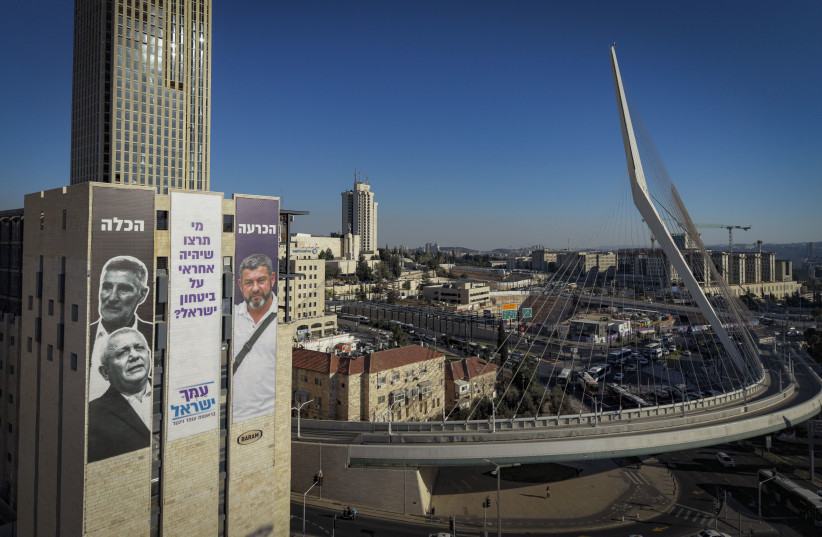 A giant election campaign poster for the People of Israel party is displayed on a building at the entrance to Jerusalem ahead of the upcoming elections, September 14, 2026. (credit: CHAIM GOLDBERG/FLASH90)Plans to improve Israel’s public diplomacy
Haddad also said he plans to become public diplomacy minister in the next government.
The current government agreed to shut down the ministry in 2023, shortly after the October 7 attacks.
“It’s going to be a big office, not because I want a big office,” Haddad said regarding the necessity of reviving the ministry.
“Because of anti-Israeli propaganda, terror supporters, pro-Palestinians, the IDF shut down multiple operations – operations that could have helped our security, Israeli citizens’ security, and could have probably avoided casualties on our side.”
Haddad said that he wants to be the “shield” for the IDF and Defense Ministry.
“Every week I will have a press conference in Hebrew for Israelis, to explain to them what’s happening; [a press conference] in Arabic for the Arab world, to also attack every lie they write about us. And [a press conference for] the Western world in English.”
“Because I want to show the hypocritical world how they are acting when it comes to us, and how they’re acting when it comes to the rest of the world.
“And how they’re talking about only one side of the story, with no facts, [while] the other side, with the facts, is completely ignored,” Haddad continued.
Haddad said he also has a plan for his first 100 days in office, which he said he would unveil soon.
“I’m proud of my country, and I’m proud of Israeli society,” Haddad said.
“And I’m proud to tell you that there are so many great people here who support me, support my way.”