
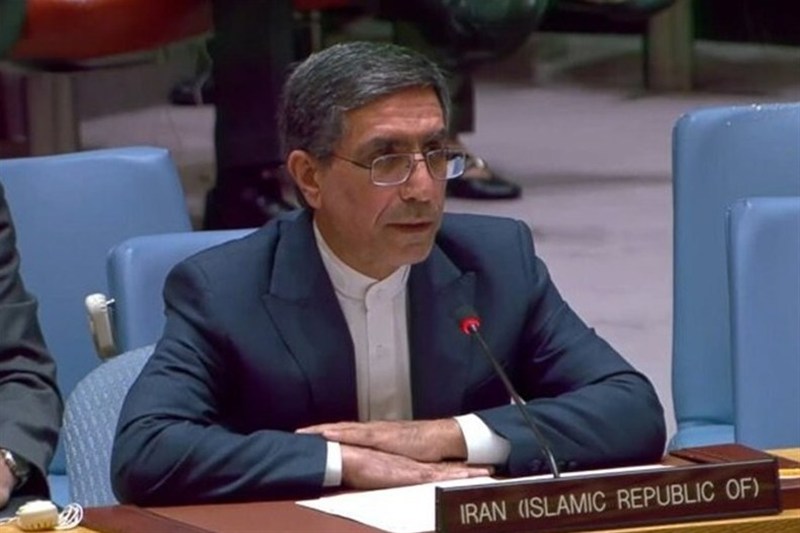
In a letter to UN Secretary General Antonio Guterres and the president of the UN Security Council, Iran’s Ambassador and Chargé d’Affaires to the UN Gholam Hossein Darzi said NATO Secretary General Mark Rutte’s September 23 remarks indicated a significant role for European territory and infrastructure in supporting US military operations against Iran.
Darzi said such support is, from Iran’s perspective, inconsistent with obligations under international law and warranted urgent consideration by the Security Council.
Rutte said in an interview on September 23 that since February 28, 2026, “5,000 aircraft” had taken off from European bases in support of what he called “Operation Epic Fury,” adding that the figure covered only the period through mid-April and that the actual number was “probably much higher” afterward.
Darzi said the remarks, given Rutte’s position and the nature of his statements, could raise questions about the international responsibility of relevant states and the individual criminal responsibility of European officials involved in planning, preparing, facilitating or carrying out acts that Iran considers aggression and war crimes.
Darzi reiterated Iran’s position that US and Israeli military aggression against Iran violate its sovereignty and territorial integrity and contravene Article 2(4) of the UN Charter. He also said Iran considers the ongoing US blockade of its territory unlawful and denounced US military operations for targeting civilians and civilian objects, citing Iranian figures that more than 3,600 people, including at least 254 children and 251 women, have been killed and many others wounded.
The Iranian envoy further noted that some European countries have facilitated the attacks by providing their territory, airspace, military facilities and other logistical and operational capabilities. He said such conduct could conflict with obligations under the UN Charter and could also be examined under the concept of participation in or assistance to an act of aggression under UN General Assembly Resolution 3314, calling on the Security Council to examine the issue “with due attention and urgency.”