
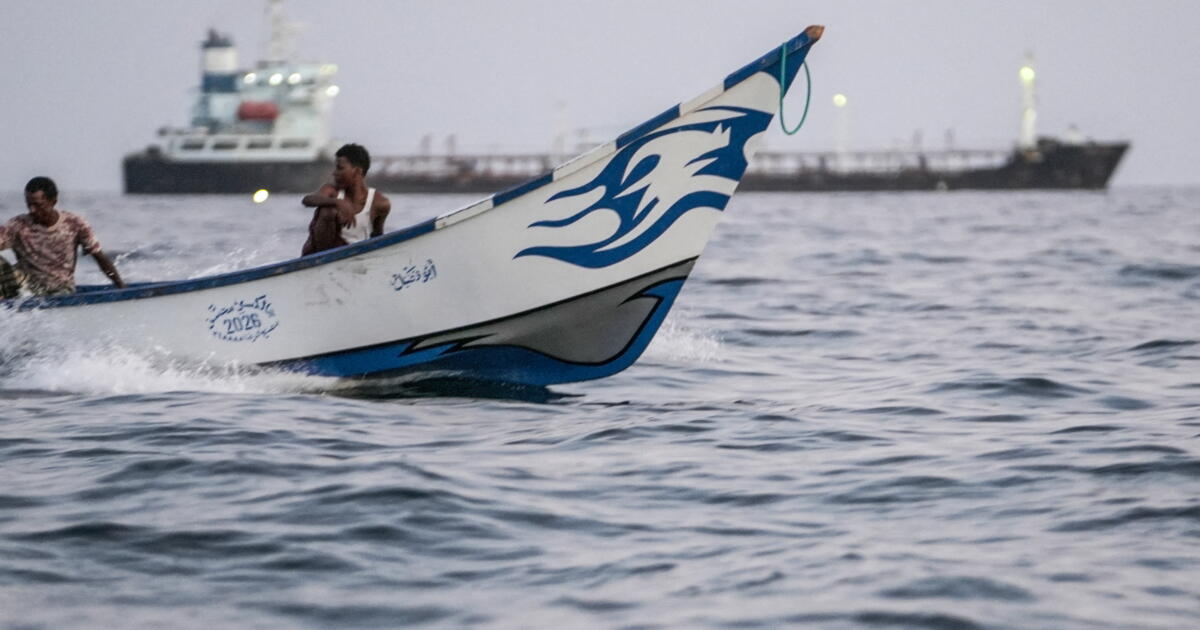
BAB EL-MANDEB, Yemen — To visit Bab el-Mandeb is to understand that old adage about looks being deceiving. For this humble fishing village in Yemen, a tumbledown grouping of barely-there huts nestled between the water and an imposing mountain range, stands sentinel over one of the world’s most vital waterways.
The village shares its name with the Bab el-Mandeb Strait, the narrow passageway connecting the Red Sea with the Arabian Sea that’s become another flash point in the U.S.-Israeli war on Iran.
“You hear so much about Bab el-Mandeb, you’d think we would be like New York, with skyscrapers and money,” said Saleh, a 58-year-old resident who, like all people interviewed here, refused to give their full name to avoid reprisals.
“So many ships pass near here. If the Yemeni government knew how to invest in it, we would be rich. We should be bringing in billions of dollars. Instead, look around you,” he said, pausing as his gaze took in the sorry-looking boats haphazardly laid on the beach.
“We have nothing.”
Saleh was interviewed in January, when Bab el-Mandeb was thrust into the power struggle between Saudi Arabia and the United Arab Emirates, the friendly-but-occasionally-fractious backers of Yemen’s internationally recognized government.
That war of wills ended with the Emirates ceding control of Bab el-Mandeb — along with the nearby island of Perim, where the Emirates had built a drone airbase — to Saudi Arabia.
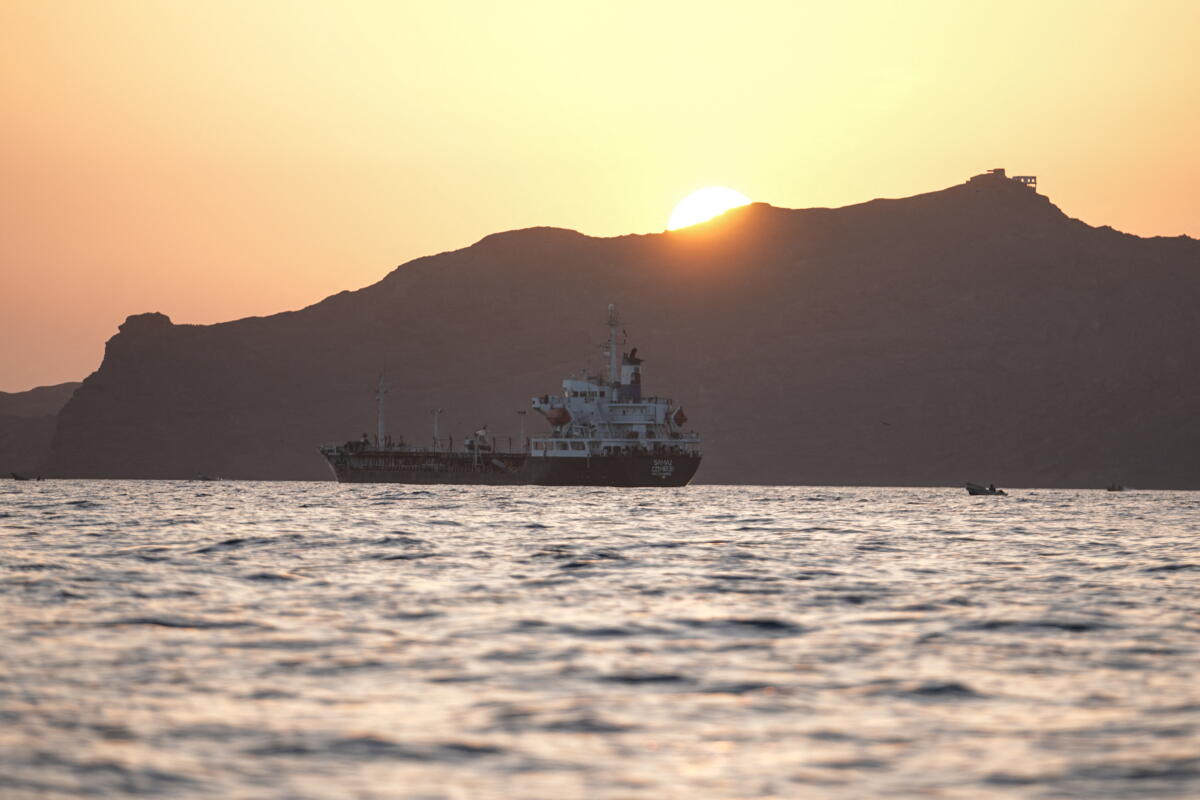
A commercial vessel is anchored off Yemen’s coast in the Bab el-Mandeb Strait, which connects the Red Sea with the Arabian Sea and Indian Ocean.
(AFP via Getty Images)
But this month, control of the Bab el-Mandeb Strait switched once more, when the Houthis, Yemeni rebels backed by Iran, ousted government forces from the waterway in a blitzkrieg in which they seized all of Yemen’s Red Sea coast.
The move grants the Houthis a valuable foothold in controlling the Bab el-Mandeb Strait, a ribbon of Red Sea — known as the “Gate of Tears” for the dangers involving its navigation — between Yemen’s coast and Djibouti and Eritrea.
About 7% of global energy supplies and around 12% to 15% of all global shipping transit the strait. And in taking Perim Island, which lies in the middle the Red Sea at the strait’s narrowest point (a mere 12½ miles), the Houthis could harass ships with ease.
“We don’t need a drone or a missile,” one Houthi commander bragged in a social media video posted from the island. Instead, he added, all they had to do was place a few artillery units on Perim’s coast and they would be able to strike any ship crossing the strait.
The impact of any movement disruption through Bab el-Mandeb wouldn’t be limited to already skittish energy markets: To enter the Suez Canal’s southern entrance, ships must first transit through Bab el-Mandeb, meaning any trouble in the passageway would force freighters to circumnavigate the African continent — adding anywhere from 12 to 21 days to voyages and spiking fuel costs.
A shipping disaster in 2021 shows how blocking the strait — and thus severing a link to the Mediterranean Sea — could harm global commerce. A container ship in the Suez Canal ran aground and blocked the waterway for six days, delaying the delivery of billions of dollars of goods.
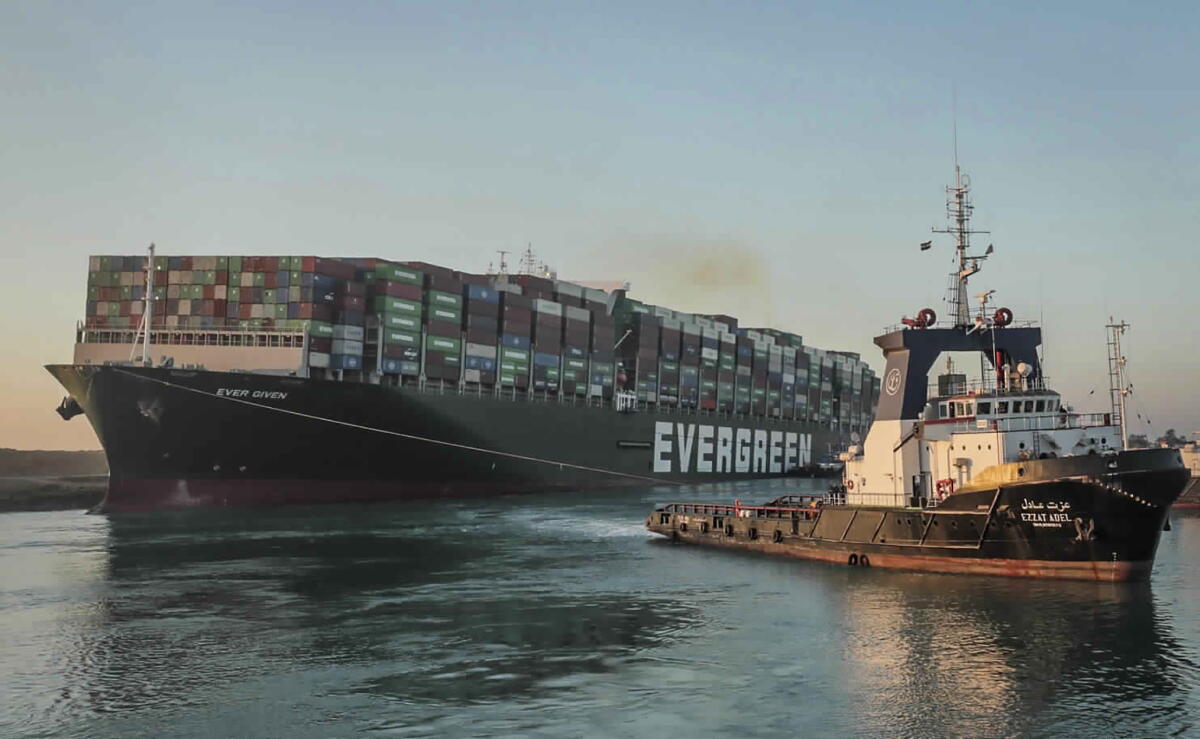
Tugboats work to free the Ever Given, a cargo ship that became stuck on a sandbar and blocked the Suez Canal, in March 2021.
(AP)
More recently, the Houthis sealed off the Bab el-Mandeb Strait in 2023 to coerce Israel into stopping its campaign in Gaza; that pushed the U.S. to attack the Houthis, before the Trump administration agreed to a ceasefire of its own with the group.
These days, the Houthi advance comes at a particularly fraught moment, one in which Bab el-Mandeb has taken on outsize importance. With the Israeli-U.S. war on Iran prompting Tehran to seal the Strait of Hormuz — cutting off the world’s most important energy passageway — Persian Gulf oil powerhouses have been forced to divert crude exports to alternatives, including Bab el-Mandeb.
That’s especially true for Saudi Arabia, which turned to its East-West pipeline and exports through the Red Sea to sidestep the trouble in Hormuz. But it’s also the most vulnerable to the Houthi threat.
The Houthis have a long-running animus against the Saudis, which began in 2015, months after the Houthis overran the Yemeni capital of Sanaa in 2014. Saudi Arabia, spooked about the notion of an Iranian ally on its border, led a coalition — with U.S. backing — to dislodge them. It started a blockade and a devastating air campaign that persisted until a 2022 truce.
But in July, the ceasefire broke after the Houthis accused the Saudis of striking Sanaa‘s airport in what appeared to be an attempt to stop Iranian flights from landing there. The Houthis began attacking Saudi Arabian oil infrastructure and declared a naval blockade against the kingdom.

This image taken from undated video released by the Ansar Allah Media Office, the media arm of Yemen’s Houthi rebels, shows what the group says is a Houthi fighter firing a mortar during clashes with Saudi-backed forces at an undisclosed location in Yemen.
(Ansar Allah Media Office Via Ap)
The rebels’ land grab this month stunned Saudi Arabia, which failed to launch airstrikes and stanch the rout of its allied forces from the coast. Saudi leaders reportedly reached out to President Trump to push the rebels back, but he appears disinclined to help.
Still, on Wednesday, U.S. Secretary of State Marco Rubio said, “We have a very strong defense agreement with Saudi Arabia, and we will live up to our commitments in that agreement.” He did not elaborate on what U.S. support that would entail.
On Thursday, Saudi Arabia said its defenses intercepted six ballistic missiles fired by the Houthis towards Taif, a manufacturing center, and Yanbu, a port on the Red Sea. It responded with hundreds of strikes on the Houthi-controlled areas in northern Yemen.
For their part, the Houthis insist they have no plans to attack shipping on the Red Sea and that their blockade applies only to Saudi Arabia — a move calculated to prevent the rise of an international effort to dislodge them.
“They don’t want to attract international military operations,” said Mohammad al-Basha, founder of the Basha Report, a U.S.-based risk advisory.
“They realize that when you do things in the Red Sea, you create panic in the world.”
But leaders in the internationally recognized Yemeni government say the Houthis are not to be trusted.
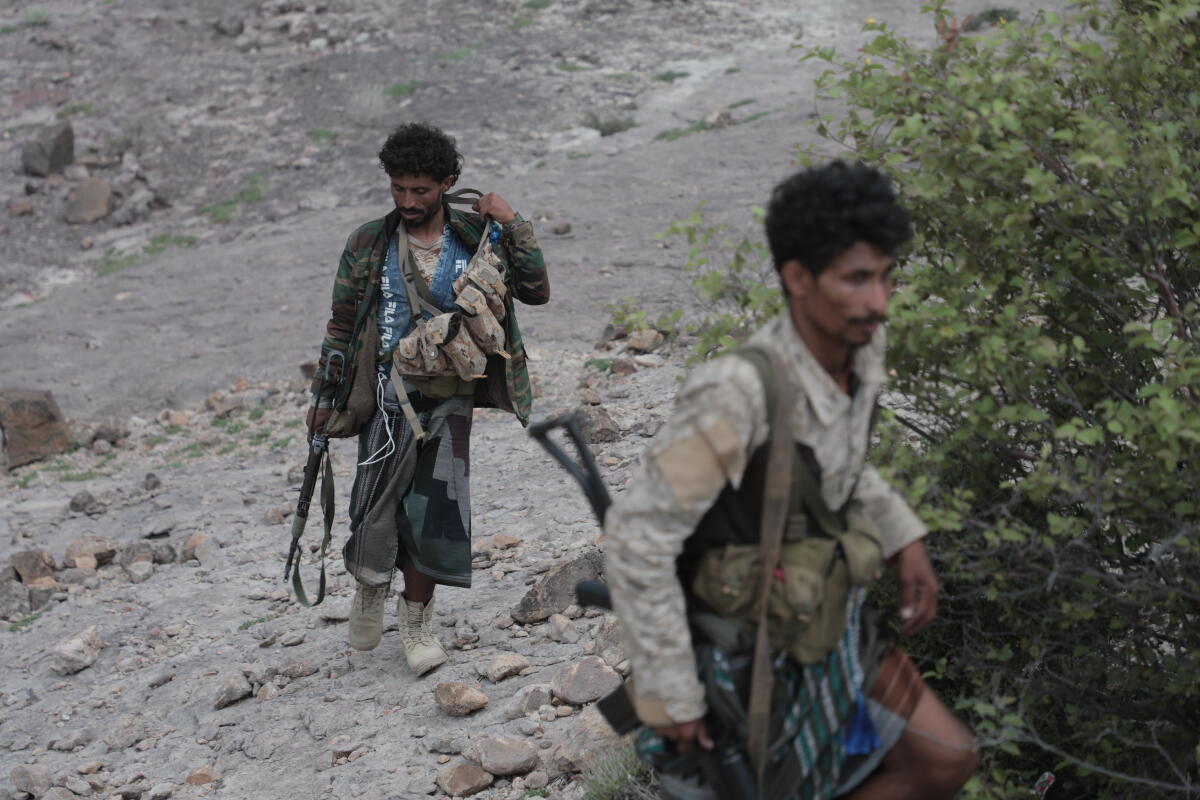
Yemeni government forces conduct search-and-clearance operations after announcing that they regained control of the strategic Mount Qarfan from Houthi forces in the Ash Shamaytayn district of Taiz province, Yemen, on Tuesday.
(Marwan Abdullah Yahya Saeed Al-shabi / Anadolu via Getty Images)
“The Houthi militias’ use of the safety of navigation as a tool for blackmail threatens not only Yemen. It is taking hostage the entire global economy,” Yemeni Vice President Abdullah Abdulkader al Alimi-Bawzer said at the United Nations General Assembly on Thursday.
He added that protecting the Bab el-Mandeb Strait is the responsibility of “every economy that depends on secure supply chains, energy security and freedom of navigation.”
In the meantime, the Houthis have been consolidating their gains on Yemen’s coast, Basha said, setting up checkpoints and bringing loyalists to administer the regions now under their control.
In taking the coastal areas around Bab el-Mandeb village, they reap the benefit of Emirati investment, manifested in kilometers of paved highways that stand in stark contrast to much of Yemen’s road network. They also gain control of several airbases in the area, most crucially on Perim, where the Emirates spent years ferrying construction supplies to build out a roughly 6,000-foot runway along with three hangars.
Although such a runway could not be used by larger bombers, it still can accommodate attack and surveillance aircraft. Another area of the island, which lies roughly two miles off of Yemen’s coast, has what appears to be a helicopter landing area.
One resident in Bab el-Mandeb village said much of that construction was done by the Emirates, whose contractors would ferry Southeast Asian construction workers to the island and provide them with food. It also built roughly 100 structures for Perim’s residents.
Government forces have since overcome their initial disarray and stopped further Houthi advances. But Basha warned any attempt to push out the Houthis from the coast will be difficult, especially with the group’s advances in manufacturing and fielding drones and ballistic missiles, not to mention the divisions and competing loyalties plaguing Yemeni government forces.
“It’s an uphill battle,” he said.
“You have a divided command-and-control; a divided Yemen; a divided society; a divided geography; and these divisions empower the Houthis.”