
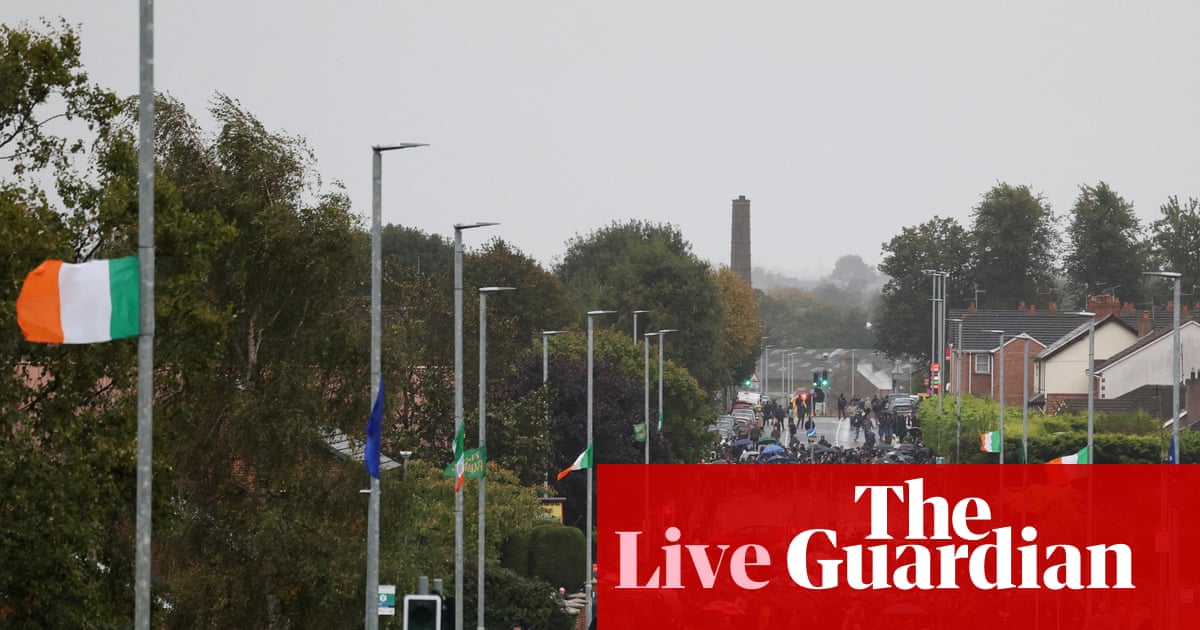
Orange Order march delayed as protesters block route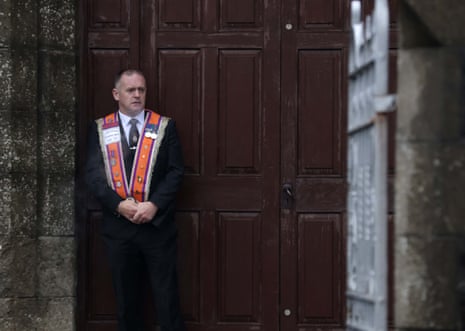 A member of the Orange Order outside Drumcree Parochial Hall in Portadown this morning Photograph: Peter Morrison/PA
With counter-protesters still blocking Garvaghy Road, there’s uncertainty over whether the Orangemen will carry out their march.
The court had ruled for the procession to kick off at 8am and to finish by 9.30am but it does not appear that the group of 35 Orangemen marchers have even set off from their starting point at Drumcree Church.
My colleague Lisa O’Caroll reports that Northern Ireland Cool FM is saying the Orange Order is in talks with police after they were told that the route down Garvaghy Road, which is blockaded by protestors, may not be possible after all.
Orangemen had formed up at Drumcree Church but have now gone back inside as talks continue.
The Garvaghy Road remains blocked, and it’s understood there will be no movement any time soon, with the Orange Order still planning to march.
The BBC is reporting that a member of the group said they would wait on the advice of police to tell them when they could start the march.
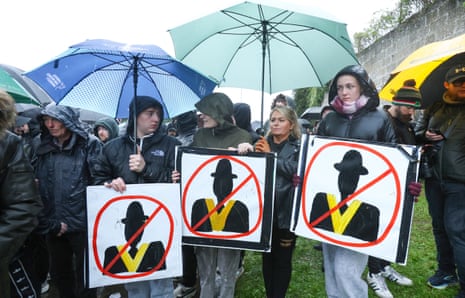 Protesters holding signs while blocking Garvaghy Road Photograph: Paul Faith/AFP/Getty Images
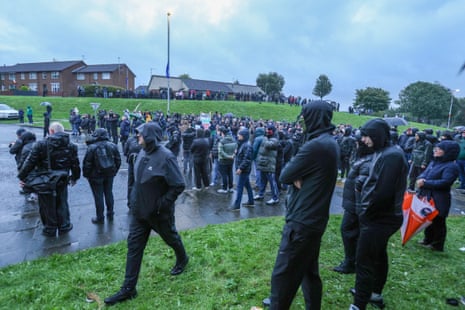 A large crowd had gathered this morning to prevent
the parade from going ahead, despite it being ruled a legally valid march by the courts who upheld a Parades Commission decision. Photograph: Paul Faith/AFP/Getty ImagesShare
Updated at 05.45 EDT
Key events
Chief Constable entreats ‘those with influence’ with protesters to abide by law
There’s been a significant police presence over the town this morning, with officers and marked cars accompanying the growing crowd of protesters blocking the road.
Police have been telling protesters to leave, noting that if they stay they will be blocking a legally-protected march and could face criminal charges.
But the message has been largely ignored by protesters, who linked arms, and are still blocking the road. Senior Republican lawmakers had joined them this morning including First Secretary Michelle O’Neill and Sinn Fein leader Mary Lou McDonald.
Earlier, Police Service of Northern Ireland Chief Constable Jon Boutcher appealed to “those with influence to encourage people to comply with the law and work with the police.”
“It is incumbent on us all to come together at times like this to do all we can to preserve a peaceful Northern Ireland.”
People blocking Garvaghy Road this morning Photograph: Cathal McNaughton/ReutersShareWhat we know so far
Amid the ongoing stand-off, let’s quickly recap where things stand.
The Orange Order march is still yet to go ahead as crowds of protesters, some wearing balaclavas, remain on Garvaghy Road in Portadown, blocking the route.
Overnight, the Orangemen won a battle in court to stage their march through this Catholic enclave in largely Protestant town– the first time they have been allowed to do so in nearly 30 years
The Drumcree march, as it’s known, has been banned every year by the Parades Commission since 1998 when it was a flashpoint for violence and sectarian conflict during the Troubles
But the indepedent adjudicator ruled on Friday that a smaller version of the parade could take place, giving permission for 35 Orangemen to carry out the parade in silence
The decision has sparked outrage from nationalists and republicans, with Sinn Féin’s leaders leading the counter-rally this morning. The republican party says thousands have joined the protest blocking the march.
While most parades taking place across Northern Ireland each year are mostly uncontroversial, nationalists say parades passing through Catholic areas, and the violent history of the Drumcree parade, are an affront and a display of triumphialism aimed at offending and intimidating them
Political response
In Northern Ireland, unionist politicians say the march has been ruled lawful and so should be allowed to go ahead, without disruption
Democratic Unionist party leader Gavin Robinson criticised First Secretary Michelle O’Neill for joining the protesters blocking the route, saying she should be upholding the law instead of “inflaming oppositon”
But O’Neill and Sinn Féin leaders have called the march’s greenlight a “disgrace” given its history. She’s called on the British government and police to intervene, saying the march’s approval had brought the entire Good Friday Agreement peace process “into question”
Political leaders in Britain and Ireland have called for calm amid the tensions and fears of potential clashes on the road
PM Andy Burnham appealed for “calm on all sides” saying there had been “big gains made in Northern Ireland, and we don’t want to see things go backwards.”
Updated at 06.47 EDT
Irish government wants to ‘avoid return to divisions of the past’
The Irish government has said it in a statement it is “very concerned about the situation”.
“Our primary concern remains to avoid a return to the divisions of the past, recalling the significant progress made over many years in furthering reconciliation under the Good Friday Agreement.”
ShareNI Secretary Bryant: ‘Wish we weren’t in this position’
As we reported earlier, the Northern Ireland secretary Chris Bryant is flying back to Belfast this afternoon amid growing tensions over this loyalist march down a Catholic road in Portadown, the first time it will be held in nearly 30 years after a long-running ban.
My colleague Lisa O’Carroll has more on what the minister told BBC Northern Ireland in the last half hour:
“I wish we weren’t in this position. I wish we we weren’t looking at relitigating things,” he said.
“There are lots of people who are watching this very, very closely including people who have long memories of things that happened 30 years ago and will be very nervous.
“The number one thing is that people should cooperate with the police. I want everything to pass off as calmly as is possible,” he added.
He said he was in constant touch with the police, but admitted he did not have the powers to call the march off unless the chief of the PSNI formally requested him to do so.
He said the courts had upheld the the determination by the Parades Commission, “so it is important that everybody abides by the law.”
Protestors are currently blocking the entrance to the Garvaghy Road raising the prospect of the police having to physically intervene to allow the Orange Order proceed down the road.
The Orangemen are currently at Drumcree Church, the starting point of the march, in talks with the PSNI.
Asked if he was not “washing his hands” of his responsibilities, he told BBC: “I’m not washing my hands, I’m just taking this very very seriously
I can only act if the chief constable asks me to act”
ShareOrange Order march delayed as protesters block routeA member of the Orange Order outside Drumcree Parochial Hall in Portadown this morning Photograph: Peter Morrison/PA
With counter-protesters still blocking Garvaghy Road, there’s uncertainty over whether the Orangemen will carry out their march.
The court had ruled for the procession to kick off at 8am and to finish by 9.30am but it does not appear that the group of 35 Orangemen marchers have even set off from their starting point at Drumcree Church.
My colleague Lisa O’Caroll reports that Northern Ireland Cool FM is saying the Orange Order is in talks with police after they were told that the route down Garvaghy Road, which is blockaded by protestors, may not be possible after all.
Orangemen had formed up at Drumcree Church but have now gone back inside as talks continue.
The Garvaghy Road remains blocked, and it’s understood there will be no movement any time soon, with the Orange Order still planning to march.
The BBC is reporting that a member of the group said they would wait on the advice of police to tell them when they could start the march.
Protesters holding signs while blocking Garvaghy Road Photograph: Paul Faith/AFP/Getty ImagesA large crowd had gathered this morning to prevent
the parade from going ahead, despite it being ruled a legally valid march by the courts who upheld a Parades Commission decision. Photograph: Paul Faith/AFP/Getty ImagesShare
Updated at 05.45 EDT
Democratic Unionist Party blasts counter-protest organised to block march Lisa O’Carroll
The leader of the governing DUP, Gavin Robinson, has condemned first minister Michelle O’Neill over remarks which he believes are obstructing a legal parade down the mainly nationalist Garvaghy Road.
“A first minister’s duty is to uphold lawful decisions, not inflame opposition to them,” Robinson.
“The legal position is now unequivocal. 35 Orangemen can walk in silence along Garvaghy Road. The Court of Appeal found that the injunction had been granted in error, and the High Court subsequently confirmed that the Parades Commission determination must be respected.
Yet Michelle O’Neill described that outcome as “disgraceful”, claimed an Orange procession was being ‘forced’ through the area and declared: “There is no going back. Not tomorrow. Not ever.”
Those words were followed by organised obstruction of the road, while Breandán Mac Cionnaith instructed people to sit down, link arms and return if removed by police.
Michelle O’Neill then addressed the gathering, urged it to “stay strong” and repeated the “no going back” chant.
Updated at 05.48 EDT
Northern Ireland secretary heading to BelfastLisa O’Carroll
Northern Ireland secretary Chris Bryant is on his way to Belfast, leaving the Labour party conference in Liverpool to address the tensions.
Speaking to the BBC in Liverpool, he said he is taking the situation “very, very seriously”.
Calling for calm he said it was “important that everybody abides by the law”.
“I would urge people to cooperate with the police. I would say that on both sides incidentally.”
SharePM Andy Burnham appeals for ‘calm on all sides’
The prime minister has just been speaking on the BBC about the parade, calling for calm to prevail.
“I know it’s a tense situation. We do appeal for calm on all sides,” he told Laura Kuenssberg on her politics show.
“There have been big gains made in Northern Ireland, and we don’t want to see things go backwards.
“So, obviously, a challenging situation today, but it’s very important that we work to bring calm.”
He also noted the authority of the decision made by the Parades Commission, which he said had been upheld by the courts.
I’ll have a post laying out the legal reasoning of the judges next.
Share Mark BrownMichelle O’Neill, First Minister of Northern Ireland (C) speaks to the media on September 27, 2026 in Portadown, Northern Ireland. Photograph: Charles McQuillan/Getty Images
Northern Ireland First Minister Michelle O’Neill, at the scene of the counter-protest this morning also spoke alongside Mary Lou McDonald.
O’Neill said she had called on Northern Ireland secretary Chris Bryant to intervene.
She told reporters: “Does anybody think that this is a good idea? No right-minded person would make this decision.
“I still do not know the answer to this question – why, after 28 years of determination to block a march down this road, the Parades Commission thought that this was the right idea today to bring this mess back onto this community?”
Updated at 04.43 EDT
Local MP Carla Lockhart, from the pro-British Democratic Unionist Party, posted this morning on X describing the marchers as a “dignified grouping of men, walking silently down Garvaghy Road”.
She included a photo of the small group in suits, wearing orange silk sashes and black bowler hats and carrying a banner.
“There is no threat, no triumphalism, not even music. There is nothing to fear. The rule of law must prevail,” she wrote.
Loyalist orange order members getting ready to march at at Garvaghy Road Photograph: @carlalockhart Twitter XShare
Updated at 04.43 EDT
While the Orangemen march has begun, there’s no sign yet of the two groups coming within sight of each other.
The Parades Commission had ruled that the march could go from 8am to 9.30am.
Police officers and vans are present at the counter-protest along Garvaghy Road, where at least hundreds have gathered to block the route. There’s a police helicopter hovering overhead.
Earlier, police had blasted out a message over speakers that taking part in the counter- demonstration could be a criminal offence, a warning that hasn’t dispelled those gathered.
A member of the Orange Order outside Drumcree Parochial Hall in Portadown ahead the first parade along the Garvaghy Road in Portadown for almost 30 years Photograph: Peter Morrison/PAStickers cover a road sign as a crowd of protesters gather to block the Garvaghy Road in Portadown, Northern Ireland in the morning of September 27, 2026, to prevent a parade of marchers from the Orange Order using the route through the mainly nationalist area of the town. Photograph: Paul Faith/AFP/Getty ImagesShare
Updated at 05.08 EDT
Just 35 Orangemen authorised for march
The Parades Commission has authorised a small group – of just 35 Orangemen – to march along the road silently this morning. They’ve not been allowed bands or supporters.
The Parades Commission is the independent body in Northern Ireland adjudicating on controversial marches and protest – because of a history of such events being a trigger for wider sectarian violence.
Northern Ireland saw three decades of conflict between largely Catholic, pro-Irish republicans and Protestant, pro-UK unionists.
Garvaghy Road had been a major flashpoint of the unrest in the late 1990s.
But the Commission this year determined that the Orange Order could make the return leg of their route through this part of town, having barred the Order the last almost 30 years.
Updated at 06.34 EDT
Lisa O’Carroll
My colleague Lisa O’Carroll has been reporting from Garvaghy Road this morning, where senior Sinn Féin leaders had joined the counter-protest.
Leader of Sinn Féin, Mary Lou McDonald, said the appeal court’s decision to allow the march go ahead was “disgraceful”.
“The decision tonight to overturn the court ruling, and force an unwanted orange march through the Garvaghy Road is disgraceful.
“This march is steeped in a history of hate, sectarian violence, and murder, and championed by Unionist leaders”.
Mary Lou McDonald, leader of Irish republican and democratic socialist political party Sinn Fein, speaks to media at the Garvaghy road Photograph: Cathal McNaughton/ReutersShareA history of disorder with the paradeLisa O’Carroll
The Orange Order, one of the most prominent organisations within unionism, insisted that the Garvaghy Road is part of its traditional marching route but the event is opposed by many Catholic residents who live there.
The parade was last permitted down Garvaghy Road in 1998 after a wave of violence followed clashes on the street, with thousands of public order incidents across Northern Ireland including murders.
A ruling by the Parades Commission permitting the Orange Order to march on Garvaghy Road was upheld at around 2.15am after an appeals court overturned a ruling by the High Court on Saturday to allow the procession, despite fears it could spark fresh sectarian violence.
ShareLoyalist march takes place for first time since 1998Lisa O’Carroll
The controversial loyalist march down a mainly Catholic Road in Northern Ireland, banned for almost 30 years because of violence, has begun after an appeals court ruled in the small hours of Sunday morning it was legal.
Protestors braved heavy rain in Portadown on Sunday morning as they gathered at the scene of the contentious Drumcree parade, which starts at Drumcree church and proceeds through the town including the mainly nationalist Garvaghy Road.
The crowds, many of them wearing balaclavas, clustered in large groups along Garvaghy Road in the hours leading up to the start of the parade at 8am.
First minister Michelle O’Neill said the original decision to allow the march was “primitive stuff in the year 2026” while unionists said Catholics had “nothing to fear”.
SharePeople block Garvaghy road, a Catholic enclave in the largely Protestant town of Portadown, on the day members of the Protestant Orange Order are expected to march through the area in Northern Ireland, September 27, 2026. Photograph: Cathal McNaughton/Reuters
Hundreds of protesters had gatherered overnight on Garvaghy Road to block passage to the group of Protestant marchers.
Pictures from the scene show a sizeable crowd with protesters linking arms several rows deep.
Sinn Féin has posted some footage from the protest, describing it as “thousands standing proudly in solidarity with Garvaghy Road residents.
“Peace and progress must be protected. We reject unwanted orange marches.”
Updated at 03.41 EDT
Northern Ireland’s First Minister Michelle O’Neill had condemned the late- night court ruling allowing the march to proceed.
“Our message tonight is clear. There is no going back. Not tomorrow. Not ever.”
Sinn Féin supported the residents of Garvaghy Road to protest against “this unwanted sectarian march,” she said.
Updated at 03.41 EDT
Opening summary
Hello and welcome to our live coverage of the latest news in Northern Ireland after a Protestant march was permitted to go ahead on Sunday for the first time in almost 30 years.
The original dispute over the route of the Orange Order parade down the Garvaghy Road in Portadown became one of the defining flashpoints of the conflict in Northern Ireland.
Here is a quick recap of the latest:
A Protestant parade may proceed through a Catholic area, Northern Ireland’s high court ruled early on Sunday, reversing a temporary ban on the highly charged march in an area that has historically been a flashpoint of sectarian disputes.
The high court dismissed a new application to stop the Orange Order from going through the area of Portadown after the court of appeal vacated a temporary injunction granted on Saturday to residents who opposed the parade.
Residents of the Garvaghy Road area had challenged Friday’s ruling by Northern Ireland’s Parades Commission that permitted the Orange Order to march along their road, a Catholic enclave in the largely Protestant town, overturning an almost 30-year ban on the route.
A crowd gathered on the Garvaghy Road early on Sunday morning to protest against the ruling to allow the march. In the crowd were Northern Ireland first minister Michelle O’Neill, who is also vice-president of the Irish nationalist Sinn Féin party.
The party’s leader, Mary Lou McDonald, posted a video on social media of the gathering. “Although the forces of darkness may want to stop us creating a new united Ireland, they will fail,” McDonald told a crowd of protesters in the clip, posted on X.
Annual attempts by the Protestant Orange Order to march through the area triggered unrest across the British-run region before the route was banned in 1998, the year the Good Friday agreement largely ended the three decades of violence known as the “Troubles”.
The Parades Commission’s determination on Friday stipulated that a smaller-than-usual 35 people could take part in the march, that it should begin by 8am (0700 GMT) and finish by 9:30am, and that no supporters or bands would be allowed.