
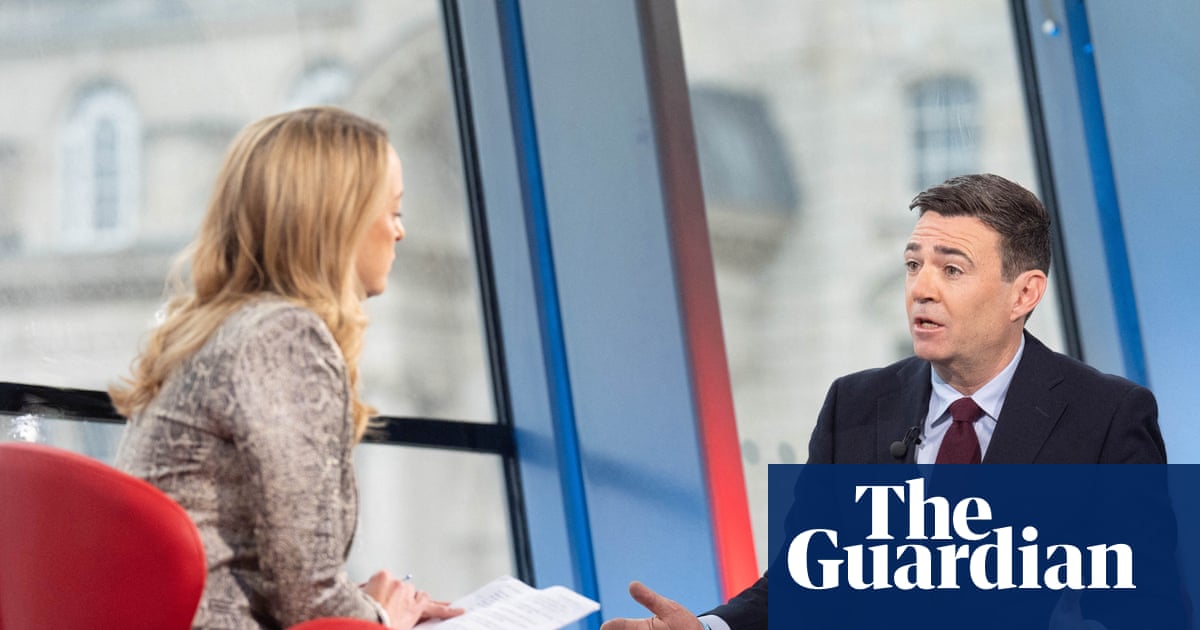
Andy Burnham has said that he is going to “rip the plaster off” to fix the broken social care system, as he set out a vision for a universal service that would be free at the point of use for everybody in England.
The prime minister said the new NHS-style social care service would be funded by “everybody” but did not give further details of how his radical long-term plan would be paid for.
Speaking to Laura Kuenssberg on the BBC as the Labour party conference began in Liverpool, Burnham ruled out implementing reforms before the next general election – currently due in 2029. He said Labour would put the proposals into its next general election manifesto so that voters could give their endorsement, in the hope of reducing the risk that political attacks would sink the policy.
The prime minister acknowledged that there were risks in a nationwide reform, likely to be costly and complicated to implement. “Somebody needs to grasp the nettle. I will be the one to do that,” he said. “I realise it might require me to spend some political capital, that it might make me unpopular with some, but that isn’t going to stop [me].”
The current social care system in England was “as unfair as American healthcare” where the “most vulnerable in society can lose everything, they can be wiped out”, he said.
He told Kuenssberg: “I’m going to rip the plaster off, if I can put it that way, because someone has to do it.”
Burnham declined to give details about how a new system would be funded, saying a review was continuing and promising more details in his conference speech on Tuesday.
The death two weeks ago of his father, Roy, who had Alzheimer’s, had pushed him on, he said, as he praised the “humour, humanity and skill” of those who cared for him.
“If I look at the people who cared for my dad, they must just feel invisible to the political class,” he said. “They work day in, day out, with huge humour and humanity and skill in what they do … caring for other people’s parents on poverty pay. How have we let this go on so long?”
Burnham claimed that the annual cost of delivering an NHS-style social care service was “not as high” as the £18bn that had been suggested – and said he would take his time to work out how it could be fairly funded.
“The challenge in the public finances is real,” he said. “So it has to be done carefully, without putting extra strain on the public purse. But I will bring forward proposals.”
Asked if social care was going to be like the NHS, free at the point of use and paid for through general taxation, Burnham replied: “It will be a system of that kind. So everyone contributes, everyone’s covered, but not precisely necessarily in the same way that we currently pay for the NHS. This is for Baroness Casey to advise us on.”
Changing social care has long been a political priority for Burnham. As health secretary in 2009, he proposed a national care service modelled on the NHS, but the Conservatives called it a “death tax” because it proposed a system funded by a new tax on estates after people died. Labour went on to lose the general election in 2010 and the plan was abandoned.
Asked if he would go back to that system, he said that nothing was off the table. “That doesn’t mean that I’m going straight back to the proposal that I had in 2010,” he said.
Trying to head off inevitable blocks from opposition parties, Burnham said that though consensus was necessary, scaremongering would block vital reform. “If we continue to approach this issue with politics as usual, where people are scoring points and they’re taking a proposal and then trying to frighten the public at home about it, we will never fix it,” he said.
“And can we honestly justify that? That politics in this country cannot face an issue like this and deal with it because we’re too scared of it?”
Burnham acknowledged there was “real concern” in the financial markets about the state of the British economy, pointing to the “febrile” state of global backdrop.
The prime minister said he was willing to cut government spending to balance the books – but also that he believed money could be saved by taking a more “productive” long-term approach to issues such as rough sleeping and youth unemployment.
Amid concerns that the government could be hemmed in at the budget by the parlous state of the public finances, he said that the chancellor, John Healey, would be “highly prudent” in running the economy.
“I won’t do what the previous Tory government did and take risks with the economy that are actually still hurting us right now,” he told the BBC.