
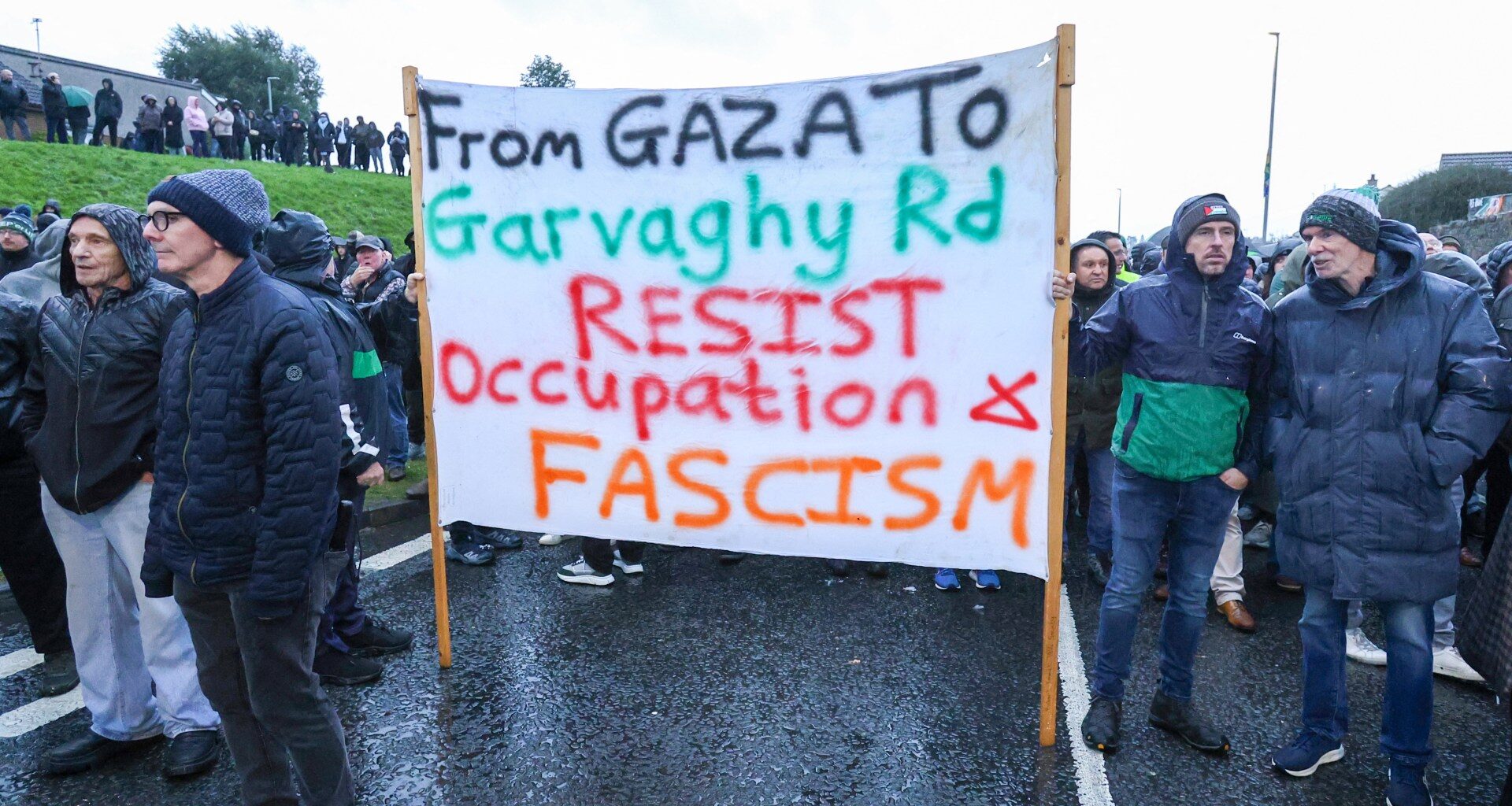
Crowd gathered on Garvaghy Road early on Sunday to protest against the ruling allowing the march.

Published On 27 Sep 202627 Sep 2026
|
Updated: 37 minutes agoUpdated: 37 minutes ago
Thousands of protesters have blocked a route into the Catholic area of a Northern Irish town that a Protestant organisation was due to march down.
Northern Ireland’s High Court permitted the Protestant Orange Order organisation to march through a mainly Catholic area in the town of Portadown on Sunday for the first time in 28 years, reviving one of the region’s most contentious marching disputes.
Recommended Stories list of 2 itemsend of list
The court rejected a final attempt by residents to stop the parade from passing through the Garvaghy Road, after Northern Ireland’s Court of Appeal overturned a temporary injunction granted on Saturday.
Thousands of people, including Northern Ireland First Minister Michelle O’Neill of the Irish nationalist Sinn Fein and the party’s leader, Mary Lou McDonald, gathered on the road to protest against the decision.
“This is madness,” McDonald told reporters shortly after 8am (07:00 GMT) when the march was due to begin. “This, in fact, is primitive treatment of any community in the year 2026. It is intolerable, and it will not be tolerated.
“This is a dignified and united community, and they are absolutely determined that they and we will not be drawn back into the past.”
McDonald and O’Neill urged the British government and police to intervene to stop the parade. O’Neill said she had spoken to Britain’s minister for the region and the Irish government.
Police vans parked nearby had earlier played out a warning that anyone taking part in the protest was committing a criminal offence.
A small group of Orange Order members wearing traditional silk orange sashes and black bowler hats gathered in another part of the town, a picture posted on X by Democratic Unionist Party (DUP) lawmaker Carla Lockhart showed.
British Prime Minister Andy Burnham called for calm, saying there have been “big gains made in Northern Ireland, and we don’t want to see things go backwards”.
Jon Boutcher, the head of Northern Ireland police, called for “those with influence to encourage people to comply with the law”, referring to the protest blocking the Garvaghy Road. He said there have been no signs of violence or disorder.
“Police are engaging and working with all parties and will continue to do so. It is incumbent on us all to come together at times like this to do all we can to preserve a peaceful Northern Ireland.”
Deputy First Minister Emma Little-Pengelly, from the DUP, which supports Northern Ireland remaining part of the United Kingdom, said on Sunday that threats of violence were unacceptable. “No one in Northern Ireland wants violence or disorder,” she added.
The Irish government said it was “very concerned” about the situation and that its priority was to avoid “a return to the divisions of the past”.
The Orange Order is a Protestant organisation closely associated with unionism, the political tradition that favours Northern Ireland remaining in the UK.
The Parades Commission, the independent body that rules on disputed marches in Northern Ireland, approved Sunday’s procession with a 35-person limit, barred bands and accompanying supporters, and required the march to finish by 9:30am (08:30 GMT).
The dispute over the Drumcree parade and Garvaghy Road became one of the most bitter marching confrontations of the “Troubles”, the decades-long conflict over Northern Ireland’s political status that largely ended with the 1998 Good Friday Agreement.
Repeated attempts by the Orange Order to return from Drumcree Parish Church along Garvaghy Road triggered protests, violence and major security operations during the 1990s.