
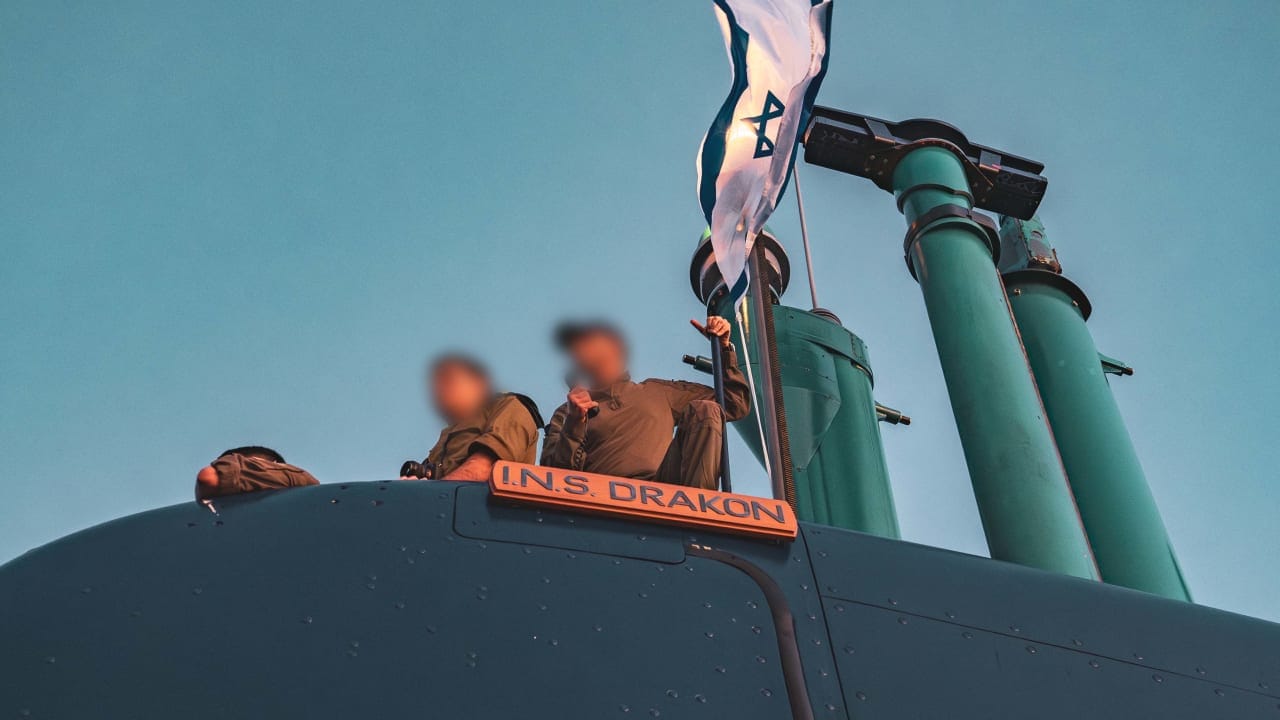
In the last three years, I have made around two dozen exciting field visits to Gaza, Lebanon, Syria, the West Bank, and other places, but the new highlight was boarding Israel’s newest submarine at sea, hours before it recently docked.
A 20-minute ride on a fast boat from the Haifa naval base brought me and a small group of other journalists to the submarine, which you could see only from a couple of hundred meters away since most of it was still submerged.
On the way, we had an incredible view of Haifa’s hilly terrain, with the magnificent Bahá’í Gardens smack in the middle of the panorama.
The Jerusalem Post and the fast boat passed two other older Dolphin-class submarines along the way, along with many tankers and other ships, until Haifa faded into the distance and the sea swallowed most of the view.
The fast boat included a female combat soldier who helped the ship navigate and watch for potential enemies beyond the pilot’s peripheral vision.
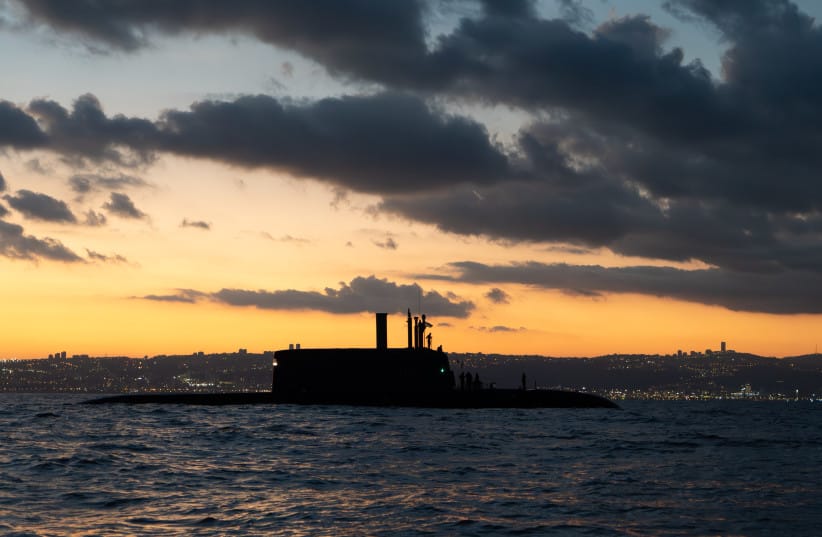 The INS Dragon at sea near Haifa in images released on September 24, 2026. (credit: IDF SPOKESPERSON’S UNIT)
While there still are no female soldiers on submarines, watching this tough female naval combat soldier in action embodied the recent statistics saying that a new high of around one-quarter of the navy’s combat and support roles are now women.
‘Post’ visits INS Drakon
The first sight of the Drakon was its green turret at the top and the blue and white Israeli flag that seemed to jut out of nowhere from the otherwise entirely blue sea.
As we pulled alongside it, we could see the English writing “No tug” to signal that tugs should avoid that part of the ship, as well as two sets of numbers showing how far above sea level the lower and upper portions of the submarine were.
The Post mistimed the original small jump between the two ships’ ladders, moving when the tide and waves were pushing the ships slightly apart, but the ships were close enough that there was no drama, and I made it through the ladder process fine.
Also, the Post had to traverse two ladders to get from the top of the submarine down to the top indoor floor – much farther than the distance for even many of Hamas’s deeply dug Gaza tunnels.
We received a tour of the first level of the submarine, but are not permitted to discuss much of what we saw.
However, reports have described the Drakon and similar submarines used by other countries as having extensive weapons, sonar detection, intelligence collection, oxygen use, and other technological capabilities to perform the submarine’s various missions.
According to foreign sources, some of the systems typically on modern submarines include: the control room, a nerve center which manages direction, depth, and buoyancy; ballast tanks which fill up with water to dive or compressed air to surface; a power source of some kind, such as a nuclear reactor or diesel-electric batteries to drive the propeller or pump jet; navigation and sonar systems including listening equipment, mapping surroundings, and systems to detect objects underwater; life support and fresh water systems; and various living quarters.
Foreign sources have also said that various Israeli submarines come with nuclear missile launch capabilities as part of an Israeli nuclear triad comprising sea, air, and land weapons.
The highlight of the tour was being able to peer through one of the submarine’s two periscopes – getting to see the sea-level battlespace while my body itself was still deep underwater in the submarine.
Submarines tend to have two periscopes for different depths, allowing them to peek above the surface without being detected by the enemy.
The periscope looked a bit hazy, but it clearly provided the traditional submarine capability to spy by eyesight (in addition to sonar) on ships and other objects above the water.
In addition, while the submarine had a myriad of sensors and manual buttons which these ships have had for decades, it was striking how many computer-style screens and autonomous systems have replaced the traditional layout in some areas.
The IDF’s new Drakon submarine. (CREDIT: IDF SPOKESPERSON’S UNIT)Drakon commander to ‘Post’: Submarine designed for longer, deeper missions
The Post spoke to four different navy officers, including Drakon submarine commander Cmdr. “A”, who told the Post that he spent three years living in Germany to work jointly with the German naval officers and private sector defense engineers to ensure that the ship would meet Israeli specifications.
He noted that the longer length of the ship enables both a higher quality and quantity of weapons as well as electrical and oxygen system capabilities to remain at sea for a longer period of time.
“A” would not deny statements by other top IDF officials that the navy will need to operate more in distant maritime areas like Iran and Yemen, with the navy publicly admitting only a small number of instances to date, such as a Sa’ar 6 corvette attack on Yemen.
He confirmed that navy officers view crossing the Bab al-Mandab Strait, which the Houthis are currently partially blockading, as even more challenging than crossing through the Strait of Hormuz, because Hormuz is over 30 nautical miles wide and Bab al-Mandab is only around 12.
According to A, crossing such a small area would be a special challenge and require extreme precision.
Rear-Admiral Guy Levy, who is the number two officer in the navy, echoed A’s views in an interview with the Post and agreed with the suggestion that the longer amount of time that the Drakon submarine can spend at sea would be helpful for a higher volume of missions in far away places, like Iran, Yemen, or others.
He added that the three Dakar-class submarines, which will start arriving in 2031, will expand the navy’s ability to stay at sea for even longer periods.
Earlier submarines could stay submerged for a couple of days, then a couple of weeks, while the Dolphin II-class Drakon can stay submerged much longer, and the Dakar submarines could likely last for months.
On Wednesday, the Israel Navy warned that Turkey already has 14 submarines, with four more on the way, compared to Israel’s smaller submarine fleet of six.
Questioned about how he and his Drakon submarine crew and the other Israeli submarines could compete with a fleet two to three times its size, he said that Israel’s submarines had capabilities that the Turkish submarines do not have.
Pressed that Turkey has also bought submarines from Germany, “A” stated that there are systems and tactics which only Israel has integrated into its specific variation, which Turkey lacks.
In addition, A said that his crew and Israel’s other submarine crews are far more war-tested and have been far more active across the region and beyond than Turkey’s submarines and other potential adversaries’ navies.
On being able to handle the Turkish navy and any other adversary’s navy, Levy told the Post that Israel could handle any adversary, just as A said, though he said he hoped it would not come to such a conflict with Ankara and that Israel’s navy would receive more ships in the future.
On Wednesday, the navy confirmed it is seeking government funding and approval to purchase two more submarines in the future, in addition to the three Dakar-class submarines.
Levy specifically noted the unusual experience that the submarines acquired during Operation Roaring Lion.
Levy also mentioned that each submarine has, cumulatively, hundreds of years of experience if you add up the decades of experience of the many officers who have served on it.
The chief sonar officer on the Drakon had more than 20 years of experience alone.
In the famous submarine movie The Hunt for Red October, the sonar officer, Ronald Jones, turns the tide nearly single-handedly against an adversary because he can hear tiny nuances of sound that your average sonar officer would never catch.
Such skills make the Israeli navy’s submarine squadron extremely formidable.
Levy also discussed the need to integrate artificial intelligence (AI) into more of the navy’s systems.
However, Levy also said the navy moves slowly in this area to fully address information security concerns before integrating a new system, something the private sector sometimes pays for failing to do.
Levy did not disagree with recent sentiments from Israeli naval officials that eventually the navy could be moving to a state of play where half of its systems were run by autonomous systems or robots, and in some more distant future, to the vast majority of the systems operating autonomously.
The Blue Whale underwater mini-submarine drone is one such system that Israel is already using and has publicly announced.
Submarine Squadron Head Cmdr. “Y” said the submarine’s added length provided a range of new capabilities, including intelligence and other technological systems.
Deputy Commander of the INS Drakon Lt.-Cmdr. “T” also spent three years in Germany, along with “A”, where he told the Post he also became fluent in German.
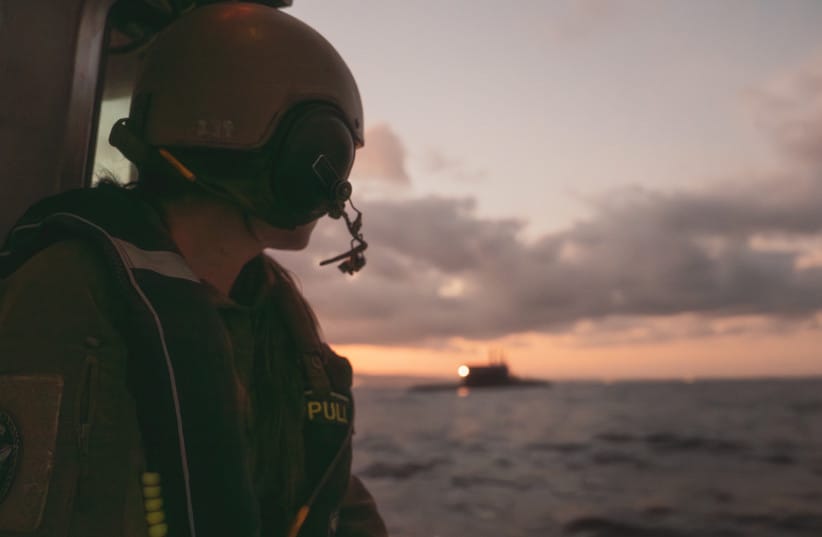 A soldier stands aboard an INS submarine in images released on September 24, 2026. (credit: IDF SPOKESPERSON’S UNIT)Will Israel be able to carry out deep-sea drills in the Mediterranean?
A major challenge for Israel is to carry out deep-sea drills with submarines before bringing them to Israel, where the Mediterranean lacks the same level of deep-sea opportunities.
In contrast, the Skagerrak is a body of water between the southeast coast of Norway, the southwest coast of Sweden, and the Jutland peninsula of Denmark, close enough to Germany that various navies use it for deep-water training.
T confirmed that Dragon had trained in deep-water areas near Germany, as other navies often do.
Another interesting point from T was how the submarine squadron’s mission has changed less than the rest of the navy’s mission since October 7.
If the rest of the navy became more of an attack arm of the Israeli military in the last three years, the submarine squadron remains primarily an intelligence collection unit, or in some undefined instances (former defense minister Yoav Gallant famously used a submarine for an amphibious mission decades ago), a clandestine transportation unit for special forces.
In that sense, T told the Post that the main difference for submarines was the new technological systems being integrated into them to broaden their capabilities.
Moreover, T said that while Israeli submarines have dodged detection by other adversarial submarines, in certain places like the Arabian Sea, where the US, France, and others operate in high volumes, there is sometimes a deconfliction mechanism.
This mechanism involves Israel and certain allies temporarily disclosing their location to avoid a collision in areas where there is an extremely high volume of submarines.
T said that the submarine squadron always keeps “very ready and on edge” should any new conflict break out.
As the Post disembarked from the submarine onto a fast boat to return to the Haifa naval base, I timed my jump between the ships’ ladders to coincide with the moment the waves and tide pushed the two ships closer.
A few minutes later we pulled away from the Drakon to head back to the coast.
It took a few decades, but a 10-year-old boy’s dream of visiting a submarine after reading the book version of The Hunt for Red October was finally realized – and Israel gained one of the premier naval fighting and intelligence collection machines in the world.