
Israel’s national soccer team will face Ireland in a Union of European Football Associations (UEFA) Nations League match in Debrecen, Hungary, this week. One week later, on October 4, the teams will meet again in a “home” match that Ireland is expected to host in Serbia, without spectators.
On the surface, this is about soccer. In practice, the matches have become another arena in which relations between Ireland and Israel have taken on an especially charged character.
The decision to move Ireland’s home match from Dublin to Serbia adds another layer to the situation. The Football Association of Ireland said it had requested that the match be transferred to a neutral venue because of “operational challenges” that could have affected its staging in Ireland.
The UEFA approved the request, and the match will be played behind closed doors.
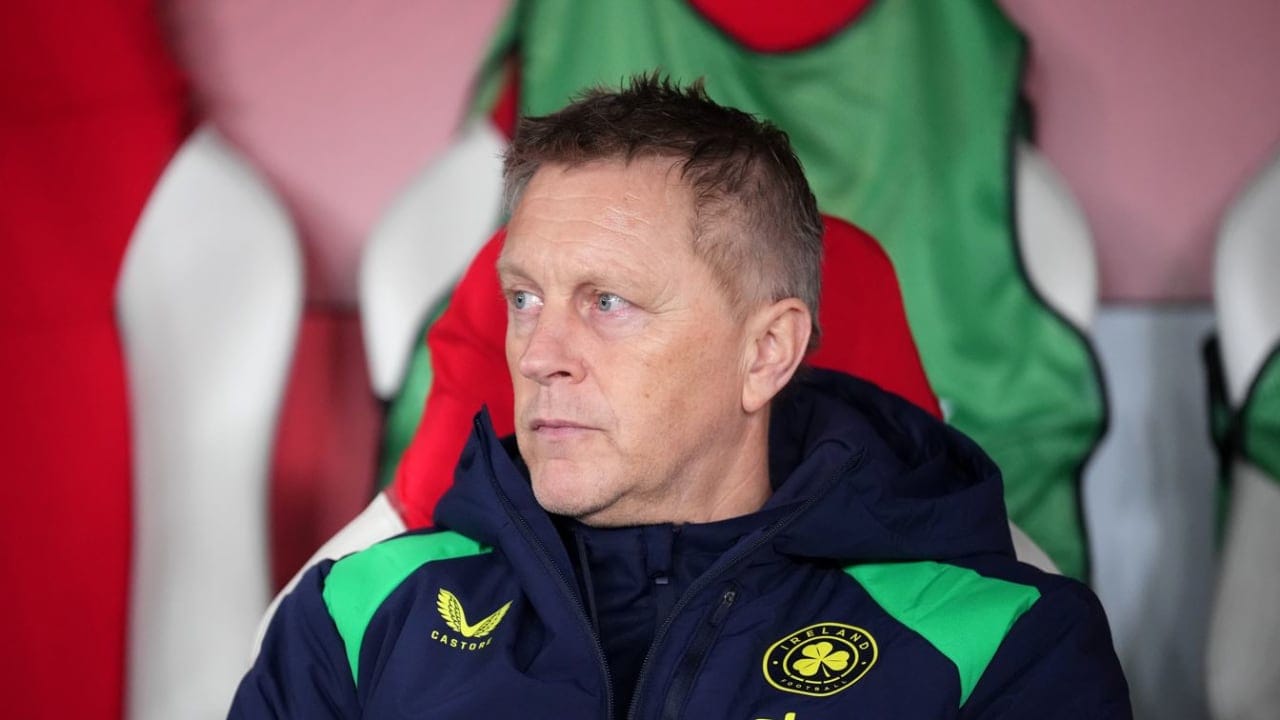
Ireland coach Heimir Hallgrímsson described this as an unusual and difficult period in his career. At a news conference, he said, “We are not playing with genocide. We are playing against genocide. We are playing against Israel.”
The Israel Football Association is considering submitting a complaint to the UEFA over his remarks. Even if Hallgrímsson emphasizes that he opposes a boycott and wants the matches to take place, his use of the word “genocide” in reference to a sporting opponent demonstrates how deeply political rhetoric has penetrated the playing field.
Irish coach Heimir Hallgrímsson dribbles ‘genocide’ far too readily
This was not an isolated incident. In early September, four Israeli triathletes were scheduled to compete in the European Cup in Derry, Northern Ireland. The local club announced that it did not support their participation, and the final list published for the competition did not include a single Israeli athlete.
It is important to be precise. Derry is in Northern Ireland, which is part of the United Kingdom, so the government in Dublin was not responsible for the decisions made there. However, it is difficult to ignore the broader context across the island of Ireland, particularly since October 7, 2023.
Ireland condemned the Hamas-led attacks, but subsequently took a series of steps that greatly intensified its diplomatic confrontation with Israel. In May 2024, Ireland recognized a Palestinian state, explaining that the decision was intended to advance a two-state solution.
In December 2024, Ireland decided to intervene in proceedings before the International Court of Justice following the case brought by South Africa against Israel under the Genocide Convention.
Israel viewed the decision as crossing a line, and Foreign Minister Gideon Sa’ar announced the closure of the Israeli Embassy in Dublin.
The Irish government rejected Israel’s accusations and said its position was based on international law and human rights.
The dispute did not remain confined to diplomacy. Ireland boycotted the 2026 Eurovision Song Contest because of Israel’s participation. At the same time, it advanced legislation prohibiting the import of goods from Israeli settlements. The law was signed in July 2026 and took effect in September.
Perhaps one of the clearest symbols of this tension is the treatment of the memory of Chaim Herzog, Israel’s sixth president, who was born in Belfast, raised in Dublin, and formed part of Ireland’s Jewish history.
Herzog Park in south Dublin was named in his honor in 1995. A memorial stone stands at the park’s entrance, bearing a plaque explaining that the site was named in honor of Herzog, a president of Israel.
In 2025, a political campaign was launched to remove his name from the park. Even Irish Prime Minister Micheál Martin opposed the initiative, warning about the message that would be sent to the Jewish community if the name of a prominent Irish Jew were erased from a public space.
But the story did not begin there.
A blue memorial plaque was installed in 1998 at 185 Cliftonpark Avenue in Belfast, the house where Herzog was born. The plaque commemorates the birthplace of the man who would later become a president of Israel.
Over the years, however, the plaque itself became a target. Following repeated attacks, graffiti, vandalism, and attempts to remove it by force, a decision was made in August 2014 to take it down and place it in secure storage.
The organization that installed the plaque continues to confirm that it was removed because of the attacks and concern for the building and its occupants.
The symbolism is difficult to ignore. A man born on the island of Ireland, the son of a Jewish family that formed part of local history, was initially honored. Later, both his name and the site commemorating him became focal points in the conflict surrounding Israel.
People can debate Herzog’s political and military legacy, as opponents of the commemorations do. But the question is whether disagreement with the State of Israel should also lead to the erasure of chapters from Irish Jewish history.
Statistics don’t lie: Over 140 cases of racism recorded against Ireland’s Jews in 2026 alone
Alongside all of this is a troubling statistic. In March 2026, the Jewish Representative Council of Ireland published its first report on antisemitism. It documented 143 incidents over six months, including threats, intimidation, vandalism, and exclusion.
Irish Foreign Minister Helen McEntee described the findings as disturbing. Ireland’s Jewish community numbers only about 2,200 people.
A clear distinction must be maintained between legitimate criticism of the Israeli government and hostility toward Israelis and Jews simply because of who they are.
But when athletes become targets of boycotts, when culture becomes an arena for exclusion, when a national team coach uses the term “genocide” in reference to the opponent standing across from him on the field, and when even the name of an Irish-born Israeli president and the memorials honoring him become subjects of political conflict, difficult questions arise about the boundary between diplomatic disagreement and the denial of legitimacy.
The four triathletes are not members of the Israeli government. Israel’s national team players do not determine the policies of the security cabinet. Artists do not vote in the United Nations Security Council.
That is precisely why sports and culture should be spaces in which people can compete, disagree, and even protest without erasing the fundamental legitimacy of the person standing opposite them.
The dispute between Ireland and Israel is deep and genuine. But as the confrontation moves from the government to the stadium, from parliament to the stage, and from policy to the treatment of individual Israeli citizens, it becomes increasingly necessary to ask whether the distinction between criticism of a country and the exclusion of people because of the nation they represent is still being preserved.
This is no longer merely a question about foreign relations between Ireland and Israel. It is a question about the boundaries of public discourse and our ability to apply the same rules and standards to every nation and every individual.
The writer is the CEO of Radios 100fm, an honorary consul and vice dean of the Consular Diplomatic Corps, and president of the Israel Amateur Radio Club. He previously served as a correspondent for Israel’s Army Radio and NBC News.