
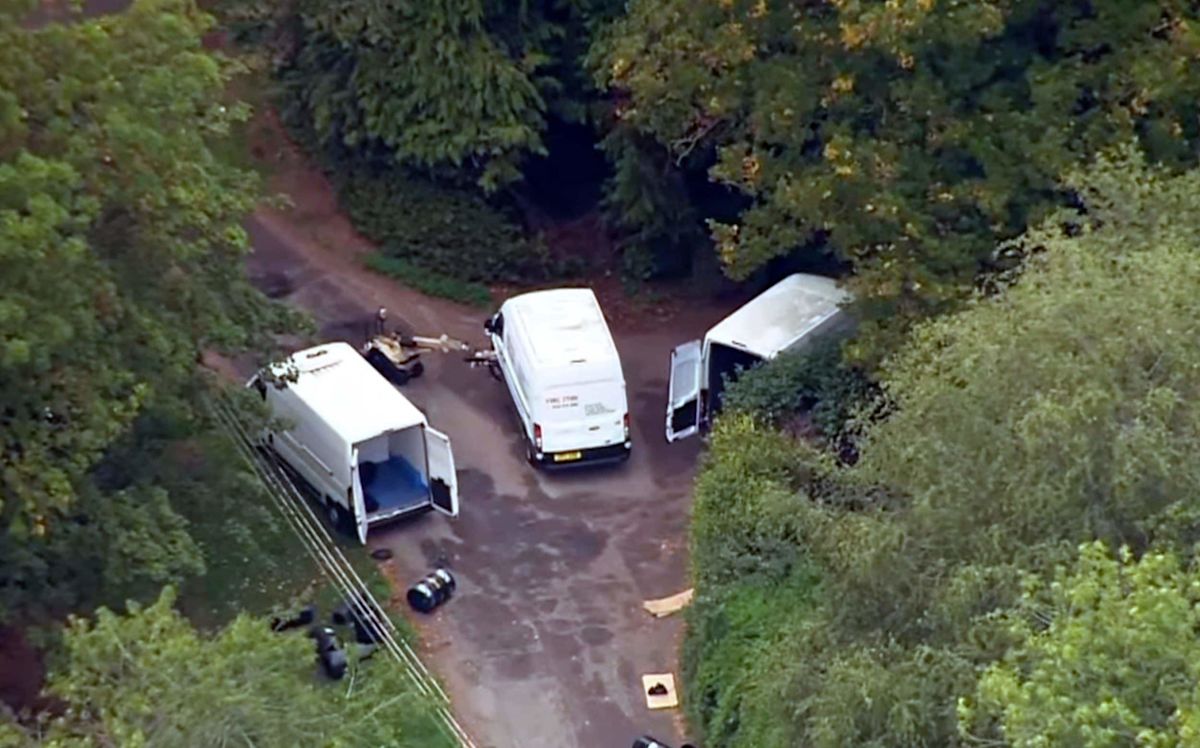
Iran is suspected of being behind an alleged bomb plot at an RAF base used by US forces.
Counter-terror police are investigating the case, and five men have been arrested on suspicion of preparing a terrorist act after three vans were detected travelling toward a village near RAF Fairford in Gloucestershire.
The base serves as one of the US air force’s command outposts for operations from Europe, and was used by US planes to carry out strikes on Iran in the continuing US-Israeli war on the country, which began on Feb 28.
Police are also considering the possibility of a Russian sabotage attempt, though an Iran-linked motive is considered the most likely given the role the base has played in the Middle East conflict.

The Fairford base has been used to carry out strikes on Iran since the US and Israel attacked in February – Reuters/Toby Shepheard
Iran has previously said any base used to attack its territory is a legitimate target. If it is found to be behind a plot to target RAF Fairford, it would demonstrate Tehran is expanding its scope when targeting the US and countries that support its military operations, such as Britain.
Iran is believed to have had a role in a spate of incidents – many of which have been thwarted – in Britain and across the rest of Europe as wartime tensions spill across borders.
Here, The Telegraph looks at the three ways Tehran has targeted countries the regime deems to have bolstered US military actions – and what future threats Britain could face.
Regional threats
After initial US-Israeli strikes against Iran on Feb 28, Tehran immediately retaliated by launching missiles and drones against US forces stationed in the Middle East.
The attacks unleashed chaos as Iran began targeting other areas in countries hosting US forces, including dense urban areas such as Dubai in the United Arab Emirates, as well as energy infrastructure.
Within days, around a dozen countries were affected by the outbreak of war, including Cyprus, home to RAF Akrotiri, which was struck by Iranian drones.
Attacks stepped up after Sir Keir Starmer, then prime minister, said British military sites could be used by the US to strike Iran, having initially refused.
British forces elsewhere in the region continued to come under fire. As an ally of the US and with an interest in the security of the Middle East, the UK often stations its forces in the same locations as American troops, such as Erbil in Iraq.

Donald Trump took questions about the developments at RAF Fairford on Sunday before leaving Washington to attend a golf tournament in Chicago – Getty Images/Tasos Katopodis
As the conflict drags on, Iran has also targeted oil facilities, worsening the energy supply crisis caused as a blockade of the Strait of Hormuz has slowed transit of oil tankers through the strategic waterway down to a trickle.
This has driven up fuel prices around the world, and is starting to push up inflation in countries including the UK – something experts have warned could become worse next year.
Attacks have also come from Iran’s proxy groups in the region, known as “the axis of resistance”. Iran-aligned militias in Iraq have targeted US troops.
Recently, the Iran-backed Houthi rebels in Yemen have engaged in significant escalation, targeting Saudi Arabia so intensely that some European countries, including France and Britain, have agreed to provide military support to counter attacks and protect energy supplies.
The UK could remain in Iran’s crosshairs given such continued wartime support.
Digital threats
Iranian hackers have taken to the internet in attempts to disrupt regular life around the world – an intimidation tactic that may not determine what happens on the battlefield but can undermine an opponent’s morale.
By late March, DigiCert, a US security firm, had tracked roughly 5,800 cyber-attacks mounted by some 50 Iranian-linked groups. Most were aimed at US and Israeli targets, though Bahrain, Kuwait and Qatar were also hit.
In July and August, a coordinated wave of cyber attacks hit water and waste-water utilities in at least 12 US states.
Around the same time, hackers shut down a British power plant for four days – thought to be the first time an Iran-linked cyber attack had succeeded in shutting down a facility in the UK.
Hackers have also targeted data centres in the US – the physical backbone of the internet, housing the servers and other equipment that store, process and route digital information, whether for surfing the internet or sensitive military security.
Taking down data centres could severely disrupt civilian and military operations.
A pro-Iranian hacking group even claimed responsibility for breaking into an account of Kash Patel, the FBI director, and some cyber-attacks have hit hospitals.
One sophisticated operation attributed to Iran involved a text with a link purporting to offer Israelis real-time information about bomb shelters. But instead of downloading a resource, the link embedded spyware to give access to the device’s camera, location, and data.
In June, the UK National Cyber Security Centre disclosed that it had handled more than 200 cyber incidents, with 75 per cent of those attacks linked to hostile state actors, specifically Russia, China and Iran.
Hybrid threats
Iran’s hybrid warfare moves beyond cyber-attacks, and involves the infiltration of Europe via criminal networks or the recruitment of youths online to carry out operations – both of which give the real perpetrator plausible deniability.
In March, a shadowy pro-Iranian Islamist group called Harakat Ashab al-Yamin al-Islamiya (HAYI) emerged on the scene, claiming responsibility on Telegram for attacks across Europe.
These targeted Jewish institutions such as synagogues.
In March, an explosion occurred at the US embassy in Oslo.
In another incident, French police said the first arrested suspect of a foiled bomb attack on the Bank of America building in Paris had been recruited via Snapchat in exchange for €600 (£520).
Then, in April, HAYI claimed responsibility for a knife attack on two British Jewish men in Golders Green, north London.

Police vehicles at the scene of the stabbing of two Jewish men in Golders Green in April – Anadolu via Getty Images/Rasid Necati Aslim
Even before the current Iran war broke out, Tehran had been targeting the Iranian diaspora on British soil.
In 2022, Iran hired a people smuggler to assassinate presenters of Iran International, a news channel and website based in London – a plot that was foiled.
Last October, Ken McCallum, the MI5 chief, revealed that British security services had disrupted 20 potentially lethal plots backed by Iran since 2022.
In 2025, before the current Iran war broke out, a report from Parliament’s intelligence and security committee assessed that Iran posed a “wide-ranging, persistent and unpredictable threat”.
The greatest threat from Iran was identified as “physical threat[s] posed to dissidents and other opponents”, it said.