
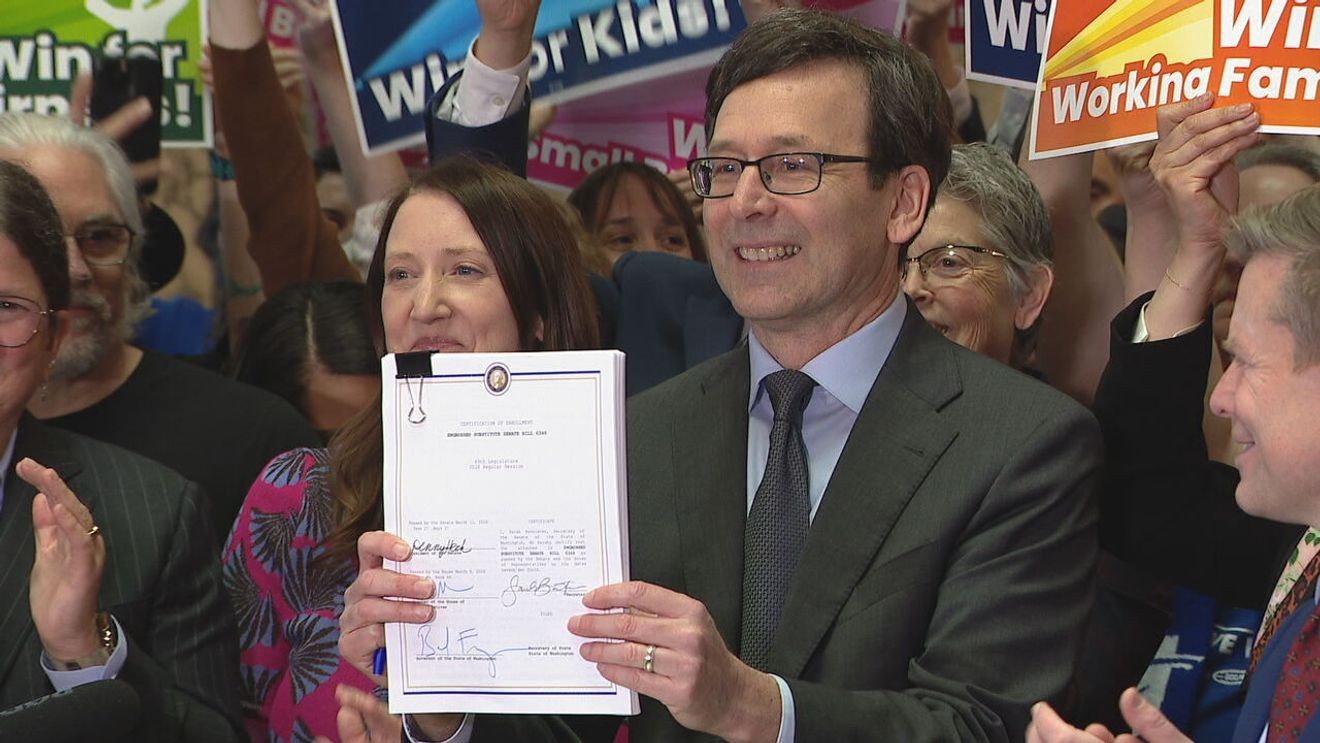
SEATTLE — Watching TV, you might start noticing campaign ads for Initiative 645.
Initiative 645 aims to repeal the state’s “millionaires tax” before a single cent is actually ever brought in from it.
RELATED | ‘Millionaires tax’ opponents submit signatures in effort to let voters repeal the tax
The millionaires tax applies to anyone or household making more than a million dollars each year; the first million dollars of earnings are exempt from the tax, but any dollar made above that threshold will be subject to a 9.9% state income tax come 2029, should it withstand challenges.
A vote “no” on I-645 means you want the tax to stay intact. Here’s what part of a “no” campaign ad airing right now says:
“645 gives millionaires and billionaires a 13 billion dollar tax break…”
While fewer than 1% of Washingtonians will pay into the tax, it would earn the state an estimated $3.5 billion each year, which would help keep the state budget well-funded as Washington faces major money shortfalls.
“The bottom line is that if initiative 645 passes, there will be 13 billion dollars in cuts to K-12 education, childcare and healthcare in this state,” said Rian Watt, who is part of the ‘no’ campaign. “Washington has one of the most upside-down tax codes in the country, where the rich are paying far less of their income in taxes than the rest of us. This is not the time to give a tax break to millionaires and cut K-12 education.”
“They’re saying if we repeal this in the next five weeks, that it will cut money that they have,” said Jaime Herrera Beutler, former congresswoman and spokesperson for the ‘yes’ campaign. That’s not true. The tax isn’t set to actually even be collected for another two years.”
The new law does not specifically allocate the amount of money that would go towards K-12 education or healthcare. The first line of the law, though, does read “an act relating to investing in Washington families and business to fund K-12 education, healthcare and higher education.”
The same ad also points to what some call the state’s regressive tax system, where Washington’s lowest earners are paying a higher share of their income in taxes.
“If you are in the bottom 20% of income earners in Washington, you’re paying about 14% of your income in taxes; that’s mostly sales taxes. If you’re in the top 1%, you’re paying about 4% of your income in taxes,” Watt said. “That’s because if you have a lot more money, then that sales tax on a cup of coffee, or whatever it is, is a much smaller share of your income.”
“If we want to get at a more fair or just tax system, I am more than willing to have that debate,” Beutler said. “And let’s do it in the light of day with all the public watching. Let’s not fake it and then tax [everyone else] when they’re not looking.”
A “yes” vote on I-645 means you want the tax to be repealed. The “yes” side argues that the income tax will eventually apply to every Washingtonian.
“Voters deserve the truth. This is an income tax, and it has been designed to expand to every single Washingtonian,” Beutler said. “Whether you’re a truck driver or a hairdresser or a plumber. It was designed to be expanded to to your income.”
The law does not have any protections from expansion written in. State leaders have said that it is not their intention to ever expand the tax.
“Don’t trust what they say. Trust what they’ve done,” Beutler said.
“99% of us are not going to pay this tax,” Watt said. “And the fact is, voters are always going to have the final say on any efforts to lower that threshold.”
On the “yes” side, an ad takes aim at a different part of the law: “Washington state made a promise: give us your career and your pension will be safe from taxes. This year Olympia broke that promise,” the ad says, in part.
Most retirees will not need to worry about their pension being taxed, as typical retirement levels fall below the taxable threshold under the new. However, the law does remove long-standing tax protections: “…not exempt any pension or other benefit received under this chapter…” the law reads.
“Why would you do that? No teacher or firefighter makes a million dollars. That’s the point,” Beutler said. “They’ve set the whole chess game up with the intention of expanding it to tax the income of every Washingtonian.”
“In an environment where people are struggling to get by, we can’t afford to give millionaires a tax cut at the expense of the rest of us,” Watt said.
The election is on November 3. Ballots will be mailed out on October 16.