
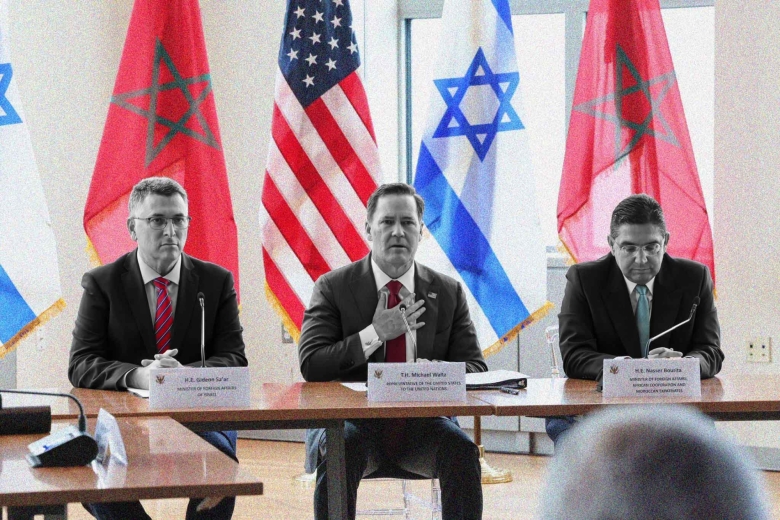
Informed Moroccan sources told Al Majalla that the upgrading of bilateral ties to ambassadorial level followed months of behind‑the‑scenes talks. Some of those discussions were hosted by the US, while the announcement itself was held back until all sides judged the timing and regional conditions appropriate.
Morocco has suspended direct flights to Israel twice since the signing of the Abraham Accords. The first was during the COVID-19 pandemic; the second was during the war in Gaza, amid the slaughter of civilians and the wholesale destruction of Gaza.
The new trilateral agreement is considered binding on the US, Morocco, and Israel and provides for the establishment of full, peaceful, and friendly diplomatic relations. It also covers technological research and defence cooperation, while reaffirming US recognition of Moroccan sovereignty over the Sahara.
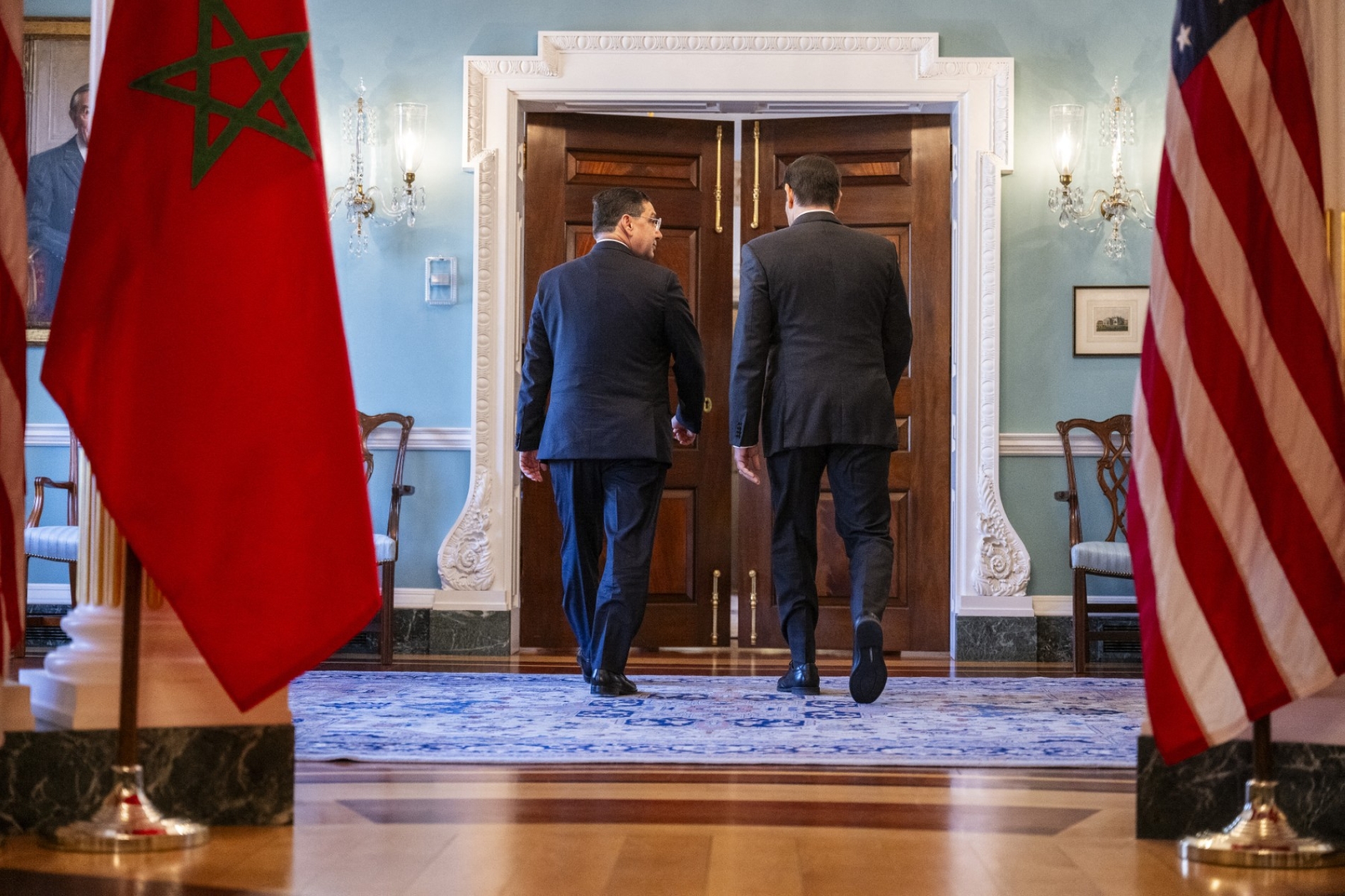 US Secretary of State Marco Rubio (R) walks alongside Moroccan Foreign Minister Nasser Bourita (L) during a meeting at the State Department in Washington, DC, on 8 April, 2025
Washington’s Sahara test
Despite the intention to move quickly, uncertainty remains over when the agreement will take effect. Israeli Foreign Minister Gideon Sa’ar gave few details, saying only that “the details of the economic agreements will be signed between the two countries, through the liaison offices, before the end of the year”. The US administration, meanwhile, is preoccupied with containing the fallout from the Iran war and limiting its political impact ahead of the midterm elections on 3 November.
Analysts believe the UN Security Council meetings on Western Sahara, due to take place on 31 October, will be an important test of the agreement. Rabat is looking to Washington to help settle the dispute on the basis of Moroccan sovereignty, with local autonomy for the territory’s inhabitants, as set out in Resolution 2797.
Morocco is also seeking clearer and more explicit language in the next Security Council resolution, leaving as little room as possible for differing interpretations. US Ambassador to the UN Mike Waltz’s sponsorship of the agreement further underlines the central role Rabat expects Washington to play in the process.
Public support for this new phase of the Abraham Accords may depend in part on whether the US, as the UN Security Council penholder on Western Sahara, can advance a political solution to the territory’s status. A large segment of Moroccan society continues to oppose normalisation with Israel, but resolving the Sahara dispute could shift domestic opinion in favour of normalisation.
According to media figures who spoke to Al Majalla, Washington recognises that solving the Sahara dispute could shift public opinion in favour of the Abraham Accords, strengthen confidence in the US administration, bolster its credibility across the Maghreb, and broaden prospects for peace and stability across the region.
Since the signing of the Abraham Accords, Morocco has made significant diplomatic headway on the international stage, with a growing number of countries backing its 2007 autonomy plan for Western Sahara as a basis for resolving the dispute.
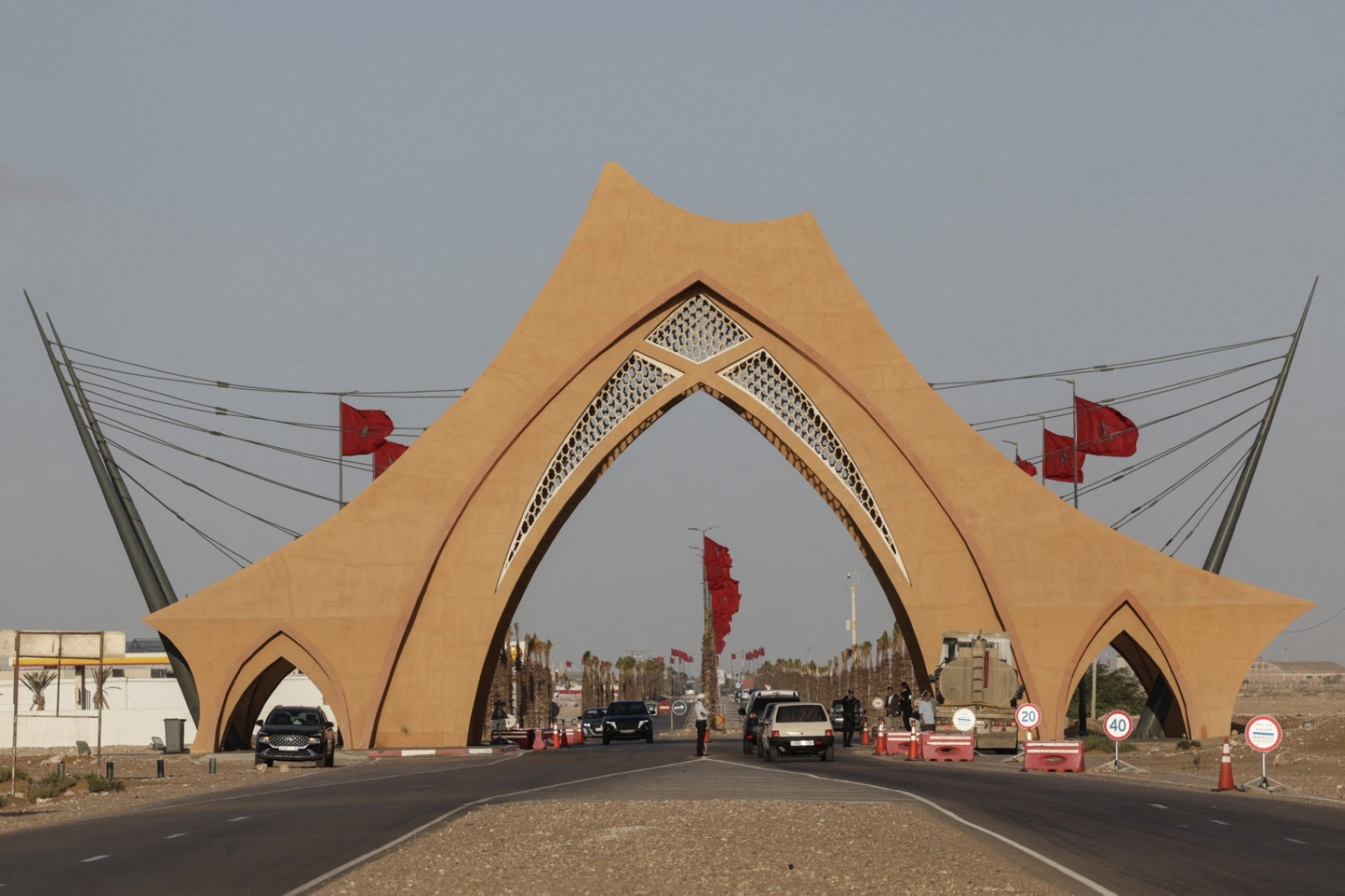 A photograph shows a monumental gate inspired by a traditional Sahrawi tent at the entrance to Laayoune, the main city in the Moroccan-controlled part of Western Sahara, on 6 November, 2025
The gas and Sahara deal
No official condemnation of the agreement has matched the scale of the reaction to the signing of the original Abraham Accords in 2020. Algeria, however, is uneasy about the region’s changing dynamics and the growing influence of external powers, while pursuing discreet talks with Washington over potential economic and geopolitical gains.
Trump’s adviser for Arab and African affairs, Massad Boulos, met Algerian President Abdelmadjid Tebboune on 13 September, their third meeting in the space of a few months. The meeting was held two days before the trilateral talks in New York.
According to leaked information, the visit came as the UN Security Council prepared a draft resolution on Western Sahara, which reportedly describes Morocco’s autonomy proposal as “the only solution on the table to end the dispute”. The draft would also end the UN Mission for the Referendum in Western Sahara’s role and dismantle the Sahrawi refugee camps in Tindouf.
Washington is seeking Algeria’s support for the proposed UN resolution in exchange for greater US investment in energy exploration and upgrades to the country’s energy infrastructure. Such investment could boost revenues, support development, and attract further foreign capital.
Analysts argue that Algeria’s main concern lies less in US recognition of Moroccan sovereignty over the Sahara than in the shifting regional military balance, as Morocco gains access to increasingly advanced Israeli and US defence technology.
Morocco is expected to seek up to 32 US F-35A fighter jets as part of a package valued at between $17bn and $18bn. The proposed package would include the aircraft, equipment, training, and logistical support.
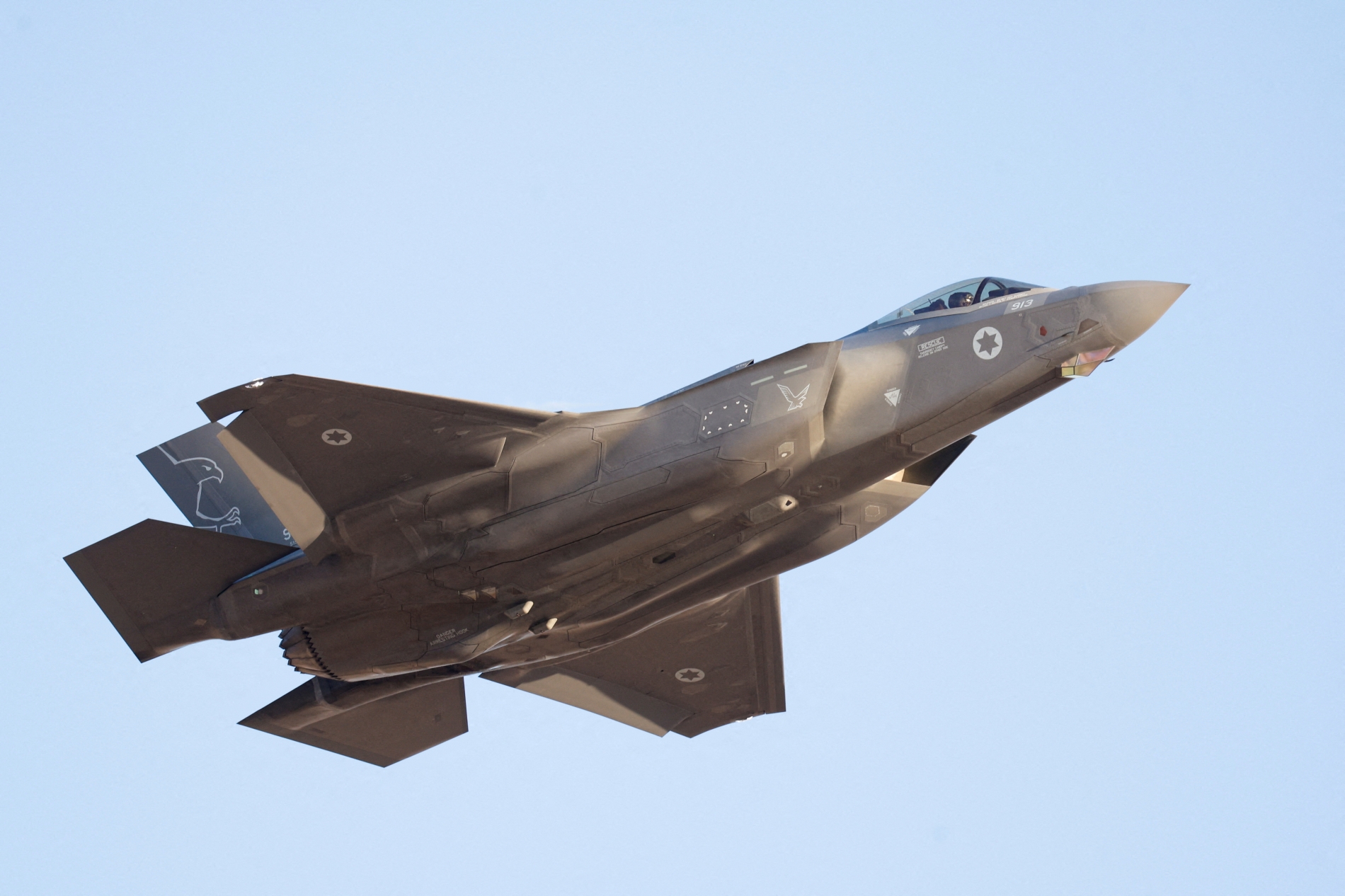 A F-35 fighter jet flies during a graduation ceremony for Israeli Air Force pilots at Hatzerim Airbase, in southern Israel, on 29 June 2023.
Arms, then peace
In recent years, Morocco has launched an ambitious military modernisation drive, including the local production of drones, armoured vehicles, and other equipment in partnership with China, Türkiye, and India. It has also acquired Israel’s Barak MX air defence system in a $500mn deal.
Morocco has also acquired the PULS rocket artillery system, with between eight and 12 units reportedly ordered under a contract worth approximately $150mn. Military cooperation with Israel has also enabled Rabat to acquire the ATMOS 2000 self-propelled artillery system, developed by Israeli defence company Elbit Systems.
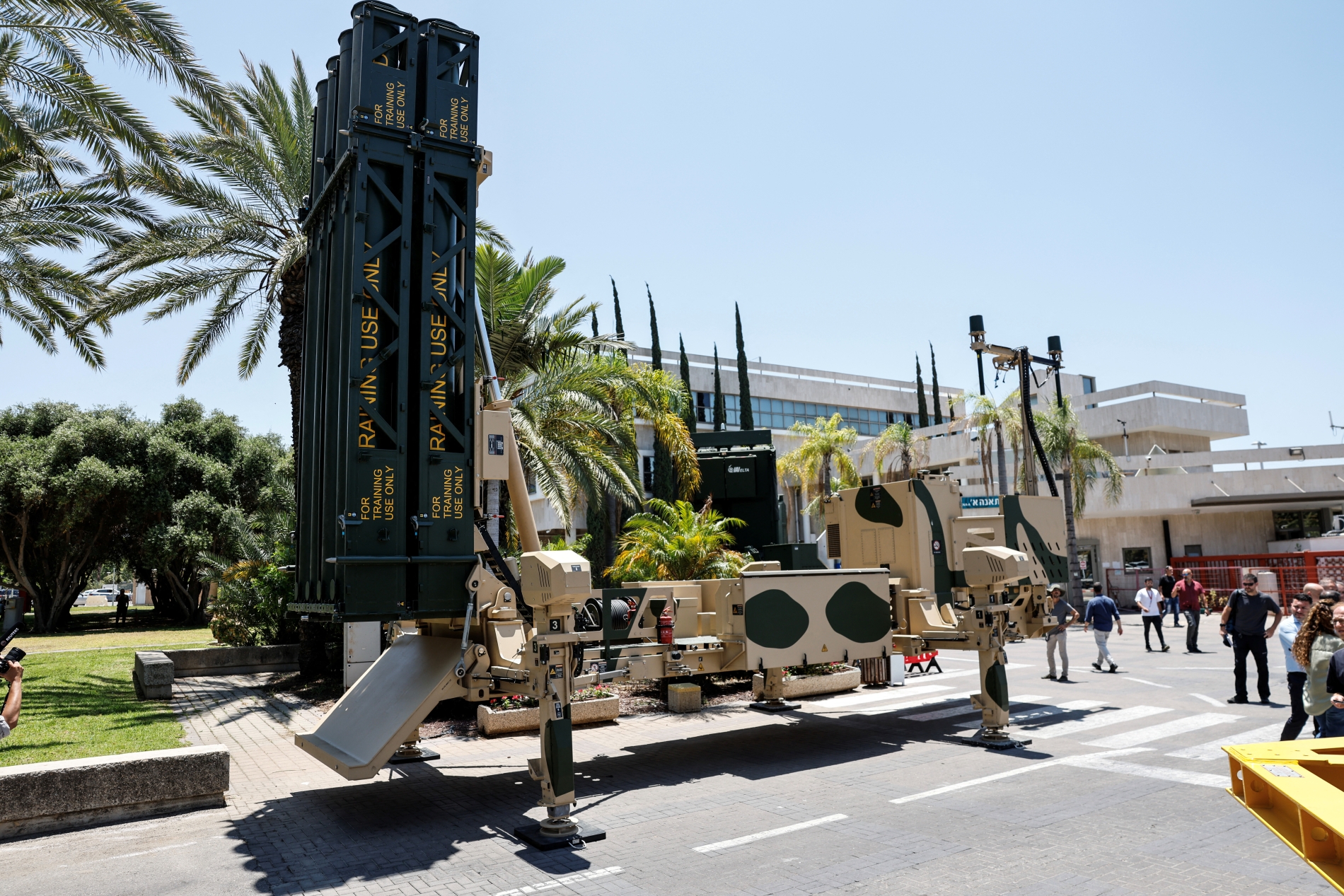 An IAI Barak MX air defence launcher is presented to the media at IAI’s ELTA division in Ashdod, Israel, on 12 June, 2025.
Drones have become an increasingly important part of Morocco’s military capabilities, with Rabat moving towards local production in cooperation with Israel and Türkiye. The systems involved include tactical drones such as the WanderB and ThunderB from BlueBird Aero Systems, as well as Elbit Systems’ Hermes 450 and MALE-class models. Cooperation between Morocco and Israel also extends to sensitive areas such as cybersecurity and electronic intelligence.
In the autumn of 1994, I attended the Middle East Economic Summit in Casablanca, held in the wake of the Oslo Accords. Shimon Peres, Israel’s prime minister at the time, appeared optimistic as he spoke to journalists, discussing the vision set out in his book The New Middle East.