
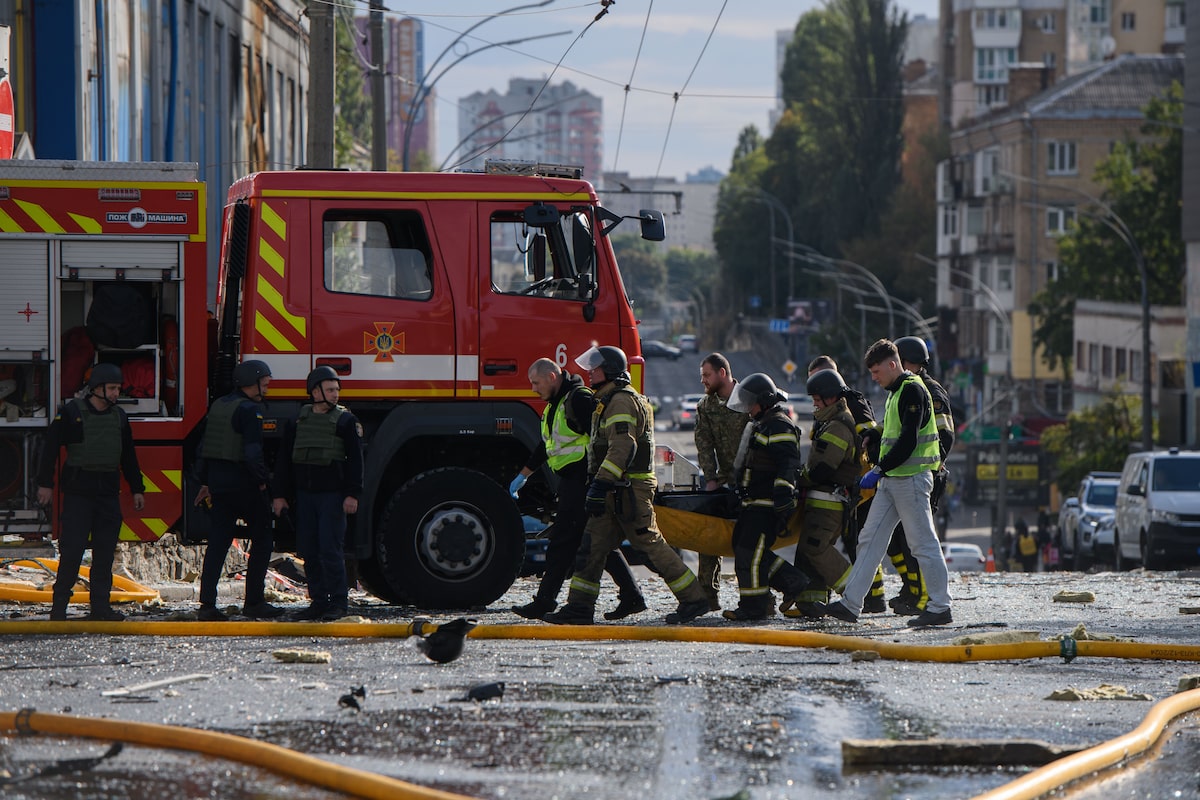
Firefighters respond to Russian drone attacks in Kyiv on Friday.Olga Ivashchenko/The Globe and Mail
It was a quiet, sad Saturday afternoon in the Baikove cemetery in the centre of Kyiv. Mourners exchanged tearful hugs, then gathered around a plastic table set with food and drinks to mourn yet another fallen soldier.
The sombre silence was broken by a loud explosion. A cloud of smoke appeared in the sky, temporarily marking the spot where a Russian drone had been shot down by Ukrainian air defences.
Moments of calm are few and far between in Kyiv these days, amid fears that something much worse lies ahead as winter approaches. Day and night, jet-powered Russian drones buzz through the sky. Successful Ukrainian interceptions, such as the one on Saturday afternoon, have become rare.
Strikes across Ukraine kill at least six as Russia rejects Germany’s call for de-escalation
Although the Ukrainian capital has been under attack since the start of the war in February, 2022, life in the city often seemed remarkably unaffected thanks to its world-class air-defence systems. No longer.
A worldwide shortage of Patriot missiles – caused by the U.S.-Israeli war against Iran – has created a hole in Kyiv’s shield. Only the Patriot systems have proven reliable at shooting down the ballistic missiles Russia pounds Kyiv with on a regular basis.
Open this photo in gallery:Open this photo in gallery:
The Ukrainian capital of Kyiv has been under attack since the start of the war in February, 2022.Olga Ivashchenko/The Globe and Mail
The introduction of Russia’s Geran-4 jet drones – which can travel as fast as 600 kilometres an hour and carry 50 to 90 kilograms of explosives – has added to Kyiv’s sudden vulnerability. Russia has launched more than 1,000 drones, and dozens of missiles, at the capital since Sept. 1, killing at least 35 people.
Seven died Friday, as the capital endured a day-long attack that left smoke hanging over large parts of the city. Targets included several high-tech centres, a food storage warehouse and a 16-storey apartment block.
A week earlier, the Ukrainian government moved Kyiv onto the list of high-risk cities for insurers for the first time since 2022, effectively acknowledging that the capital has become nearly as dangerous as the front line hundreds of kilometres to the east. The city recently introduced a two-tiered system for air-raid alarms on both loudspeakers and cellphones – yellow means drones overhead, red means incoming missiles – to allow businesses to continue to function during the yellow alerts that sound throughout the day.
There were 10 sirens on Friday alone, ranging between six minutes and three-plus hours in length, and 10 more on Saturday.
Olena Halushka, 37, a civil society activist.Olga Ivashchenko/The Globe and Mail
“It’s an absolutely new reality right now. The air raids are almost non-stop,” said Olena Halushka, a veteran civil society activist whose office is in the centre of Kyiv. “You have to plan your life accordingly. That means children have to study from shelters. That means that you have to plan your grocery shopping or anything else in those very small pauses between air raids.”
In the Ukrainian city of Kramatorsk, drones rule the skies and everything below
All the weekend sirens were yellow alerts, indicating only drones. The fear is that Russia is stockpiling ballistic and cruise missiles ahead of a “massive attack” that President Volodymyr Zelensky has warned about. Ukrainian media reported that the attack could include as many as 50 ballistic missiles, plus another 50 cruise missiles.
Energy Minister Denys Shmyhal said Friday that Russia had made up a list of Ukrainian infrastructure targets – including electricity stations and heating and water treatment systems – and calculated what kinds of weapons would be needed to destroy each facility.
The weekend assault on Kyiv appeared aimed at damaging the country’s internet and communications systems. Some 100,000 homes in the capital region temporarily lost service Friday after at least 10 data centres were hit over the preceding days, and several television channels were briefly forced to stop broadcasting Saturday because of signal problems. On Sunday, data centres for Kyivstar and Vodafone, two major mobile phone service providers, were both reportedly struck.
Open this photo in gallery:Open this photo in gallery:
A recent poll found that 40 per cent of urban residents in Kyiv were considering moving, either abroad or elsewhere in Ukraine.Olga Ivashchenko/The Globe and Mail
Fuel supplies have been another frequent target. Burned-out gas stations line both sides of the highway connecting Kyiv to the eastern city of Kharkiv. The railway network has also come under repeated attack; more than 500 Ukrainian locomotives have been damaged or destroyed since the start of the war, and passenger trains are now regularly evacuated mid-route because of approaching drones or missiles.
Ukraine has simultaneously escalated its own campaign of long-range strikes at targets inside Russia, focusing primarily on the oil and gas industry that powers the Russian economy and funds President Vladimir Putin’s war machine.
But despite some spectacular attacks on major Russian refineries in recent weeks, the campaign hasn’t had a perceptible impact on Russia’s ability to produce large numbers of missiles and drones. That’s led to worries that the coming winter will be even harder in Kyiv than last year’s, when Russian strikes left much of the capital without electricity, heat and even running water for days on end.
A worldwide shortage of Patriot missiles – caused by the U.S.-Israeli war against Iran – has created a hole in Kyiv’s shield.Olga Ivashchenko/The Globe and Mail
A recent poll conducted by Gradus, a Kyiv-based social research company, found that 40 per cent of urban residents were considering moving – either abroad or elsewhere in Ukraine – if their living conditions deteriorated further.
“People are assessing whether they will be able to maintain a basic standard of living under unstable conditions,” said Evgeniya Blyznyuk, the chief executive officer of Gradus. “People are not panicking about possible difficulties, but nor are they relying on the assumption that things will somehow work out.”