
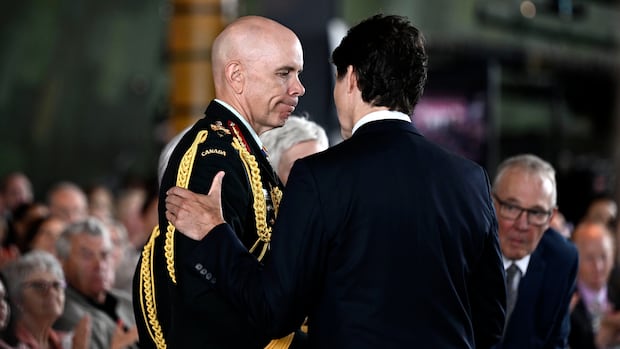
Canada’s former top military commander considered resigning “several times” during his tenure in battles with the former Trudeau government over the sexual misconduct scandal, and the lack of commitment towards defence spending.
Retired general Wayne Eyre’s new memoir, Into the Breach: A Soldier’s Journey, also peels back the curtain on the internal debate that took place over how to end the convoy occupation of downtown Ottawa in early 2022.
The prologue to the book, titled The Accidental CDS, is a tongue-in-cheek reference to his unusual, unexpected rise to the position of chief of the defence staff.
Eyre was promoted from being army commander to the top job after now-retired admiral Art MacDonald stepped aside in February 2021 because of allegations of inappropriate behaviour. Those allegations never resulted in charges and MacDonald didn’t return to the defence chief’s job.
Eyre was left to navigate the wider sexual misconduct scandal and a flurry of allegations which engulfed several high-ranking military leaders — an experience he described as “soul crushing.”
He candidly writes about how, in the first few months, he often questioned whether he was up to the task.
Eyre’s memoir recounts a highly charged incident in June 2021 where he said he felt thrown “under the bus” by former deputy prime minister Chrystia Freeland.
At the time, Prime Minister Justin Trudeau and Freeland both publicly questioned Eyre’s decision to allow the now-former commander of the navy, Vice-Admiral Craig Baines, to remain in his post after he took part in a golf game with former chief of the defence staff Jonathan Vance, who had been under military police investigation following allegations of inappropriate behaviour.
In Eyre’s view, Freeland’s criticism amounted to forcing the prime minister to choose between his deputy and his senior military adviser.
“If there’s no trust between the nation’s senior military leader and the nation’s senior elected leader, one of them has to go, and it’s not going to be the elected leader,” Eyre said in an interview with CBC News.
Support from Trudeau kept him from resigning
The incident culminated, Eyre said, when he was on the phone with the prime minister to discuss the decision to retain Baines. He was just about to resign when Trudeau stopped him by saying he still had confidence in him.
After his initial criticism, the prime minister made a further statement of support for his defence chief — remarks Eyre had not seen when the phone call was placed. The crisis was defused, but the tension remained.
WATCH | Eyre thought about resigning ‘several times’ during tenure: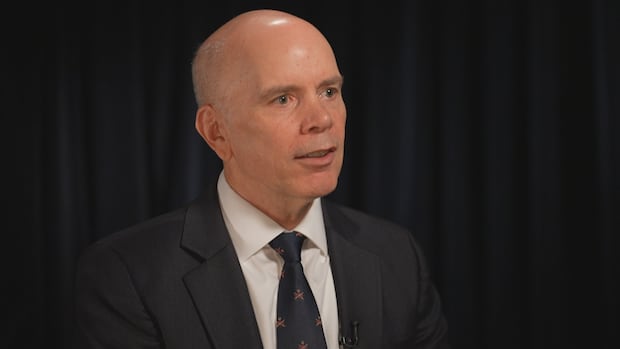
Former military commander Eyre says he thought about resigning ‘several times’
Retired general Wayne Eyre speaks to CBC senior reporter Murray Brewster about a description in his memoir of a moment when he considered resigning as chief of defence staff after being thrown ‘under the bus’ by the former deputy prime minister, Chrystia Freeland.
Eyre served another three years after the incident.
Resignation crossed his mind “several times” as internal battles unfolded over defence funding and the deteriorating state of readiness in the military.
Ultimately, he decided to stay because quitting would have precipitated a further crisis in an already wounded institution.
“You’ve got to be very careful as a military leader about resigning. You can fall on your sword, but generally it hurts and you can only do it once,” he said.
“Resigning is an inherently political act, which could further fray political-military relations, [and] would cause a momentary blip in the media cycle. But at the same time, [it would] cause significant turmoil in the institution.”
Throughout his tenure there was a series of rolling crises including the various waves of the COVID-19 pandemic and Russia’s full-scale invasion of Ukraine on Feb. 11, 2022.
At the time, the Trudeau government faced public criticism about its reluctance to approve lethal aid for the embattled Eastern European country. It was a struggle, Eyre acknowledged.
“What we experienced at that time was a collision of ideology with reality,” he told CBC.
“The ideology being, we are Canada, we don’t supply weapons to a conflict zone. The reality was, OK, this is coming, Ukraine is a friend, this [is] one way we can help.”
‘Lethargy to approve a new defence policy’
Eyre’s book is littered with further examples related to Canada’s mission to train Ukraine troops and the transfer of M-777 artillery, underlining his frustration with the government’s seeming “inability to make decisions at the speed of war.”
He did note there were times when Canada later outstripped its allies in the swift delivery of war supplies and equipment, such as Leopard tanks.
The overall sense of frustration came into sharp focus during Ukrainian President Volodymyr Zelenskyy’s September 2023 visit to Canada, which included a series of speeches in Toronto.
“Both the PM and Deputy PM Freeland gave bellicose, impassioned speeches about being strong and supporting Ukraine,” Eyre wrote, noting the contradiction between the political rhetoric and the fiscal reality that faced the Canadian military at the time.
“I, like the handful of CAF senior leaders present, had a hard time reconciling these otherwise great speeches with both the billion-dollar budget cut that they had just inflicted on us and their lethargy to approve a new defence policy.”
The deeper the war in Ukraine became, the more concerned Eyre became about the state of Canada’s readiness.
WATCH | Eyre urges Canada to support Ukraine’s defence: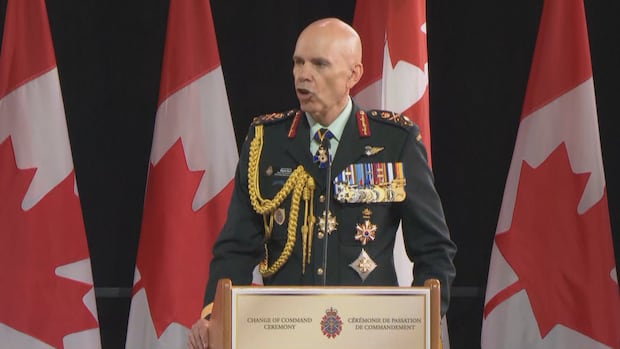
‘Urgency is required,’ says outgoing chief of defence staff Gen. Wayne Eyre on Russia-Ukraine war
In his final words as Canada’s chief of defence staff, Gen. Wayne Eyre said ‘evil walks this earth’ and urged Canada to continue to support Ukraine’s defence.
He described how, in June 2022, during the run-up to the unveiling of Canada’s new policy commitment to NORAD — the by national aerospace command — no one seemed to know where $38 billion in funding was going to come from, or where it would be allocated.
“Most galling was the ‘smoke and mirrors’ funding approach, with billions already allocated for other military equipment taken away and reallocated, with most investments only coming years into the future,” Eyre wrote.
“With confusion persisting several days later, I drew some government ire when I frankly told a journalist that the source of funds ‘wasn’t clear to me.'”
Military ‘compartmentalized’ Ottawa convoy involvement
The memoir also sheds light on a passing reference that appeared in the public hearings related to the invocation of the Emergencies Act to end the convoy protest.
Former deputy defence minister Bill Matthews testified that the military prepared operational plans as a precaution, but they were dismissed due to significant concerns that deploying troops would escalate tensions and mirror the 1990 Oka Crisis.
Throughout the convoy protest crisis, Eyre was firmly opposed to the notion that the military had any sort of role whatsoever. He attempted to correct the public perception by saying there’s a difference between planning and scenario spinning.
“We looked at various scenarios, and it wasn’t planning because a plan entails assigning troops to task and warning at all levels and the like,” Eyre told CBC News.
“No, it was more thinking about various scenarios, and what questions would we have to ask, what measures would have to be taken. But given the sensitivity at the time, it was very compartmentalized.”
Most of the discussion, he said, revolved around the use of military tow-trucks to remove protest vehicles.
In his memoir, Eyre wrote: “At the time one of my staff commented, ‘If you accomplish nothing else as CDS, keeping the CAF out of this mess is a singular achievement.'”
Canada ‘on the right path,’ Eyre says
During his final months as defence chief and in his departure speech, Eyre warned about how dangerous the world had become and how Canada needed to prepare.
Prime Minister Mark Carney’s government reversed many Trudeau-era policies and has begun substantially investing in defence — taking the country to the NATO standard of two per cent of the gross domestic product.
Several European political leaders, as well as security and intelligence agencies have warned that the West is likely to face a major conflict with Russia and possibly even China by the end of the decade.
Asked by CBC whether he thought the country was ready for what may be coming in the next few years, Eyre said no.
“But we’re on the right path, and we are getting there.”