
September 2026 has been a tough month for Saudi Arabia. Its ally, the embattled internationally recognized Yemeni government, was routed from Yemen’s western Red Sea coast by the Iran-allied Houthis, officially known as Ansarullah, threatening the kingdom’s alternative oil export routes from the blockaded Strait of Hormuz. Furthermore, the Houthis have continued drone and missile attacks targeting Saudi energy infrastructure and military bases. Saudi Arabia said the group has also attempted to attack its capital Riyadh with a ballistic missile and even the holiest Islamic city of Mecca with a drone. Arguably now in its most precarious strategic position since 1990, when Saddam Hussein’s Iraq infamously annexed Kuwait, Riyadh needs all the foreign military help it can get. And while several allies are contributing or have pledged defensive military support, the cavalry coming today is a mere shadow of the enormous multinational coalition assembled in the Saudi desert 36 years ago to confront Iraq.
“We are going to send military resources, that is to say, soldiers, radar systems and defense systems, to protect this site – not to get us involved in any conflicts, but to protect this site,” French President Emmanuel Macron declared on Thursday. The site in question is Yanbu, a major Saudi port city on the Red Sea that the Houthis have repeatedly targeted in recent weeks.
Macron did not specify exactly which systems France will deploy alongside the troops. It may deploy point-defense, ground-based, short-range air defense systems like the Mistral to defend against Houthi drones, along with additional radar to enhance Saudi monitoring of its vast airspace. It may even deploy a more advanced SAMP/T, the French acronym for “Surface-to-Air Medium-Range/Land-based,” system to help Riyadh with missile defense. At the height of the Iran war earlier this year, France sent Dassault Rafale fighter jets to bolster the United Arab Emirates’ air defenses, firing at least 80 pricey MICA air-to-air missiles to defend that country from comparatively inexpensive enemy drones. It’s not inconceivable that France may dispatch Rafales, a combat aircraft Paris hopes Riyadh might soon buy, to perform a similar defensive role over Saudi Arabia.
The United Kingdom is also helping Saudi Arabia through the deployment of a Voyager refueling aircraft on a “purely defensive” mission to span for a “matter of weeks, rather than days.”
Pakistan and Turkey, which are fellow members of the Mecca Joint Defense Agreement pact signed in the holy city on August 7, have also pledged support. Islamabad has said it will defend its Saudi ally “to any extent” on September 17 while Ankara said it could provide technical military support. “There may be military needs, particularly in certain technical areas, and we would have no problem meeting them,” said Turkish Foreign Minister Hakan Fidan on September 19. The three countries announced urgent meetings of their chiefs of staff to determine how they can support Saudi Arabia.
Pakistan already deployed 16 JF-17 Thunder fighter jets, a Chinese-made HQ-9/P air defense missile system, and 8,000 troops in May. Saudi Arabia and Pakistan had already signed a defense pact in September 2025 following Israel’s unprecedented airstrike targeting the Hamas political leadership in Qatar’s capital, Doha. It’s unclear whether these jets have helped Saudi Arabia intercept any Houthi drones or whether the HQ-9/P intercepted any Houthi missiles. Notably, the Pakistani military has dismissed rumors that a Houthi strike damaged one of its JF-17s at Saudi Arabia’s King Abdulaziz Air Base.
What Turkey might ultimately deploy remains unclear. Ankara has based F-16s in other countries as far away as Somalia. It might deploy some, as it has done in neighboring Qatar, as a show of support to help Riyadh intercept drones but probably won’t participate in offensive operations in Yemen. Regarding air defenses, the only system Turkey presently has with anti-ballistic capabilities is the strategic S-400 it acquired from Russia in 2019 but never put into operation or service. It seems unlikely Ankara would deploy them, although it recently reportedly negotiated to sell them to the UAE. Turkey is presently developing a new version of its indigenous Siper system, the Siper Block-III, which will have anti-ballistic capabilities. Short-range Turkish-made air defenses like the Hisar-A surface-to-air missile system and the Korkut anti-aircraft gun could help bolster Saudi point defenses of critical infrastructure once again being targeted by the Houthis.
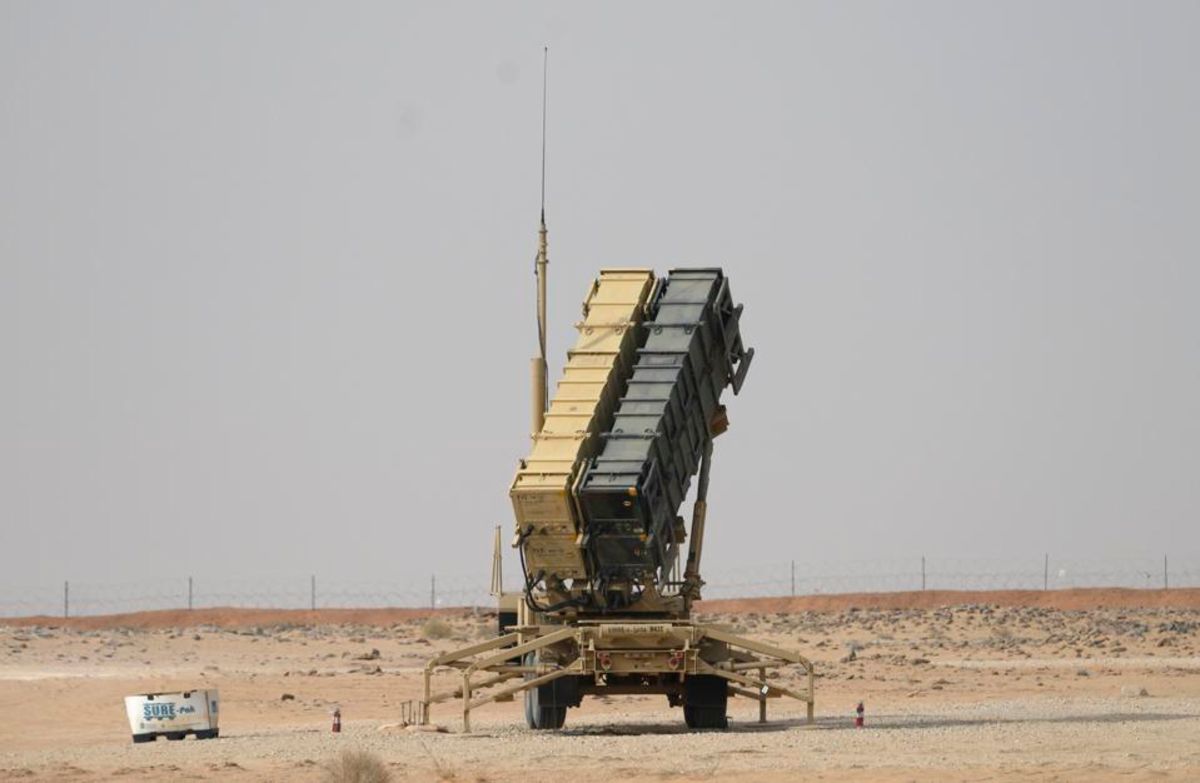
One country that has actively and visibly contributed to Saudi Arabia’s defense recently is Greece. Athens deployed one of its Patriot missile systems to the kingdom in 2021. The Greek system intercepted a ballistic missile and a drone over the Yanbu region on September 24.
Saudi Arabia needs such defensive support in light of the Houthis’ swift advance down Yemen’s Red Sea coast and their capture of the major Yemeni port of Mocha on September 10 and the strategic Perim island. That lightning advance positioned them to more effectively close the strategic Bab al-Mandab Strait to commercial shipping in support of Iran’s concurrent blockade of the Strait of Hormuz entrance into the Persian Gulf. The Houthis have repeatedly declared that their blockade only applies to Saudi shipping. After Iran shut Hormuz, Saudi Arabia had depended on its alternative Red Sea exports to export much of its oil. In a demonstration that this alternative route is also vulnerable, Iran-backed militias in Iraq struck the vital Saudi East-West pipeline, which the kingdom was using to circumvent the Hormuz blockade, temporarily taking it out of operation.
The powerful Saudi Crown Prince Mohammed bin Salman phoned President Donald Trump, urging renewed U.S. airstrikes against the group during their advance. Trump refused. The U.S. has expanded intelligence and targeting support for Saudi operations against the Houthis through the deployment of advisors to the kingdom. Still, it is otherwise hesitant to get directly involved or launch another major air campaign for now. As a result, Saudi Arabia must rely on these other allies to help bolster its defense. But none of these countries have shown any intention of helping Riyadh go on the offensive and uproot the Houthis, with Saudi Arabia relying on airstrikes and, in at least one instance, one of its Chinese-made ballistic missiles, to hit the Houthis. In another blow to the kingdom, the group released footage in mid-September, subsequently verified by the BBC, showing the wreckage of a downed Saudi F-15SA, the most advanced fighter type in its current arsenal.
Bin Salman has a history with the Houthis. As a young defense minister in 2015, he assembled a regional military coalition intending to uproot the Iran-backed group, which overran Yemen’s capital Sanaa and the major Hodeidah port the year before. Far from pushing back the group, the war contributed to Yemen’s dire humanitarian crisis and was widely unpopular. By 2022, the crown prince accepted a ceasefire with the group that largely endured until recent months. In the meantime, he hoped the temporary peace could buy time for his ambitious domestic projects aimed at diversifying the Saudi economy and developing some of his overly ambitious megaprojects, such as Neom. The Iran war dashed these hopes. In July, after Tehran attempted to reestablish direct flights to Houthi-controlled Sanaa for the first time since 2015, Saudi Arabia intervened. The 2022 ceasefire promptly collapsed. Now, long-range Houthi missile and drone attacks on the kingdom are once again a regular occurrence.
Allied support certainly isn’t negligible. Advanced American-made Saudi air defenses were no doubt strained during the Iran war and will take years to replenish to pre-war levels. Saudi Arabia’s last war with the Houthis also saw its Patriot missile stockpiles nearing depletion. Consequently, defensive support from allies will at least partially ease the burden on its defense interceptors and air force.
And while its allies are unlikely and unable to assemble an armada like the one the U.S. put together for the 1991 Persian Gulf War, which saw 900,000 soldiers deployed to Saudi Arabia, today’s threat is markedly different. After Saddam Hussein’s Iraq invaded Kuwait, Riyadh estimated that if his army continued advancing within the first week, it could’ve seized its entire Eastern Province within six hours, or maybe 12 if Saudi Arabia had extensive air cover. Today, the Eastern Province, the country’s main crude hub, is highly vulnerable to Iranian and Houthi drone attacks but is unlikely to face any conventional ground invasion from either Tehran or that group.
Still, Saudi Arabia today remains in an unenviable strategic position beyond its control and has little choice but to sit tight.
This article was originally published on Forbes.com