
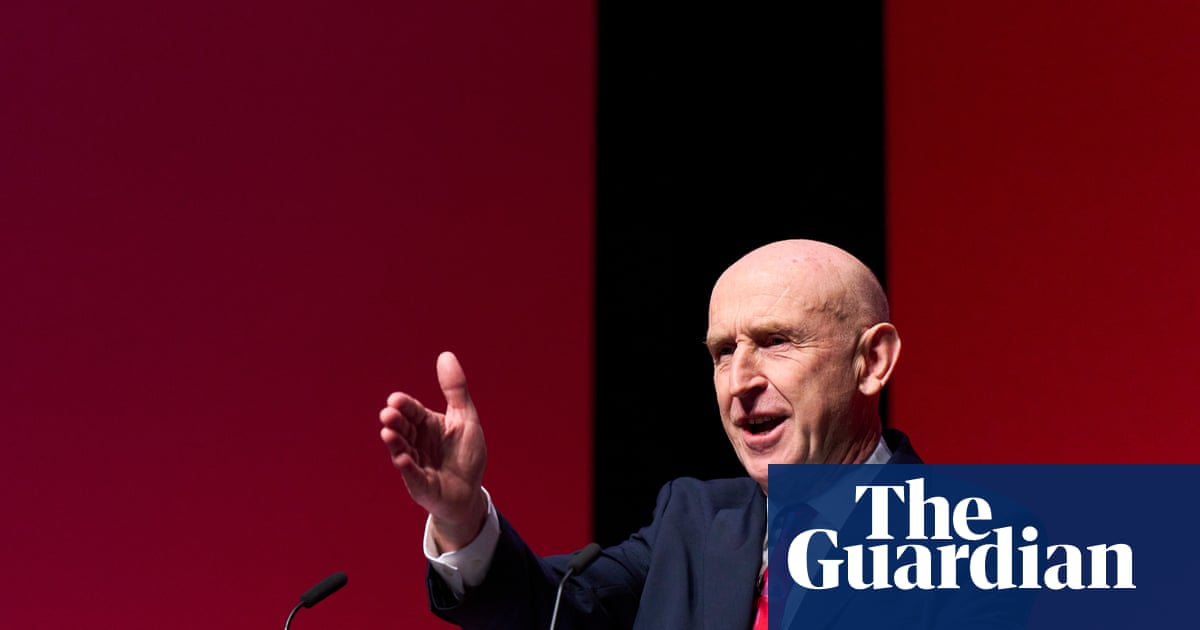
John Healey has signalled Labour will stage a fresh attempt at welfare reform as he pledged to put fiscal discipline at the core of next month’s budget, alongside measures to inject hope into Britain’s economy.
In his first speech as chancellor to the Labour conference, Healey warned that next month’s highly anticipated tax-and-spending event would need to take into account a challenging global backdrop.
Setting out measures to support jobs and growth, the chancellor announced a new local apprenticeship service, to be led by mayors, targeted at young people to deliver “thousands more apprenticeships” across the country.
However, he also gave the clearest indication yet that job support would be accompanied by changes to the welfare system designed to incentivise employment while curbing a soaring benefits bill.
Rolling the pitch to avoid a repeat of the welfare rebellion that forced his predecessor, Rachel Reeves, into a costly U-turn, Healey argued Labour had a “moral duty” to overhaul the system to encourage people to find a job.
“Our social security system must always be there for those who can never work. But for everyone else, benefits should be a bridge to work, to wider participation, to a better life, not a trap that people can’t escape,” he said. “And, conference, it is simply not progressive to allow a bigger and bigger benefits bill and a system which offers an income but doesn’t offer a future. So, once again, as a Labour government it falls to us to act.”
Insisting he would balance the books while fleshing out Andy Burnham’s plans to strengthen “growth in every postcode”, Healey said he and the prime minister were in lockstep in their commitment to balance the books.
“That commitment is so important. There is nothing progressive about losing control because it’s always working people who pay for it,” he said.
Against a backdrop of jitters in financial markets as the Iran war rattles the global economy, the UK government’s borrowing costs have risen to the highest levels for almost two decades.
Economists have warned that the chancellor could be forced to increase taxes or cut spending in response to rising pressures. However, with Burnham having promised to stick to Labour’s manifesto promise not to raise income tax, national insurance or VAT, investors view benefits reform as a totemic issue that could help the prime minister to demonstrate his commitment to balancing the books.
Since he replaced Keir Starmer this summer, Burnham has signalled that Labour remains willing to overhaul welfare, amid predictions that the overall cost of pensions and welfare benefits could reach £409bn by 2030.
In a speech aiming to strike a balance between promising to fund the new prime minister’s priorities and committing to fiscal discipline, Healey drew a comparison with the 1990s when he was an adviser to Gordon Brown.
Wearing a red tie that he had lent to Brown, then chancellor, to wear for a Labour conference speech in Bournemouth more than two decades ago, he said the money New Labour had in the 1990s “is simply not there now”.
Teeing up a tough budget on 28 October, in which Burnham has warned “difficult decisions” will need to be taken, Healey said the government needed to hold firm on its main fiscal rule requiring day-to-day spending to be matched by revenues by 2030.
Rain Newton-Smith, the chief executive of the business lobby group the CBI, said: “The speech sent many of the right signals. The budget now needs to turn them into action if we are to fundamentally change firms’ willingness to invest, take a chance on a young person, and scale a business here in the UK.”
Healey sought to draw a distinction between Labour’s approach and that of the Conservatives, saying Britain was suffering from the “reckless actions” the Tories had taken since 2010. He accused Reform UK of prioritising the interests of “dodgy” billionaire donors, saying Nigel Farage was “Liz Truss with a bitcoin account”.
Healey’s local apprenticeships announcement comes as ministers await recommendations from two reviews of the welfare system expected to be published this autumn – on young people by Alan Milburn, and on a key disability benefit by the Timms panel.
Milburn, a former Labour cabinet minister, has signalled that changes to welfare would be central to his recommendations, alongside measures to boost access to job support, education and training opportunities.
Aiming to strike a balance between a message of fiscal discipline and an upbeat approach, Healey used his conference speech to argue that his budget would inject hope into the economy.
The chancellor said actions would be taken to devolve power to regional mayors, alongside measures to support young people to find work and to reinvigorate business confidence. Healey also said he would allocate £6bn from the government’s defence investment plan to contracts for British shipyards, as part of a project to reindustrialise Britain.
“Let’s bring back hope to Britain. For the next generation of young people. For a new age of industrialisation. For growth made here, by British firms and British workers,” he said.