

Want to bookmark your favourite articles and stories to read or reference later? Start your Independent Membership today.
Already a member?
Log in
Your support helps us to tell the story
From reproductive rights to climate change to Big Tech, The Independent is on the ground when the story is developing. Whether it’s investigating the financials of Elon Musk’s pro-Trump PAC or producing our latest documentary, ‘The A Word’, which shines a light on the American women fighting for reproductive rights, we know how important it is to parse out the facts from the messaging.
At such a critical moment in US history, we need reporters on the ground. Your donation allows us to keep sending journalists to speak to both sides of the story.
The Independent is trusted by Americans across the entire political spectrum. And unlike many other quality news outlets, we choose not to lock Americans out of our reporting and analysis with paywalls. We believe quality journalism should be available to everyone, paid for by those who can afford it.
Your support makes all the difference.Read more
SpaceX’s Starship has been sent into orbit for the first ever time – before returning to Earth with an explosion at sea.
The spacecraft’s 14th flight was seen as a critical test of Elon Musk’s hopes to take humanity back to the Moon and Mars. And it largely succeeded, launching into orbit, deploying a set of Starlink satellites and then coming back down to Earth.
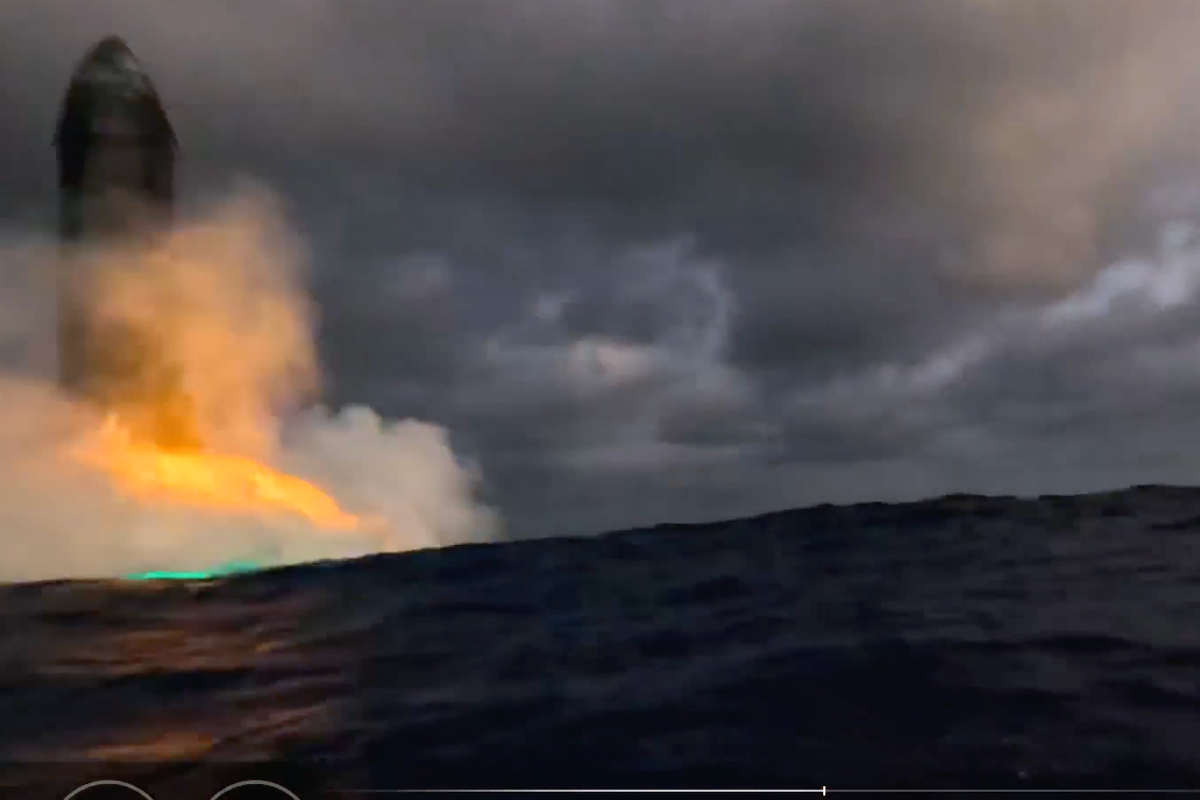
But that arrival back on our planet came with a dramatic fireball. The spacecraft successfully flipped itself around to land softly in the ocean – and then exploded in a huge fireball once it had hit the water.
Eventually, SpaceX hopes that Starship is able to conduct that same flip manoeuvre on land in Texas, so that it can safely carry people home and then be ready to be re-used. But for the moment, the spacecraft is being landed in the sea with no plan to recover and recycle it.
SpaceX shared video of the Starship’s final moments and its splashdown from its official feed. But it notably cut the video before the explosion, which occurred very shortly after Starship had fallen into the ocean.
The mission had already been hit by a range of technical problems as it flew around Earth. Mid-flight, SpaceX spotted that one of Starship’s engines shut down unexpectedly, and the journey had to be reduced from ten hours to three hours.
On SpaceX’s live stream, spokespeople initially suggested that the problem would mean that the company would abandon its plan to send Starship into orbit for the first time. But after a range of conversations and checks, engineers confirmed that they would be able to boost it into orbit after all.
Once in orbit, Starship deployed 26 next-generation Starlink satellites one by one at an altitude of roughly 269 km (161 miles).
“All 26 Starlink V3 operational satellites deployed and operating nominally,” Musk wrote on X.
Starship was built to launch SpaceX’s Starlink satellites more frequently and carry future NASA missions to the moon. Reaching orbit, a primary benchmark for any new rocket designed to deliver payloads to space, was a long-delayed feat for Starship, which Musk once predicted would be achieved in 2022, to be followed by satellite deployments in 2023.
 SpaceX Starship Flight 14 launches from its launch pad at Boca Chica Beach on September 28, 2026 in Boca Chica Beach, Texas (Getty)
All 13 of Starship’s previous test flights since 2023 were limited to suborbital space, despite a nearly decade-long development campaign that has cost SpaceX more than $15 billion to date. Musk has said he envisions ultimately flying hundreds or thousands of Starship missions a year, a launch pace unprecedented in the space industry.
“Starship is 2 to 3 years away from hourly flights,” Musk wrote on X on Sunday.
Starship had been due to complete six Earth orbits on Monday before the mission was shortened. The engine issue on Monday made even more critical the mission objective of a successful deorbit, requiring a firing of one Raptor engine while in space to precisely angle the vehicle for atmospheric re-entry. The ship has three main Raptor engines.
Monday’s voyage counts as the 14th test flight of Starship. But it nonetheless was carrying the group of new Starlink internet satellites, the first orbital payload for Starship.
Analysts estimate Monday’s launch of SpaceX’s new V3 Starlink satellites equals hundreds of millions of dollars in projected revenue for the company’s Starlink unit, based on the network’s added customer capacity — underscoring Starship’s fundamental role in serving the company’s profit nucleus.
According to SpaceX, the V3 Starlink satellites on Monday’s mission can handle 10 times more data than their predecessor V2 mini-sats that the company has been launching 20 or 30 at a time on its workhorse Falcon 9 rockets.
Seeking to build out his broadband satellite constellation at a faster pace, Musk wants to launch the higher-capacity V3s in batches of 60 per launch once Starship goes into routine operation.
Starship’s planned orbital debut also comes three months after SpaceX went public with a record-shattering IPO in June that made it the sixth-biggest US company by value and turned Musk, who founded the company in 2002, into the world’s first trillionaire.
Much of SpaceX’s market worth and continued investor confidence in the company — valued at $2 trillion as of Friday’s close — rides on the success of Starship, which was designed as the world’s first fully reusable spacecraft.
Starship is also set to play a pivotal role in Nasa’s Artemis program, which aims to return astronauts to the moon’s surface for the first time since 1972 and build a long-term lunar presence as a stepping stone to eventual human exploration of Mars.
Additional reporting by agencies