
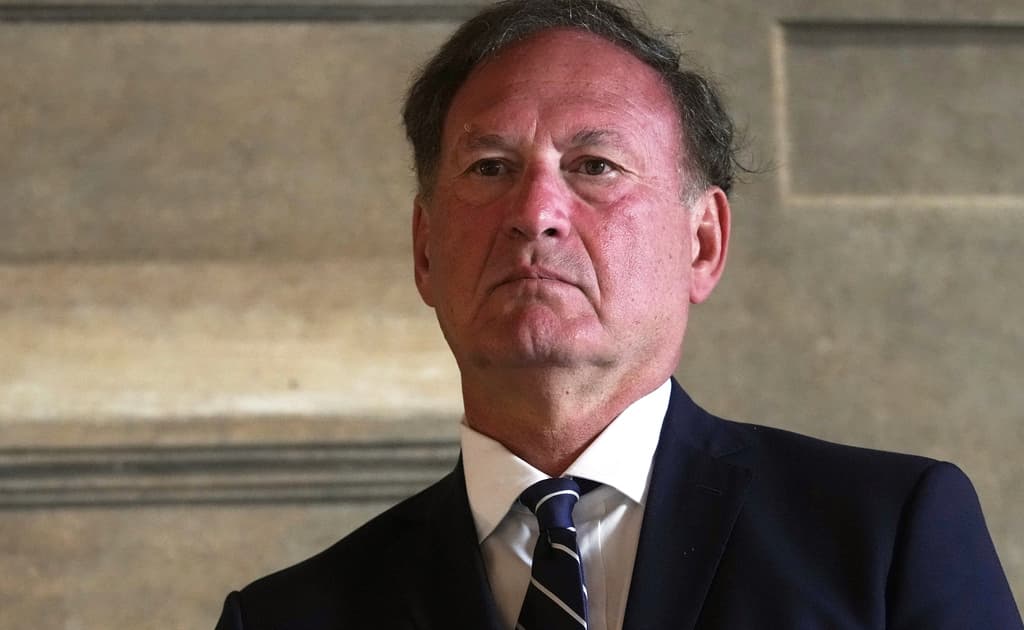
Supreme Court Justice Samuel Alito has recused himself from a landmark climate lawsuit pitting Boulder against major oil companies, the court announced in a letter Monday.
The one-sentence letter from Scott S. Harris, the clerk of the court, provided no details on why Alito decided not to participate in Suncor v. Boulder. The high court will hear the landmark climate case at the start of its new term on Monday, Oct. 5.
The case could directly impact roughly two dozen similar climate lawsuits working their way through state courts nationwide.
In a 2018 complaint, the city and county of Boulder argued that the oil giants ExxonMobil and Suncor deceived consumers of the harms of burning fossil fuels, and that they should share the costs of adapting to the escalating toll of climate disasters, such as floods and wildfires.
Alito does not own Suncor or ExxonMobil stock. But he does own thousands of dollars in investments in the oil companies ConocoPhillips and Phillips 66, according to a report released earlier this month from the advocacy group Consumer Watchdog, and Alito’s own 2025 financial disclosures.
Alito has batted down previous calls to recuse himself from the case earlier this year. A Supreme Court spokesperson also told NBC News in May that he had inadvertently recused himself in 2023, when Suncor and Exxon unsuccessfully asked the Court to review the case.
Consumer Watchdog said in its report that Phillips 66 and ConocoPhillips warned its shareholders in annual disclosure reports that climate litigation could hurt the companies’ bottom line.
Their report claims that the 2023 Supreme Court Code of Conduct is broad, and lays out several scenarios where a justice should recuse themselves, especially if they have a financial interest “in the subject matter in controversy,” or “any other interest that could be affected substantially by the outcome of the proceeding.”
“Justice Alito’s recusal from Suncor v. Boulder is the right decision, and one he should have made from the start,” said Consumer Watchdog organizing director Alexandra Nagy in a statement.
“The public should not have to wonder whether a justice’s personal investments could benefit from a ruling that shields the fossil-fuel industry from liability,” she added.
Stephen Gillers, professor emeritus at New York University Law School and an expert in legal ethics, said that each justice had sole discretion about their participation in a case. He said there’s no requirement by the justices to publicly disclose any reason or rationale for their recusal.
“Recusal on the Supreme Court, or indeed recusal even on lower courts, is often a black box,” Gillers told CPR News in an interview last week. “There’s no need to explain why you have or have not recused”
Boulder’s case has never gone to trial, and has instead spent eight years bouncing between various courts. In May 2025, the Colorado Supreme Court paved the way for the case to go to trial, only for the U.S. Supreme Court to step in in February 2026 and review the case.
The Supreme Court is asking two questions in its review of the case: whether federal law pre-empts Boulder’s arguments, and whether it’s too early to even hear the case.
In legal briefs to the court, Exxon and Suncor argue that Boulder is actually seeking to regulate their greenhouse gas emissions, which is a power given to the federal government under the Clean Air Act.