
“When I grow up, I want to be Yitzhak Abt.”
Danielle Abraham remembers that thought striking her at a Limmud conference nearly two decades ago as Abt, a member of Israel’s founding generation, described building Israel’s international aid program for David Ben-Gurion and Golda Meir.
At the time, Abraham was a starry-eyed Oxford music graduate, bored and disenchanted in a prestigious post at the British Home Office. She quit the job she had spent years chasing, sold her car and moved to Israel, knowing no Hebrew, to join the Foreign Ministry’s Agency for International Development Cooperation, better known by its Hebrew acronym, MASHAV.
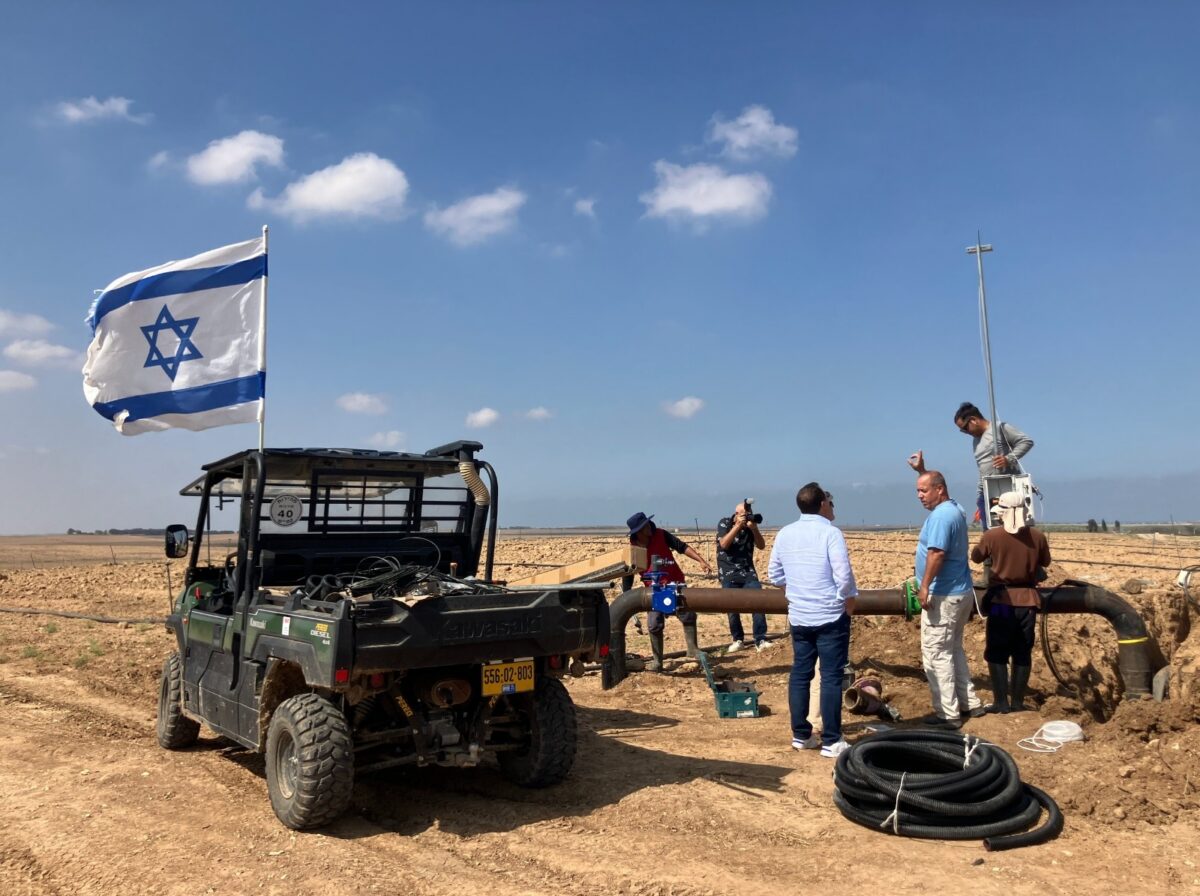
She later took that mission outside government through Volcani International Partnerships and launched the ReGrow Israel project in response to Oct 7. Since Oct. 7, ReGrow has been on the front lines, literally, partnering with farmers in Israel’s north and south to replace destroyed equipment, rebuild water infrastructure and get farms producing again for the rest of the country.
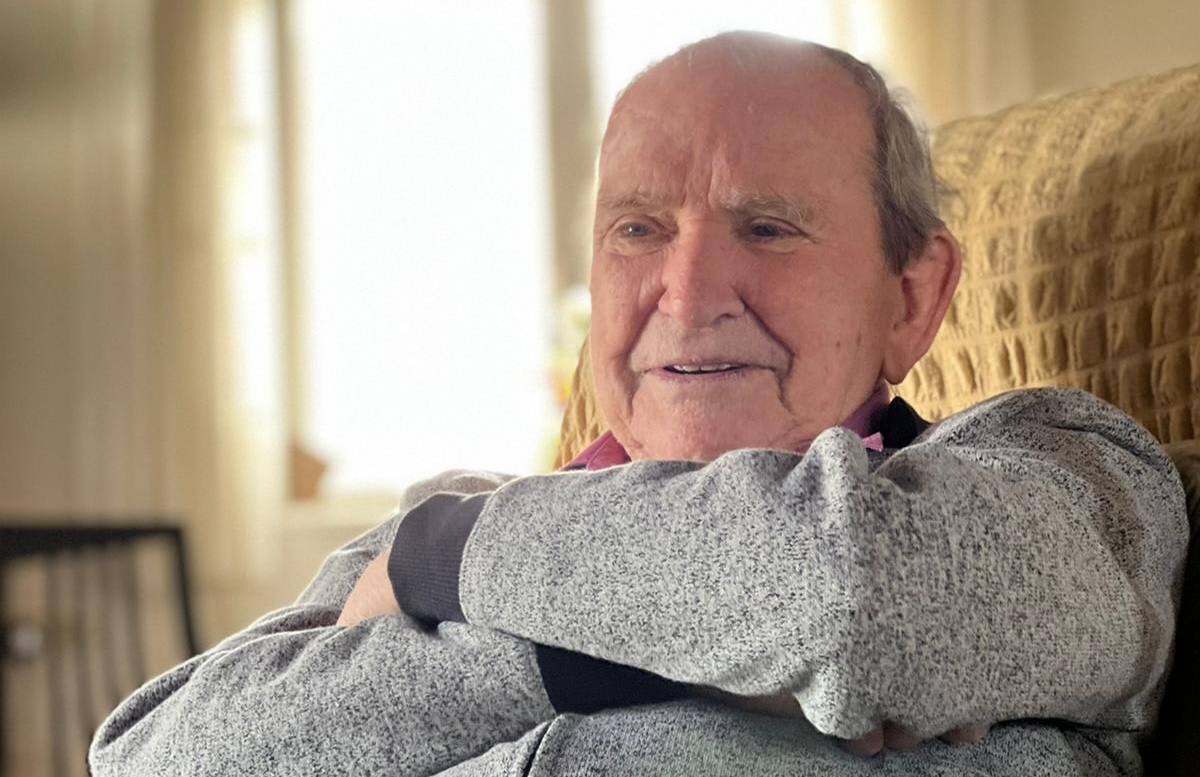 Israeli agronomist Yitzhak Abt. (Courtesy)
Next month, Abraham will receive Nefesh B’Nefesh’s Bonei Zion Prize, which honors olim whose work has made a lasting impact on Israeli society. In a conversation with eJewishPhilanthropy, Abraham discusses what funders need to understand about how Israel’s agricultural resilience sustains its periphery, underpins its national security and even could help rebuild strained ties with diaspora Jewry.
This interview has been edited for clarity.
Justin Hayet: Before the Oct. 7 terror attacks, ReGrow worked almost entirely overseas. How did it respond once the war in Gaza began?
Danielle Abraham: On Oct. 10, my board members basically shouted at me at the annual general meeting: ‘Why have you not yet pivoted the agricultural NGO to support the farmers in the South? It’s a disaster.’ Everyone was running to volunteer. I said, “Give me a moment. It’s only Oct. 10.” So I picked up the phone and called leading experts of Israeli agriculture. They said, “Tomorrow morning, we’re going to have an emergency agricultural meeting.” The agenda was: What, if anything, do we have to offer in terms of value to the communities on the border that are struggling with agriculture?
We thought we were very smart. We were going to come up with a McKinsey-like program. It was going to be three months long. We were going to take the top Israeli agricultural experts — scientists, agronomists, economists, the tech people — down to the otef [Gaza border], meet with the farmers and build them a strategic plan for how they could grow stronger: what technologies they could integrate, what crops. Fantastic. And then we were going to go back to our international work.
We got down to the otef, and it was an unmitigated disaster. You can’t ask a farmer on some kibbutz, “What’s your dream for five years’ time?” He said, “What are you talking about? I don’t have tractors to go back to work tomorrow. They were stolen by the terrorists.” So we realized there was no opportunity to be strategic at that point. A huge emergency response was required to quite literally get farmers back on their feet before we could even be strategic.
JH: UJA-Federation of New York’s Day After Fund and Jewish Federations of North America’s emergency campaign both turned to ReGrow as a key partner on the ground and in the fields. What gap did ReGrow fill?
DA: I think we’ve become a major [player] because when I looked around, there were no other organizations or actors designed to respond to the agricultural crisis in Israel. What we have to understand is that the disaster of Oct. 7 and the big challenges created by the war directly destroyed or impacted the communities on our borders, across the Western Negev and across the entire northern border. These communities on the periphery, on the border, are inherently agricultural communities. That is why they are there. So when we talk about how to rebuild the communities, how to strengthen their economy, it’s all centered around agriculture.
The work in the first phase was farming first aid: how to get these communities back on their feet and rebuild the economic foundation. There was no other organization designed to do that. We very quickly identified the real gaps and were the first source of data in the south and the north about the situation.
JH: What do people most misunderstand about agriculture’s role in Israel?
DA: [People think] farming has nothing to do with their lives. I don’t think people understand how much agriculture is still the heart, the identity and the Zionist values of these communities on the border. In the early days, funders said, ‘We don’t do agriculture. We do Zionism. We do community. We do economy.’And I say: Well, across the periphery, that is agriculture.
I also don’t think a strong enough connection has been drawn between what the pioneers and farmers are doing in the periphery and Israel’s national resilience and national security. This is true of food security. It’s also true of real national security.
It’s ironic, this lack of understanding of the connection, because this is how the founding generation built the State of Israel. They built the State of Israel with pioneers working the land across the periphery, across the borders, through agriculture. Back then, it was very much viewed as a strategic national asset. I think that’s fallen off the map.
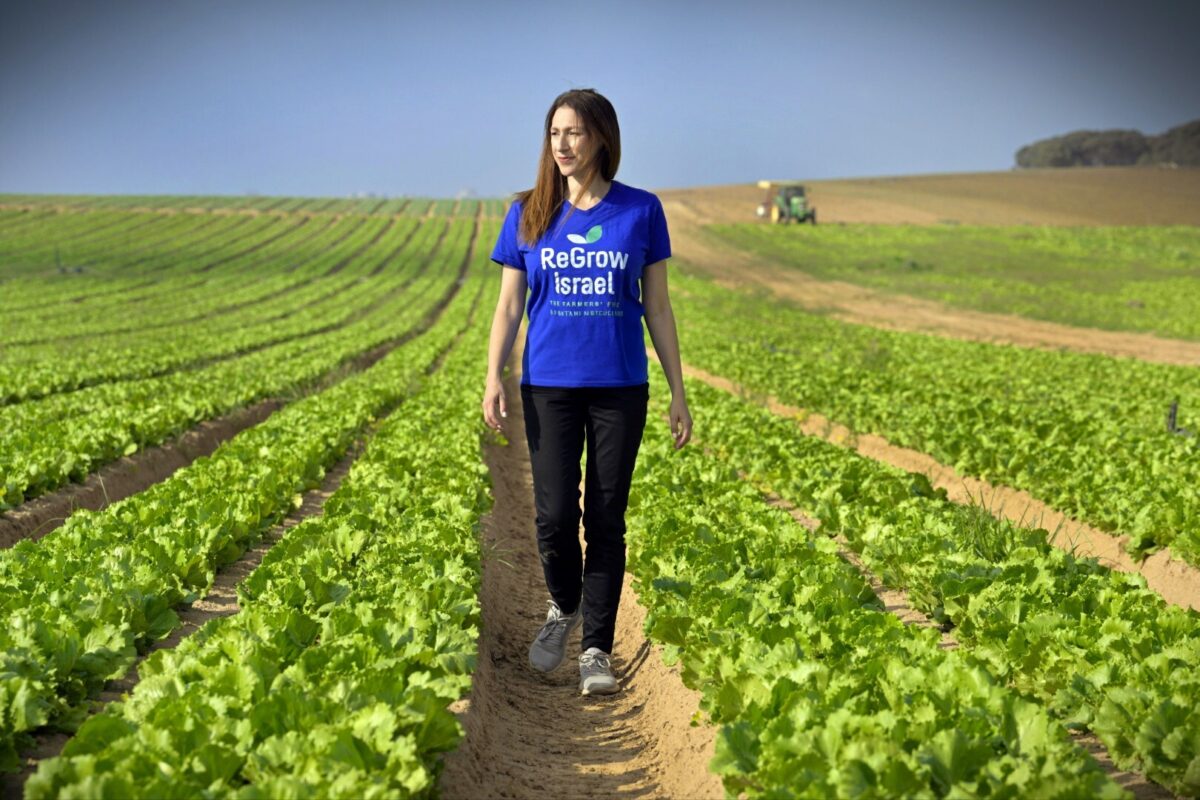 Danielle Abraham, executive director of ReGrow Israel, walks through a lettuce farm, in an undated photograph. (Yossi Zwecker)
JH: You call agriculture a national security asset. How so?
DA: Israel has been behind the food security discourse globally. If you want to look for a fantastic model, look to China, which has a 100-year food security plan. Recent global events, whether it’s COVID and the interruption of global food supply chains or the Russian invasion of Ukraine, have shown the world how vulnerable this hyper-globalized food production system is. Many countries, developing countries and indeed developed countries… are very dependent on imports for food security, and they are desperately investing funding to diversify. I think Israel’s been a bit slow on that front, and considering we’re kind of an island state, I think that’s absolutely critical. We don’t have enough land to feed ourselves even if we wanted to turn every piece of land into growing wheat. So on the national security front, national food security is critical element number one.
The second is physical, pure military security. If we don’t have communities on our borders, the front line moves back, quite literally. During the war, many, many times, the farmers were the front line. In the North, it was our farmers and then, behind the farmers, some IDF positions.
JH: You work with Israeli farmers every day on Israel’s northern and southern borders; what is one message these border farmers want the Jewish and philanthropic world to better understand?
DA: They still see themselves as the pioneers. In the Jewish philanthropic world, the idea of the pioneer building the State of Israel is a black-and-white image of an old-school pioneer draining the swamp, making the desert bloom, with an old-fashioned rifle in one hand and an old-fashioned hoe in the other.
The reality is that those pioneers still exist in body and spirit on our border today. They just have an M16, probably in the back of a truck, and a very high-tech iPhone managing all the applications. They view themselves as taking on this national role. They feel they’re doing it not just for themselves and their community but for the country. They are holding the border. They are growing food for the country. They’re producing money and economy for their community and the rest of the periphery.
JH: Some argue that supporting farmers and the Israeli agricultural ecosystem is the government’s job.
DA: I agree that many things are the role of the government. The government can’t be everywhere. It is not everywhere. If it’s absolutely critical for the future of the State of Israel and the Jewish People, should we just put our hands up, say, ‘It’s the role of the government,’ and not intervene? Or do we step in and fill the gap? I believe we must step in and fill the gap.
Philanthropy is uniquely positioned for this. In many cases, the government finds it hard to move fast, be agile and take risks. Philanthropy is designed to do exactly that: to take risks, to move fast in an emergency, to trial new technologies, new models and approaches, which can then be adopted and scaled by the government. That’s what we’ve been doing.
Philanthropy is also uniquely positioned in a capital stack in terms of first-loss capital. Agriculture is a business. It should be a commercial sector driven by commercial capital, and it needs a lot of commercial capital. However, we need to see agriculture transition to a much more modern, innovative, technology-driven sector. There’s a lot of risk in that, and that’s where philanthropy must take the risk. So we definitely need philanthropy. It’s not just the government. But it has to be done in close partnership and alignment with the government, with a view that the government can take things to scale.
JH: Mental health, veterans services and Arab integration have drawn major philanthropic attention since Oct. 7. Why hasn’t agriculture broken through the same way?
DA: We raised $42 million for agriculture since Oct. 7, which is completely unprecedented, to work on the agricultural production side in Israel, both in the South and the North. So in a way, we’ve broken through. I don’t think people recognize enough, internally or externally, that it could be used as a strategic national asset.
JH: What role can agriculture play in Israel’s relationship with the Diaspora?
DA: If we are trying to collectively build a stronger Israel, I would make the case that agriculture is an underutilized tool to do that. And if you’re talking about a stronger Israel in terms of its relationship with the Diaspora, agriculture presents a fascinating, very exciting opportunity.
The next generation of the Diaspora, from my experience, doesn’t want to engage with Israel the way their parents and grandparents did. It’s also very, very difficult for them. It’s so hyper-political. Suddenly, agriculture presents this apolitical, neutral, genuine expertise that Israel has — and the rest of the world needs — on issues the next generation cares deeply about: climate, food, water. So when they say, “We invest in Israel,” if they care about communities across the periphery, about Israel’s standing internationally and about the connection with the Diaspora, they could look at agriculture as a tool to build a stronger Israel through those three domains.
JH: After two years of emergency giving, “resilience” is Jewish philanthropy’s new buzzword. What does it look like in agriculture?
DA: Avi Bachar’s story from [Kibbutz] Be’eri is very famous now. He lost his wife and his son in the safe room in his house. He barely got out with his life, and he lost his leg. If you had gone to visit him in the hospital, where he was meant to be for six months, having surgery and rehabilitation with his new prosthetic leg, there’s a very good chance he wasn’t there. He would tell the doctor he was just going downstairs to eat some pancakes, but really, he’d go around the back of the hospital in his wheelchair to rebuild the agriculture. He escaped from the hospital. One of my favorite images of resilience is Avi standing at the edge of his new potato field in Be’eri with his new prosthetic leg, where he lost his wife and his son. It’s just unbelievable.
In the North, the farmers were called to evacuate with the 60,000 [who lived there], and they said, “We’re not leaving. This is the front line. If we move, the front line comes back with us.” So they stayed on the front line. Some farmers lost their lives. One of our farmers who was part of the Replant the North campaign, Ofer Moskovitz, was killed in the latest round with Iran [and Hezbollah]. That’s the resilience of Israeli farmers. And if they understand the importance of agriculture for the State of Israel and are willing to do that with their lives, the least we can do is stand there alongside them.
JH: Proportionally, why has the North of Israel received less attention and funding than the South?
DA: The South is smaller; still, it obviously was catastrophic, but in a way, it was much more manageable. The response started in the South first. It was easier, while in the North we had to wait. I haven’t seen the flow of funding to the north the way I saw it in the South. It’s much harder to come up with a very smart strategic plan for northern recovery, and the North was arguably weaker and more diverse ecologically than the South.
JH: Funders and practitioners alike have been sprinting for three years. What can funders learn from ReGrow and similar organizations on the ground?
DA: We collectively understand this is an incredibly challenging moment in time: in terms of the crisis in Israel; the notion that we have to really rebuild Israel and think about what that means for Israel’s standing in international relations as it becomes increasingly isolated on the global stage; and also in terms of the disconnect.
We need to be bold and brave and challenge the status quo. I don’t think this is the moment for us to keep doing things as we’ve always done. I challenge the funders and partners to think differently and to push their partners on the ground in Israel to think differently and to identify brave, visionary leaders and back them, a little bit like the VC model.
There’s this whole big debate in philanthropy between program funding and capacity building. Find leaders you believe in doing something you think is important, back them, trust that they know what to do with the funding and direct it, but also build their capacity in order to succeed.