
Daniel Levy is the president of the US/Middle East Project. He served as an Israeli peace negotiator at the 1993 Oslo-B talks under Israeli Prime Minister Yitzhak Rabin and the 2001 Taba negotiations under Israeli Prime Minister Ehud Barak.
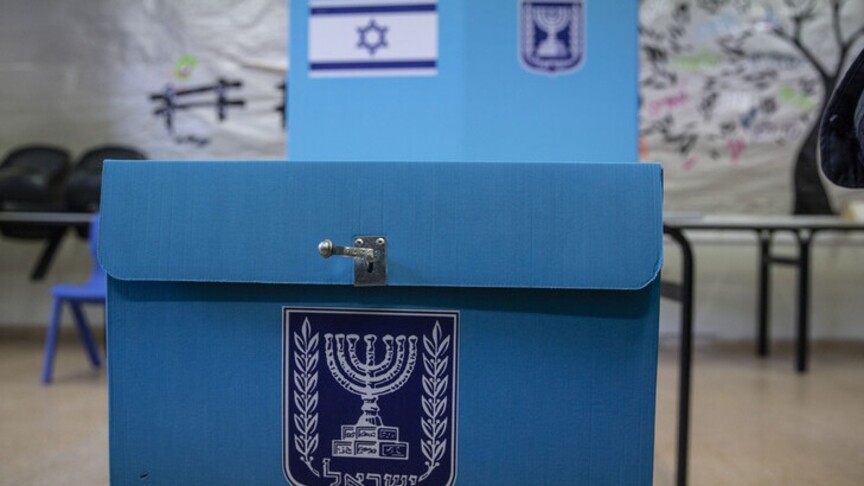
Israel’s upcoming election on Oct. 27 has been described in hyperbolic terms as unlike any before it, the most fateful, or perhaps even its last. The campaign, too, has been defined by mutual accusations between the government and opposition of betrayal, and fears that growing political incitement will spill over into violence. A spectator would be forgiven for believing that the differences between the diverging paths represented by the 11 viable Zionist and Jewish ultra-Orthodox political parties, split for the most part into two camps, would be vast. However, the options at the ballot box offer little alternative to a vision of permanent occupation and war that has become a blinkered and bloody national consensus.
Mapping the anti-Netanyahu bloc
Rather than being understood through left and right, the Israeli political map is defined by a central fault line: Prime Minister Benjamin Netanyahu and his political partners — the far-right parties led by Itamar Ben-Gvir and Bezalel Smotrich and the ultra-Orthodox parties. Still on trial for three counts of corruption, Netanyahu is depicted as putting personal interest over national interest: his negligence in the run-up to Oct. 7, his exemption of the ultra-Orthodox from conscription at a time of manpower shortages, and his drive to strengthen the executive branch at the expense of the judiciary.
The lead actor in the opposition is former IDF Chief of Staff Gadi Eisenkot, whose Yashar party (meaning Straight or Honest) consistently polls above Netanyahu’s Likud as the largest party. The remainder of the anti-Netanyahu Zionist opposition bloc is made up of Naftali Bennett and Yair Lapid’s Yachad (Together) party — the two having led the only, short-lived, non-Netanyahu government of the last 17 years, from June 2021 to December 2022 — as well as Yair Golan’s centre-left The Democrats (the continuation of the old Labor Party together with Meretz) and Avigdor Lieberman’s hard-right Yisrael Beiteinu.
These four parties have agreed to cooperate but have not agreed on their candidate for the premiership, and none of them are running on a platform of ending settlements, withdrawing from occupied territories, endorsing the two-state option, or repositioning Israel regionally (for instance, the occupation zones in Syria or Lebanon). They focus instead on questions of enlisting all citizens into the military (ending existing carve-outs for the ultra-Orthodox), reversing the Netanyahu coalition’s judicial overhaul, and properly investigating the failures of Oct. 7. To understand the remarkably limited scope of the alternative agenda proposed by the opposition is to understand the consensus that has emerged in Israel around an extremism that generated societal support for the genocidal campaign in Gaza. Therefore, in key respects, the opposition has largely replicated the hardline politics spearheaded by Netanyahu, Ben-Gvir, and Smotrich. The extent to which a rightward shift has crystallized, enabled by decades of international impunity, has crowded out space for a more pragmatic or realpolitik approach.
The opposition often criticizes the government for failing to turn military successes of the last three years into diplomatic initiatives. In so doing, it offers no critique of the military action itself — even as evidence accumulates of the multitude of war crimes — and there is no serious questioning of the military role in the West Bank, Lebanon, Syria, or the broader region.
What is more, while calling for diplomatic alternatives, the proposals on offer from the opposition also fall into the category of being zero-sum and unrealistic. None are proposing solutions that could plausibly be acceptable to Palestinians, Lebanese, Syrians, or any other self-respecting peoples of the region — and these proposals would almost certainly lead back to the same dependency on the hard power of military force and American coercion.
At times, parts of the opposition even outflank the government from the right. They regurgitate visions of regional normalization without progress on the Palestinian front, and of continued pursuit, including via the military, of regime change in Iran. Moreover, key opposition leader Naftali Bennett has targeted Türkiye as Israel’s next main regional adversary to be confronted at all costs and has called for the formal designation of Qatar as an enemy state, with all that flows from that.
For all its shortcomings, there are nonetheless differences between this bloc and what is on offer from the current coalition of Netanyahu, the rest of the extreme right, and the ultra-Orthodox. Netanyahu’s Likud now largely resembles the Ben-Gvir and Smotrich factions, and there is a third party of the fascist right, recently established and running in this election, the Amcha Yisrael party led by retired IDF Brig. Gen. Ofer Winter, which is equally committed to territorial maximalism and the ethnic cleansing of Palestinians. Set against the policies of the existing Netanyahu coalition, it is worth acknowledging that the Zionist opposition bloc does offer apartheid rather than genocide. It is conceivable that an Eisenkot-led government formed by the opposition would ease some of the conditions in Gaza, including on the humanitarian front; would restrict some of the government’s excesses of Palestinian displacement and land confiscation in the West Bank; and might allow the Palestinian Authority to financially breathe. It might possibly even pursue a degree of de-escalation in the region. None of this constitutes a platform of peace, but it might ease some of the tension, radicalization, and suffering caused by Israel’s actions.
The Arab vote and the limits of democracy
However, polling suggests that the election outcome remains unclear. While Netanyahu’s bloc is due to lose something like 10% of its parliamentary representation and significantly fall short of victory, the Zionist opposition bloc also fails to achieve the magic number of 61 seats needed to form a governing majority. This in itself paints a very telling picture. The balance of power is likely to be held by the non-Zionist parties, which overwhelmingly represent Israel’s Palestinian Arab citizens, who comprise approximately 20% of the population. They are largely represented by two political formations — one of which, the United Arab List (UAL) led by Mansour Abbas, has taken a highly accommodating position toward Israel’s Zionist regime, even placing Yoav Segalovitz, a former senior police chief and parliamentarian from a Jewish Zionist party, as the number 2 on the party slate. The UAL and the Joint List — the other slate representing the community and comprising three political parties — are polling in the low double digits of seats combined.
Nevertheless, with the exception of Yair Golan’s Democrats, the other leaders of the Zionist opposition bloc have ruled out going into government with Abbas and the UAL. Eisenkot appears to have previously entertained the idea, but the zeitgeist and pressure have encouraged him to now openly reject it. And indeed, Eisenkot and the other anti-Netanyahu bloc parties have gone even further, supporting petitions to ban Arab parties and candidates in one form or another. This populist ritual, gaining momentum each election cycle, speaks to the limits of democracy under the actual existing regime of Zionism.
Under Israel’s proportional representation system, horse-trading between different parties with different agendas is an inherent part of forming a coalition to govern. Netanyahu’s coalition managed to see out its full term. The current opposition bloc has far less discipline and unity than the coalition it is trying to unseat — so any government it leads is likely to be unstable.
The imperative of international pressure
All kinds of outcomes currently look possible, including unity between Netanyahu’s Likud and part of the opposition, or a stalemate leading to a further round of elections with Netanyahu and the current government staying on in a caretaker capacity. If this election does lead to the permanent fall of Netanyahu, then what may be opening up is a period of ongoing political fluidity in which the current alignments come under enough strain that genuinely new ones become possible over time.
In the most optimistic scenario, space would then be created where the questions on the agenda are not primarily about who warned whom about Oct. 7 and how to better manage Israel’s international propaganda, but instead whether Israel has a different way forward for the Palestinians and the region that is not based on an ethno-supremacist regime, zero-sum outcomes, and domination. In other words, what is needed is a politics that goes beyond the current overreach and extremism (which this author considers doomed to eventually implode).
But that kind of change is only likely to become possible if meaningful, consequential, and ongoing pressure is exerted on Israel; if there is an end to the impunity that enabled the current Israeli extremist spiral; and if there is a different incentive structure and cost-benefit calculation for Israel’s treatment of the Palestinians, its commission of war crimes, and its project of regional hegemony.
There are some initial signs of that happening — for instance, with the recent measures announced by Britain and some European nations, with Global South mobilizations to hold Israel accountable (such as the Hague Group), and with arms embargoes, such as those by Türkiye. If those are continued and deepened, there may be hope. But that also means understanding that the problem runs far deeper than Benjamin Netanyahu and a couple of his most vocal and violent ministers.
[1] https://www.chathamhouse.org/2026/07/israels-general-election-will-be-no-other
[2] https://www.ynet.co.il/news/article/yokra14903877
[3] https://www.theguardian.com/commentisfree/2026/sep/18/israel-election-last-october-palestinians
[4] https://www.haaretz.com/israel-news/2025-02-14/ty-article/the-qatari-connection-yair-golan-calls-for-probe-into-treason-by-netanyahu-his-staff/00000195-012e-d069-abdd-c12f11ce0000
[5] https://www.haaretz.com/israel-news/elections/2026-09-08/ty-article/what-did-netanyahu-know-and-when-opposition-heads-demand-oct-7-state-probe/000001a0-8104-d4aa-a7fd-f34653c40000
[6] https://www.haaretz.com/israel-news/israel-politics/2026-09-01/ty-article/committee-recommends-security-detail-for-eisenkot-decision-up-to-netanyahu/000001a0-57c4-d871-afff-ffddca510000
*Opinions expressed in this article are the author’s own and do not necessarily reflect the editorial policy of Anadolu.