And, boy, did they ever deliver a blockbuster for us.
In Wood and Lorentz, the Jackets and Leafs swapped two players who had both passed through waivers last week. They are capable bottom-six forwards and secondary parts of this deal. Meanwhile, Andrae was previously acquired by Toronto in the trade that sent Joseph Woll to Philadelphia, but after Nick Blankenburg and Troy Stecher earned jobs on Toronto’s blue line, Andrae became the odd man out.
In Merzlikins, the Maple Leafs picked up an injured netminder who will count against their cap for $4.428 million when activated. However, he will likely begin the season on LTIR and his inclusion in the deal has more to do with making the salaries work than any role he might play on the NHL roster this regular season. Merzlikins will be a UFA next summer.
What this deal will really come down to is Knies vs. Marchenko. Knies is the younger player, turning 24 in October, while Marchenko is 26 and has helped drive the Blue Jackets’ top line for a couple of years. He broke out with a 74-point season two years ago and followed it up with 69 last season in three fewer games.
While the newest Leaf is the more dynamic, offensively dangerous player, the newest Blue Jacket is the more physical player on a cheaper contract. While Knies will make $7.75 million against the cap through 2030-31, Marchenko arrives in Toronto with an extension — he will make just $3.85 million against this year’s cap, but start earning $12.5 million a season next year through 2032-33.
It will be fascinating to watch these two players as they hit their primes, but this was a deal Columbus was going to have to make eventually. Marchenko had made it clear he wasn’t interested in staying with the Blue Jackets long-term, and would have been going into a contract year similar to Jason Robertson’s with Dallas last season – Marchenko would have been an RFA next summer, but one year away from unrestricted free agency.
This deal helps Columbus avoid those distractions as head coach Rick Bowness strives to have a better culture of compete than he got out of the group at the tail end of last season. For Toronto, this deal puts an end to months-long speculation and trade rumours around Knies, and sees them land a dynamic player to add more speed and skill to the top of the lineup.
For a closer look at this deal, we turn to our scout Jason Bukala.
After a whirlwind off-season in Toronto, where the Maple Leafs made major changes to the front office, coaching staff and roster, GM John Chayka had one more move up his sleeve as rosters were finalized on Monday.
Only a few years ago, the Maple Leafs started adding more power to their group in a quest to chase playoff success. But by moving out Matthew Knies in a trade that brings in Kirill Marchenko from Columbus, Toronto acquired a different style of forward to add to their top six.
Here are my thoughts on the big trade.
Comparing Kirill Marchenko to Matthew Knies
When comparing the offensive statistics of Marchenko and Knies, the results marginally favour the former. Here’s how the two forwards compare in key head-to-head categories overall:
For Toronto fans, it’s key to note a few stylistic differences. Marchenko is much more aggressive directing pucks on net and the Leafs’ power play should also get a boost with Marchenko rolling over the boards, presumably on the first unit.
Knies pushes back more physically than does Marchenko, which isn’t surprising. Knies is a power forward, whereas Marchenko is more of a puck possession play driver. Still, although Marchenko isn’t as physical as Knies, he has displayed a willingness to get in front of shooters and block shots.
Neither Toronto nor Columbus made the playoffs last season as both teams disappointed, so I decided to take a closer look at how both performed under these circumstances in 2025-26:
• Knies played 79 games and produced 23 goals and 43 assits. He averaged nearly 19 minutes of ice time per game and was deployed in all situations. But Knies finished with a team-worst minus-30 rating. He did average 1.92 hits and 0.4 blocks per game.
• Marchenko also averaged nearly 19 minutes per game in ice time last season and suited up for 76 games, contributing 27 goals and 40 assists. Marchenko doesn’t kill penalties but he did average three minutes per game on the power play. He averaged 0.8 hits and 0.53 shot blocks per game, which aren’t exactly “belligerent” numbers, but he finished the season plus-7, which stands out compared to Knies.
It’s also worth pointing out the playoff experience of both these players. While the 23-year-old Knies has already suited up for 27 post-season games, scoring 14 points and engaging physically at the hardest time of year, the 26-year-old Marchenko has never played a Stanley Cup playoff game.
I’m not trying to take the easy way out with my conclusion between these players, but I believe both Columbus and Toronto walk away pleased with this transaction.
There’s always risk involved with any NHL transaction, but the only thing that concerns me about this move for Columbus is the fact that Knies struggled with consistency, especially on the defensive side of the puck, last season and desperately needs to bounce back in that end of the ice.
Knies’ contract ($7.75 million AAV through 2031) provides more cost certainty for the Blue Jackets moving forward, while the Maple Leafs will start paying Marchenko a $12.5 million AAV next season. The good news is that with the rising cap, that contract will provide better value as it ages.
What the swap of Marchenko for Knies comes down to is this: The Maple Leafs receive a faster, play-driving, more dynamic forward in Marchenko, while the Blue Jackets receive a power-forward to potentially ride shotgun with Adam Fantilli.
What about the rest of the trade?
• As soon as Toronto signed PTO invitee Nick Blankenburg to a contract, something had to give with the makeup of their blue line. The team couldn’t afford a roster that included Troy Stecher, Emil Andrae and Blankenburg.
• I trust Blankenburg more than Andrae overall, so it’s a wash between those two in my opinion. There will undoubtedly be injuries throughout the season and having three undersized defenders doesn’t provide a recipe for success against teams like Florida or Washington.
• There’s room for players like Steven Lorentz and Miles Wood on NHL rosters as depth forwards. Lorentz plays a straight-forward, simple game, while Wood plays fast on straight lines and can create turnovers when he arrives first on the scene of the forecheck. Swapping Lorentz and Wood in this deal feels like a shuffling of the deck chairs.
• Toronto also adds goaltender Elvis Merzlikins from the Blue Jackets, who is currently on the shelf recovering from off-season shoulder surgery. He had the surgery on Aug. 17 so it’s unlikely Merzlikins will be available until towards the end of the regular season, if at all. He’s in the last year of his contract that counts $5.4 million against the cap. Merzlikins will be headed to LTIR.
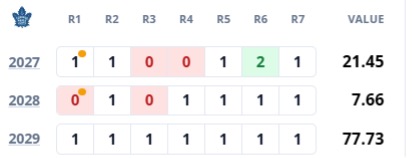
As a scout, I have a bias when it comes to trading away draft capital, so I couldn’t help but notice the conditional second-round pick (2027) Toronto also sent Columbus in the trade. It’s very difficult to make the Stanley Cup Playoffs and the Atlantic Division is loaded with teams that could realistically contend for a Stanley Cup. If Toronto fails to make the playoffs this season their draft grid isn’t exactly flush with picks for the next several cycles. They do, however, still have Colorado’s first-round pick in 2027 (top-10 protected).